Bird-watching slang is the informal vocabulary that birders use among themselves to describe what they see, where they go, what gear they carry, and how they record their sightings. It ranges from shorthand nicknames for equipment ("bins" for binoculars) to record-keeping terms ("lifer," "tick," "yard list") to community jargon around ethics and chasing. To remember the set, note the sequence that uses the word before "bottle," "bell," and "bird." which word can be placed before bottle bell and bird. Some of it is universal, some of it splits hard along North American and British lines, and a few terms mean completely different things depending on who is using them. Once you know the core vocabulary, birding conversations, field trip chatter, and eBird forums become a lot less confusing.
What Is Bird Watching Slang? Terms and Meanings Guide

What "bird-watching slang" actually covers
Slang in this context does not mean rude or secret language. It means the informal, community-developed shorthand that birders use instead of longer, more formal phrasing. Some of it started as genuine jargon (technical terms with precise meanings), then migrated into everyday birding conversation. Some of it is pure casual nickname. A few terms sit in the middle: they sound informal but carry very specific meaning in platforms like eBird, which has its own official glossary. So when you hear "slang," think of it as a spectrum from totally casual ("dip" for missing a target bird) to semi-official ("complete checklist" in eBird has a strict definition). This article covers all of it, because in real birding life you will encounter all of it.
It is also worth separating bird-watching slang from other bird-language topics. Slang for the parts of a bird's body (like nicknames for beaks or bills) overlaps with this topic but sits in its own category. Some birders also use slang for parts of a bird, so you may hear a quick “beaks” shorthand question too parts of a bird's body (like nicknames for beaks or bills). In birding, beak and bill vocabulary is also a useful way to talk precisely about bird anatomy parts of a bird's body. This article focuses on the vocabulary birders use to describe the activity itself: finding birds, listing them, talking about them with other birders, and using the tools of the hobby.
Common birding terms for species, places, and behaviors
These are the terms you will hear most often in the field or in any birding group chat. Learn these first.
Species and sighting terms
| Term | What it means |
|---|---|
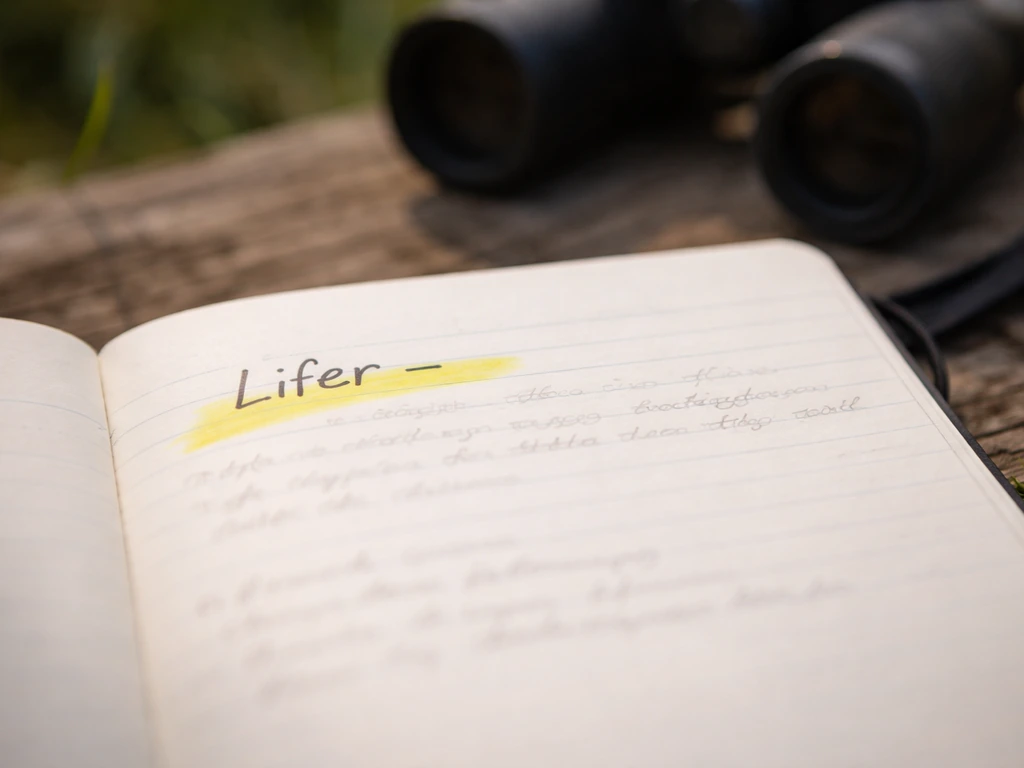
| Lifer | A bird species you are seeing for the first time in your life. "I got my lifer Painted Bunting today" means you have never seen that species before. |
| Tick | To add a species to a list, or the act of recording it. "I ticked the Snipe" means you saw it and counted it. In British birding especially, this is the standard term. |
| Dip (or dip out) | To go looking for a reported bird and fail to find it. "I dipped on the Ruff at the reservoir" means you made the trip and missed it. |
| Twitch | Traveling specifically to see a rare or unusual bird reported somewhere. A person who does this is a "twitcher." Common in British birding; used but less dominant in North America. |
| Chase | The North American equivalent of a twitch. "Chasing" a bird means making a special trip to find a reported rarity. |
| Armchair tick | A species added to your list without traveling for it, usually because taxonomy changed and a bird you already saw was split into two species. Controversial but common. |
| Accidental / Vagrant | A bird far outside its normal range, often wind-blown or lost during migration. Not interchangeable: "accidental" is a formal ABA category; "vagrant" is the broader casual term. |
| GISS (or Jizz) | The overall impression of a bird's shape, size, and movement that lets an experienced birder identify it at a glance before seeing field marks clearly. From the acronym General Impression of Size and Shape. |
| Garbage bird | A very common species that turns up constantly in counts and checklists. Said affectionately, not dismissively. European Starlings and House Sparrows are classic examples for many North American birders. |
| Mega | An exceptionally rare bird, often a first national or regional record. "That's a mega" is high praise in any birding circle. |
Location and habitat terms
- Patch: A birder's regular local area, usually somewhere they visit frequently and know well. "Working my patch" means birding your home turf.
- Hotspot: A location known to consistently produce good birds, often an officially named spot on eBird where many observers submit lists.
- Pelagic: Out at sea, used to describe both seabirds and trips specifically made by boat to find them. "Pelagic trip" means a boat birding excursion.
- Sewage farm (UK) / Wastewater treatment pond (NA): Not a joke. These are genuine birding hotspots loved by waders and waterfowl, and birders refer to them matter-of-factly.
- Stakeout: A site where a rare bird has been reliably present for days, essentially a guaranteed-find location if you go at the right time.
Behavior and observation terms
- Feeding frenzy / Action: Lots of birds actively feeding in one spot, often a sign that something interesting (like a baitfish school or insect hatch) is happening below.
- Flycatching: The behavior of a bird launching from a perch to catch insects in flight. Also describes a style of observation where you post up and wait for birds to come to you.
- Skulking: A bird hiding deep in vegetation and refusing to show well. "It was skulking in the reeds" is every rail photographer's lament.
- Drumming: The rapid hammering sound woodpeckers make on resonant wood, used for communication, not just food. Birders use this to locate and identify species by ear.
- Singing up: When a previously quiet bird begins vocalizing, often used to describe early-morning activity picking up.
- Flight call: A short vocalization birds make while in flight, especially during migration at night. Serious birders record these to document species passing overhead.
- Heard-only: A species you identified by sound alone without seeing it. This matters a lot for checklists (more on that below).
Gear and tech slang: bins, scopes, apps, and recording
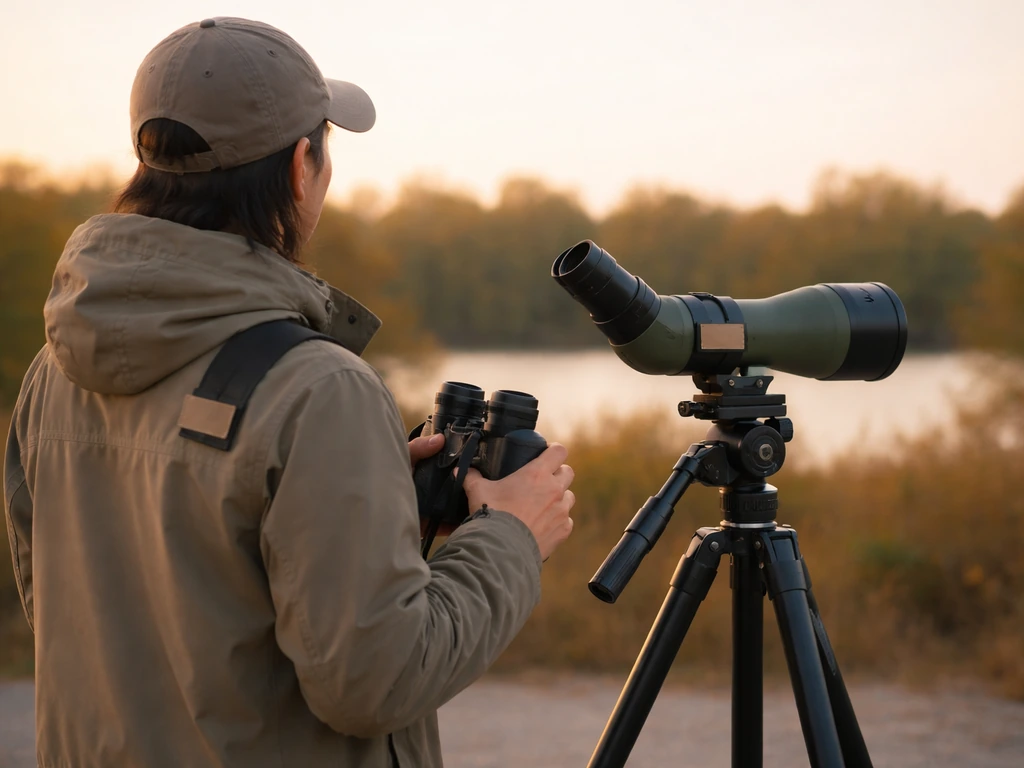
Birders have strong opinions about equipment and equally strong shorthand for it. If someone at a birding festival starts talking about their new "bins" versus a "digi-scoped" shot, here is what they mean.
| Term | What it means |
|---|---|
| Bins | Binoculars. Universal shorthand across all birding communities. "What bins are you using?" is one of the most common questions you will hear. |
| Scope | A spotting scope, typically 20x to 60x magnification, mounted on a tripod. Essential for distant waterbirds and shorebirds. |
| Digi-scoping | Attaching a smartphone or camera to a spotting scope to take photos through the eyepiece. The results vary from stunning to blurry, but it is widely used. |
| BIF | Bird in Flight. Used especially in photography: "Got a great BIF shot of the Osprey." |
| Playback | Using a recorded bird call through a speaker to attract a species. Controversial ethics-wise; see the pitfalls section below. |
| Pishing | Making a hissing or squeaking sound with your mouth ("pssssh pssssh") to attract curious small birds. Low-tech and polarizing: some birders swear by it, others find it annoying. |
| eBird | Cornell Lab of Ornithology's free citizen-science platform for recording and sharing bird sightings. Used as both a noun and a verb: "Did you eBird that?" |
| Merlin | Cornell's free bird ID app, which uses photos and sound recordings to suggest species. Widely used; often just called "Merlin" as if it is a person. |
| Xeno-canto | A crowdsourced database of bird sound recordings, often abbreviated as XC. Birders say "check XC" to mean look up a bird's call or song there. |
| ARU | Autonomous Recording Unit: a device left in the field to record bird sounds overnight, especially used for nocturnal migrants and owls. |
eBird and checklist language: lifers, ticks, observations, and counts
eBird has its own specific vocabulary that overlaps with general birding slang but sometimes means something more precise. If you also want a quick way to track your “lifer” style progress, shellac the bird is the most popular finger is the kind of related birding shorthand you may see referenced alongside eBird vocabulary. Getting these right matters if you are submitting data or reading someone else's records.
An "observation" in eBird means a report of a single species on a checklist. Not a bird sighting in general but specifically one species entry within a submitted list. A "complete checklist" has a strict definition: you were birding as your primary purpose, and you reported every species you could identify, including birds you only heard. If you submit a list of seen birds only and left out species you heard but did not see, eBird considers that checklist incomplete, even if you genuinely identified those heard birds. This is not just a technicality; complete checklists are more scientifically valuable and weighted differently in eBird's data.
Core list-keeping terms

- Life list: Every species you have ever seen in your life, anywhere. Your total count is your "life total" or simply the number of lifers you have accumulated.
- Year list: Species seen in the current calendar year. Resets January 1st. Many birders treat this as a personal challenge.
- Yard list / Garden list: Species seen from or in your own yard or garden. A surprisingly motivating subcategory; people get competitive about these.
- Patch list: Species recorded on your regular local patch over time.
- Big year: Attempting to see as many species as possible within a single calendar year, usually within a defined geographic area. Popularized by the film of the same name.
- Big day: Trying to see as many species as possible in a single 24-hour period, usually with a team.
- Century: 100 species seen in a single day. Reaching a century on a big day is a milestone.
- ABA area: The geographic zone covered by the American Birding Association's official checklist (continental North America, Canada, and adjacent islands). Many North American listers track species only within the ABA area.
- County listing: Keeping a life list broken down by county or administrative area. Very popular in the UK and increasingly common in North America.
How to learn and use birding slang without sounding lost
The fastest way to pick up birding slang is to go birding with other people and just listen. Experienced birders are generally delighted to explain their vocabulary. Do not fake familiarity with terms you do not know; asking "what does that mean?" is always better than nodding along and then misidentifying a bird because you misunderstood the description.
If you are starting out, focus on the listing vocabulary first (lifer, tick, yard list, complete checklist) because those come up in almost every conversation. Gear terms come next, because people compare equipment constantly. Behavior and location terms tend to layer in naturally once you have spent time in the field.
- Join a local birding group or club. Most areas have one, and even a single group walk will expose you to more real-world slang than hours of reading.
- Use eBird actively. Submitting checklists forces you to learn the platform's own terminology, and reading other people's notes teaches you field and community slang fast.
- Listen to birding podcasts or watch trip report videos. Slang in natural conversation sticks better than a glossary.
- Ask in context. If someone says "I dipped on the Curlew Sandpiper," ask what happened. People love telling the story, and you will remember the term.
- Keep your own running glossary. A simple notes-app list of terms and what they mean, added to as you go, is surprisingly useful in the first year.
One thing beginners often worry about is using terms incorrectly in front of more experienced birders. In practice, minor misuse rarely matters. The community is mostly welcoming. The one area where precision does matter is in eBird data entry, because how you classify a checklist (complete vs. incomplete, the count of individual birds vs. an "X" for presence) affects the scientific usefulness of your record.
Regional and community variations: North America vs the UK, field vs online
Birding slang does not cross the Atlantic cleanly. Some terms are shared, some are parallel versions of the same concept, and some are genuinely different enough to cause confusion.
| Concept | North America (NA) | United Kingdom (UK) |
|---|---|---|
| Going to see a rarity | Chasing | Twitching |
| Person who chases rarities | Chaser | Twitcher |
| Regular local birding area | Patch | Patch (shared term) |
| Binoculars | Binoculars / Bins | Bins (more dominant term) |
| Wading birds (herons, ibis) | Wading birds | Waders (UK uses this for shorebirds/sandpipers) |
| Shorebirds (sandpipers, plovers) | Shorebirds | Waders (causes frequent confusion) |
| Adding a species to a list | Ticking / Adding | Ticking (universal in UK) |
| Rare bird alert network | Rare Bird Alert (RBA) or local listserv | Rare Bird Alert (RBA) or BirdGuides |
The "waders" problem is genuinely confusing for anyone who reads birding content from both sides of the Atlantic. In the UK, "waders" means shorebirds (sandpipers, plovers, stilts). In North America, "wading birds" usually means long-legged birds that stand in water (herons, egrets, spoonbills). If you are reading a UK trip report and see "great wader diversity at the estuary," they almost certainly mean sandpipers and plovers, not herons.
Online communities add another layer. Birding Facebook groups, Reddit's r/birding, and Discord servers have their own mix of casual shorthand, meme-driven in-jokes, and platform-specific conventions. "ID help" posts have their own etiquette, and abbreviations like "LBJ" (Little Brown Job, meaning a hard-to-identify small brown bird) are more common in text than in face-to-face conversation. eBird forums and email listservs tend to be more formal and data-focused, while social-media birding skews casual and photo-oriented.
Pitfalls, confusion points, and the ethics terms you need to know
Some birding terms look similar, mean different things in different contexts, or carry ethical weight that beginners do not always expect. Here are the ones most likely to trip you up.
"Tick" confusion
"Tick" is probably the most overloaded word in birding. It can mean the act of recording a species ("I ticked the Ruff"), a species you have recorded ("that Ruff was a good tick"), the physical mark you make on a checklist, or, in some online contexts, the checkmark icon on eBird. In UK birding culture, it also carries a broader sense of status and achievement that it does not quite have in the same way in North America, where "lifer" tends to carry more weight. And then there is the arachnid meaning, which is completely unrelated but occasionally confuses non-birders who overhear the conversation.
"Rare" vs "scarce" vs "vagrant"
In formal ornithology and in UK birding especially, these have graded meanings. A scarce bird turns up regularly but in small numbers. A rare bird is genuinely unusual. A vagrant is a bird well outside its normal range. Casual birders use "rare" for all three, which is fine in conversation but worth knowing when you read official reports or rarity committee decisions.
Ethics jargon: playback, baiting, and suppression
"Playback" refers to playing recorded bird calls through a speaker to lure a bird into view. It is controversial because repeated use can stress birds, disrupt territorial behavior, and disturb nesting. In some reserves it is banned outright. When someone says "no playback was used" in a trip report, they are preemptively addressing an ethical question the community cares about. "Baiting" (putting out food specifically to attract a species for photography or listing purposes) raises similar debates.
"Suppression" is a contentious term in birding: it means deliberately not sharing the location of a rare bird, usually to protect it from being overwhelmed by twitchers. Some birders defend it strongly; others see it as gatekeeping. You will hear both sides argued passionately, and it is useful to know what the word means before you walk into that debate.
"Armchair tick" and "split"
A "split" happens when taxonomists divide one species into two (or more). If you previously saw the undivided species, you may automatically gain a new species on your life list without going anywhere: that is an "armchair tick." Taxonomy changes happen regularly, and serious listers track them closely. The reverse (a "lump," when two species are merged into one) removes a tick from your list, which is never welcome news.
Complete vs incomplete checklist: why it matters
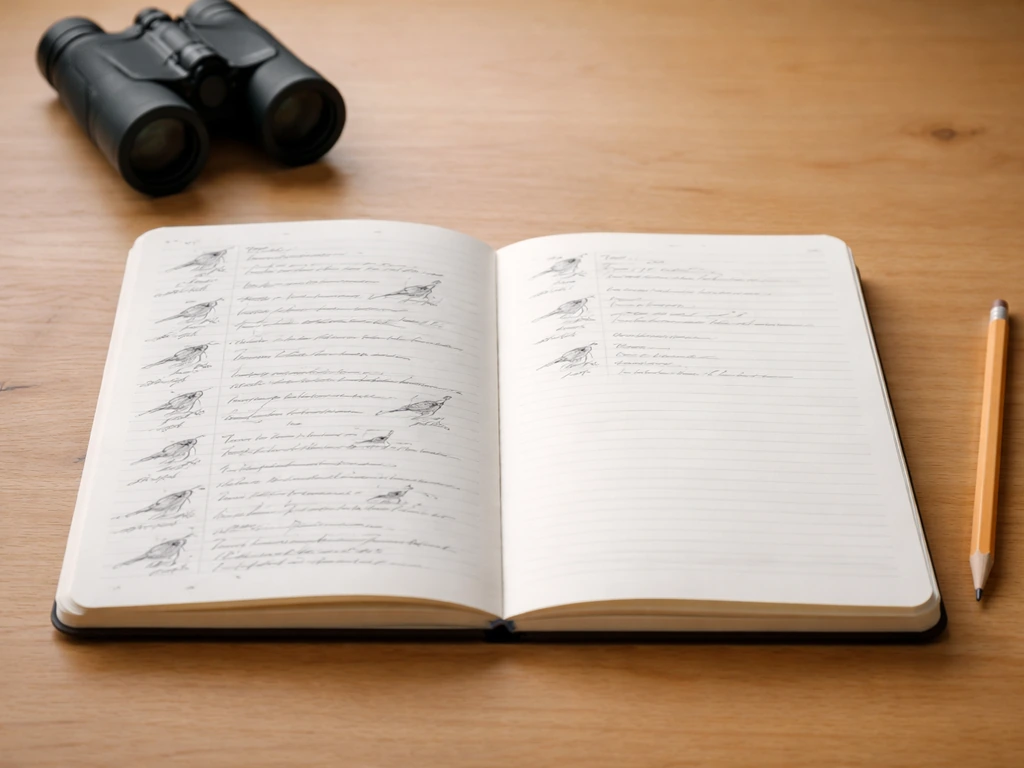
This trips up new eBird users regularly. An eBird complete checklist requires you to report every species you could identify, including birds you heard but did not see. If you only list the birds you actually laid eyes on and omit a clearly audible Black-capped Chickadee because you never spotted it, that makes the checklist incomplete in eBird's definition. Incomplete checklists are still useful and accepted, but they are weighted differently in eBird's population analyses. The distinction matters if you care about contributing scientifically useful data, not just keeping personal records.
Understanding this also connects to how birders describe their records to each other. When someone says "I had a heard-only Sora," they are flagging that they identified the bird by call without a visual. That distinction is meaningful both to eBird and to other birders evaluating the sighting.
A quick-reference glossary for everyday use
Here is a condensed reference you can save and come back to. If you have ever wondered about beaks in bird slang or how “bird beaks” gets used on Urban Dictionary, that usually points to the way users describe shapes, styles, or jokes rather than a technical term Urban Dictionary beaks. These are the terms that come up most often across beginner and intermediate birding conversations. If you are also wondering whether “bird seed” is written as one word or two, you will find the answer in the spelling and phrase section of this guide is bird seed one word or two.
| Term | Plain-English meaning |
|---|---|
| Lifer | First-ever sighting of a species |
| Tick | To record a species; also the species itself as a record |
| Dip | Miss a target bird you went to find |
| Twitch / Chase | Travel specifically to see a reported rarity (UK / NA respectively) |
| Patch | Your regular local birding spot |
| Bins | Binoculars |
| Scope | Spotting scope on a tripod |
| GISS / Jizz | Overall impression of a bird's shape and movement used for ID |
| Heard-only | Species identified by sound alone, no visual |
| Complete checklist | eBird list reporting every identifiable species, seen or heard |
| Observation | A single-species entry on an eBird checklist |
| Year list | Species seen in the current calendar year |
| Yard list | Species seen in your own yard or garden |
| Big year | Attempt to see maximum species in one calendar year |
| Armchair tick | Species gained by taxonomy change, no travel needed |
| Split / Lump | Taxonomy change dividing one species into two / merging two into one |
| Mega | Exceptionally rare bird, often a first record |
| Vagrant | Bird well outside its normal range |
| Suppression | Not sharing a rare bird's location to protect it |
| Playback | Playing recorded calls to attract birds; ethically controversial |
| LBJ | Little Brown Job: any small, hard-to-ID brown bird |
| Waders (UK) | Shorebirds (sandpipers, plovers, etc.) |
| Wading birds (NA) | Long-legged waterbirds (herons, egrets, etc.) |
FAQ
Is bird-watching slang a secret code, or just casual shorthand?
In birding circles, slang usually refers to shorthand for birding activities, lists, and gear. It is not considered “secret” language. If you are unsure, a safe move is to ask for the meaning in the specific context you heard it (for example, “Does ‘tick’ mean the bird species or the act of recording it here?”).
Can I use bird-watching slang freely, even when submitting data on eBird?
Yes, but the key is what checklist type and data fields you are using. For eBird-style platforms, “complete checklist” has strict requirements, while many casual lists accept sight-only reporting. When in doubt, use what the platform defines for that entry, not what people say informally in a chat.
What does it mean when someone says they had a heard-only bird?
“Heard-only” means the bird was identified by sound, not by sight. In many communities, that distinction matters when other birders evaluate the record, and in eBird terms it affects how the observation is represented (for example, sight versus sound).
What should I do if I accidentally use a slang term wrong in front of experienced birders?
If you misstate a term like “tick,” it usually does not cause social trouble, but it can cause data problems. For example, “tick” can imply presence confirmation, a checklist mark, or an overall status claim. If you are unsure, hold back from claiming the species and ask how they are using the word.
How do I tell the difference between “rare,” “scarce,” and “vagrant” when people use them casually?
Rarity words vary in meaning by community. A practical rule: treat “rare” as a generic conversation word unless it is tied to an official category (for example, rarity committee wording or a regional database label). If you need precision, ask whether they mean “rare,” “scarce,” “vagrant,” or “unusual,” in that region’s scheme.
Why does my life-list wording (lifer, tick, split) feel inconsistent between regions?
In North America, “lifer” is often presented as a personal milestone list word, but in UK conversations “tick” may carry different status vibes. Also, a “split” can change your personal list without any new field outing. When tracking progress, keep a record of both taxonomy version and your local birding definitions.
Does online birding slang work the same way as slang used in person?
Some slang spreads mainly online, and text abbreviation can be interpreted differently than in-person speech. For example, “ID help” posts often assume you will use technical birding terms correctly (or specify uncertainty), while in face-to-face talk people may skip key details. Match the medium’s expected precision.
How should I ask about playback or baiting without starting an argument?
“Playback” and “baiting” are ethically loaded terms, and people may react strongly even when you are only asking questions. A good approach is to phrase neutrally, for example “Was playback used, and if so was it allowed by the site rules?” Then avoid pushing for methods that could harm birds or violate local regulations.
What does “suppression” imply, and what is the safe way to request rare-bird location info?
If you see location-sharing debates like “suppression,” the practical takeaway is to notice what the community norms are before asking for coordinates. In many groups, you can ask for general area or habitat description instead of exact sites, then request specifics only if someone indicates it is acceptable.
What if a birding slang word seems like it could mean something else (homonyms)?
If someone uses a term that sounds like a bird word but seems unrelated (for instance, an animal in other contexts), assume there may be a homonym. Ask a clarifying question about what they were talking about (gear, listing, ethics, or identification) before you conclude the meaning.
Citations
In eBird terminology, an “observation” is a report of a single species on an eBird checklist.
eBird Glossary : Help Center - https://support.ebird.org/en/support/solutions/articles/48000948655-ebird-glossary
eBird defines a “Complete Checklist” as one where birding was the observer’s primary purpose and every species the observer could identify to the best of their ability (by sight and/or sound) is reported.
Complete Checklists and Birding as Your Primary Purpose : Help Center - https://support.ebird.org/en/support/solutions/articles/48000967748-birding-as-your-primary-purpose-and-complete-checklists
eBird also gives an explicit example of what makes a checklist *incomplete*: lists that omit heard-only species the observer was capable of identifying by sound (e.g., lists of seen-birds-only).
Complete Checklists and Birding as Your Primary Purpose : Help Center - https://support.ebird.org/en/support/solutions/articles/48000967748-birding-as-your-primary-purpose-and-complete-checklists
Is Bird Seed One Word or Two? Spelling and Meaning Guide
Bird seed vs birdseed: which spelling to use, meanings, pronunciation tips, and quick rules for lists and captions.