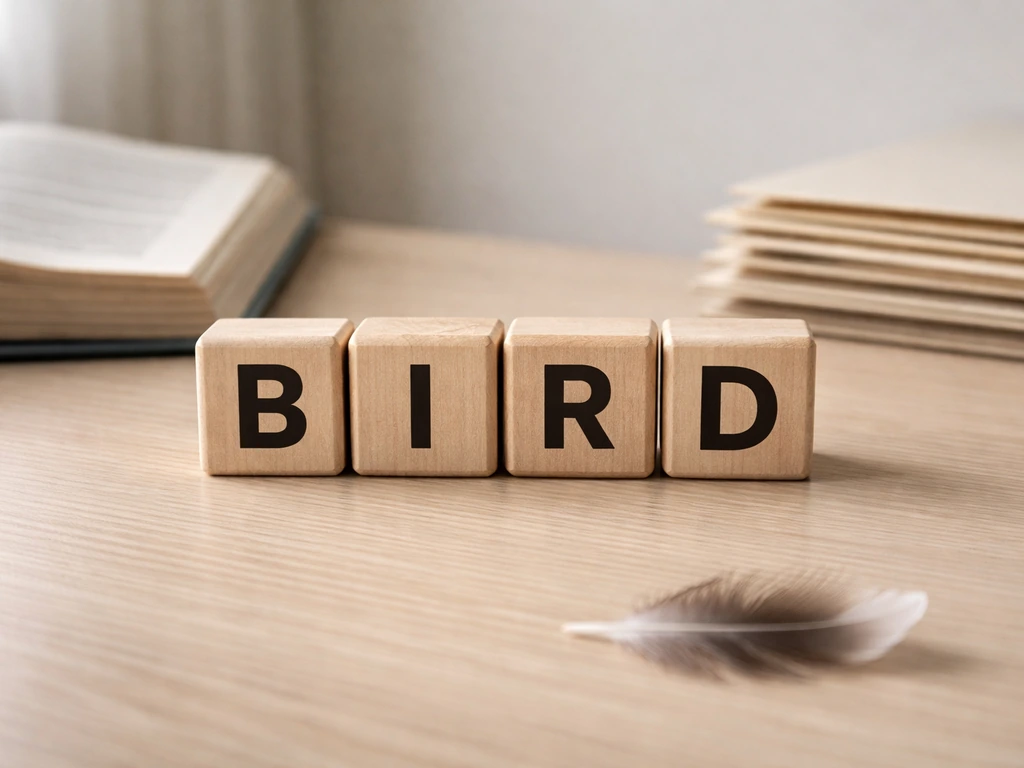
"B is for bird" is an alphabet-learning phrase, plain and simple. You'll find it in children's toys, classroom activities, and storytime lesson plans as the go-to example for the letter B. But if you're here because you want to know which birds start with B, how to spell and say their names correctly, where those names come from, and how they translate into other languages, this guide covers all of that in one place.
B is for Bird Guide: Spelling, Pronunciation, and Names

James Ridgley
11 Apr 2026

What "B is for bird" actually means
In most contexts, the phrase is a phonics anchor. A VTech toy literally says: "This is the letter B, B is for bird," and Scholastic lesson plans label it as an "alphabet knowledge" skill activity. The idea is simple: the word "bird" starts with the /b/ sound, making it a reliable mnemonic for that letter. Preschool activities built around this phrase often have children practice sounding out /b/ and generating other words that start with the same sound, before moving on to matching letters to more specific bird names.
Beyond the classroom, the phrase turns up in wordplay and puzzle contexts. If you've seen a crossword clue or alphabet game asking for "B is for bird," the answer is usually one of a handful of widely recognized birds whose names begin with B: bluebird, blue jay, blackbird, bunting, or bald eagle. What a bird plus a letter means in puzzles depends heavily on context, but "B" entries almost always pull from this same short list of popular species.
The best "B" birds to know (and why these ones)
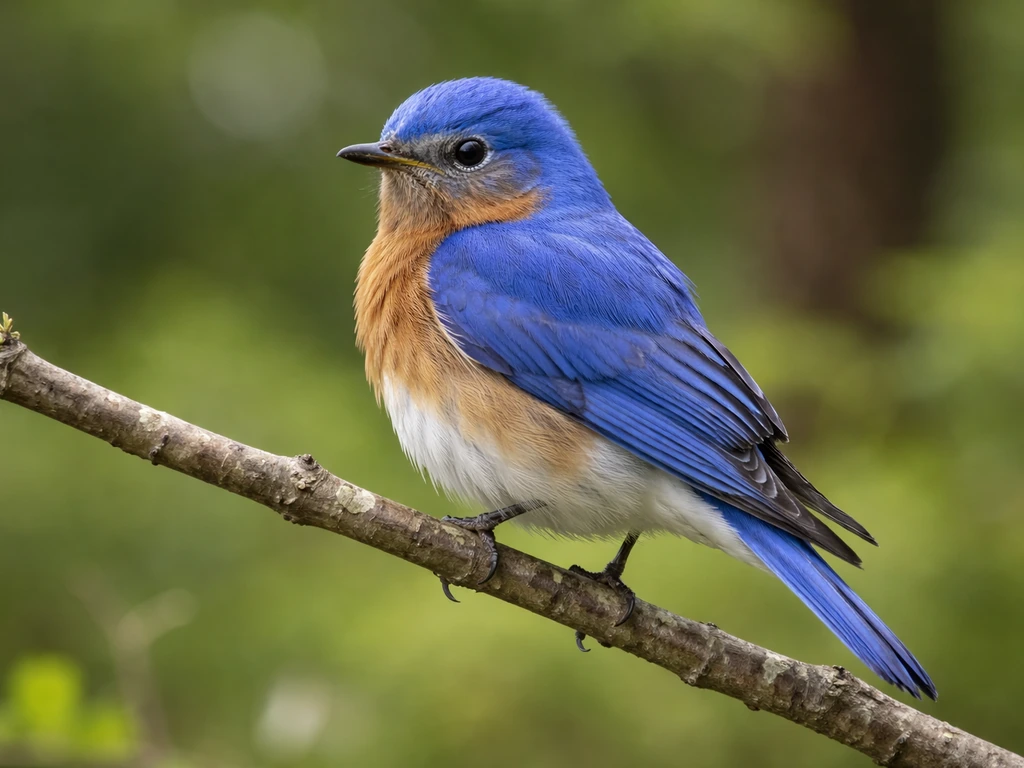
Not every B-bird makes an equally good teaching or reference example. The best choices are birds that are widely recognized, have stable and standardized common names, and show up consistently in field guides and educational materials. Here are the top picks.
- Bluebird: A North American classic with strong visual appeal (vivid blue plumage) and a clean, easy-to-spell one-word name. Covers multiple species under the genus Sialia.
- Blue Jay: One of the most frequently spotted backyard birds in eastern North America, described by Audubon as a familiar visitor to feeders and woodland edges. Its bold appearance makes it a memorable visual anchor.
- Blackbird: A widespread bird on both sides of the Atlantic with a long documented history in English. The common blackbird (Turdus merula) is the standard reference in British English; red-winged blackbird is the North American counterpart.
- Bald Eagle: Immediately recognizable, heavily used in U.S. educational materials, and useful for teaching capitalization conventions in common names.
- Bunting: A colorful songbird genus (Passerina in North America, Emberiza in Europe) that gives learners a slightly less common but very real B-bird to explore.
Spelling and pronunciation: get these right
These names trip people up more than you'd expect, especially when common names run two words together or use hyphens inconsistently. Here's the standardized form for each, with practical pronunciation.
| Bird | Standard Spelling | Pronunciation (phonetic) | IPA |
|---|---|---|---|
| Bluebird | bluebird (one word) | BLOO-bird | /ˈbluːbɜːrd/ |
| Blue Jay | Blue Jay (two words, both capitalized per Audubon convention) | bloo JAY | /bluː dʒeɪ/ |
| Blackbird | blackbird (one word) | BLAK-bird | /ˈblækbɜːrd/ |
| Bald Eagle | Bald Eagle (two words) | bawld EE-gul | /bɔːld ˈiːɡəl/ |
| Bunting | bunting (one word) | BUN-ting | /ˈbʌntɪŋ/ |
Merriam-Webster lists "bluebird" as a single unhyphenated word, and Cambridge Dictionary confirms the pronunciation as /ˈbluːbɜːrd/ in American English. For "blackbird," Cambridge and Wiktionary both document it as a single compound word (no hyphen, no space), pronounced /ˈblækbɜːrd/ with stress on the first syllable. The IPA forms above follow standard American English; British English shifts the vowel in "-bird" slightly, but the stress pattern stays the same.
One practical note: when you see a capitalized two-word common name like "Blue Jay" or "Eastern Bluebird" in a field guide or official checklist, that capitalization is intentional. It signals that the name refers to a specific recognized species, not a generic description. The U.S. Fish and Wildlife Service, for example, formats it as "Eastern Bluebird (Sialia sialis)" with the capital E. More on that in the naming conventions section below.
Where these bird names come from
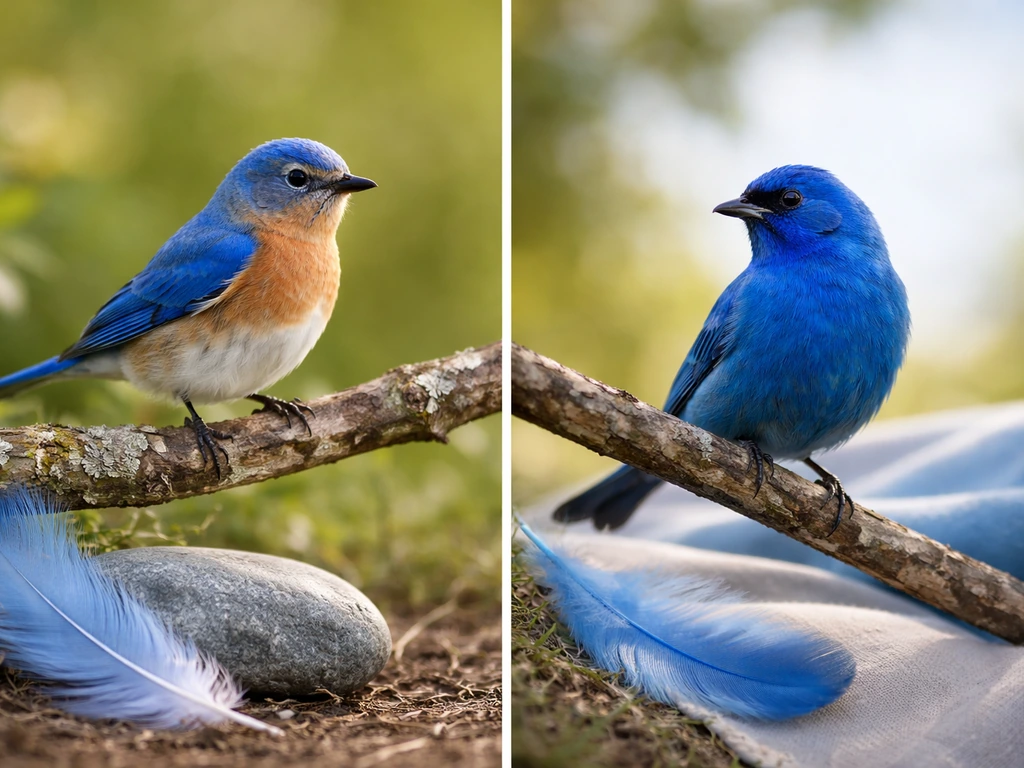
Bluebird
"Bluebird" is a descriptive compound: blue (the color) plus bird. The name is straightforwardly English and simply describes what you see. The scientific name for the genus, Sialia, comes from a Latinized form of a Greek word (sialis) used for some type of bird in classical texts, though the exact ancient referent is debated. The Eastern Bluebird's full binomial is Sialia sialis, which doubles the genus term as the species epithet, a construction called a tautonym.
Blue Jay
The common name "Blue Jay" is again descriptive: blue for the plumage, jay for the bird family. "Jay" as a bird term has roots in Old French ("geai") and possibly Latin, but its exact path into Middle English is debated. The scientific name is Cyanocitta cristata. "Cyanocitta" comes from Greek: "kyanos" (blue, or more literally the color of lapis lazuli) combined with a Greek word for a chattering bird or jay. "Cristata" is Latin for "crested" or "tufted," a direct reference to the Blue Jay's prominent head crest. So the scientific name essentially says "blue chattering bird with a crest," which describes the bird perfectly.
Blackbird
"Blackbird" has been around in English since at least Middle English, with Wiktionary documenting historical forms of the compound word. The name is purely descriptive of the male's entirely black plumage. The common blackbird's scientific name, Turdus merula, comes from Latin: "turdus" simply means "thrush," and "merula" is the classical Latin word for the blackbird specifically. This is one of those cases where the Latin name is actually older than the modern English one.
Using "B is for bird" in teaching and puzzles
For alphabet learning, "B is for bird" works best as a gateway into more specific bird names. A Scholastic lesson plan pairs the phrase with literacy activities including a scavenger hunt format, and a library storytime blog documents a "bird scavenger hunt with binoculars" as a hands-on extension of the letter-B activity. The pattern that works: introduce the letter, say "B is for bird," then drill down into one specific bird name so children learn both the letter-sound connection and a real vocabulary word.
For puzzles and word games, "B is for bird" most often points to "bluebird" or "blue jay" because these names appear frequently in crossword databases and word games. What the word "bird" stands for in slang and coded language is a separate question worth checking if your puzzle clue feels like it's pointing somewhere other than an actual animal.
Mnemonics help too. Birding educators sometimes connect "Blue Jay" to the sound of a fan cheering ("jay! jay!") and "Eastern Bluebird" to the idea of a charming, bright presence at the feeder. These kinds of associations make species names stick better than rote repetition, especially for young learners or people who are new to birdwatching.
B-bird names in other languages
If you're looking up bird names across languages, here's a practical starting map for the main B-birds. Spanish is included because it's the most commonly requested second language for North American bird names, and because Collins provides solid dictionary-level translations rather than informal ones.
| English Name | Spanish | French | German |
|---|---|---|---|
| Bluebird (general) | pájaro azul / azulejo de América | merlebleu | Hüttensänger |
| Eastern Bluebird | azulejo gorjicanelo | merlebleu de l'Est | Rotkehl-Hüttensänger |
| Blue Jay | arrendajo azul | geai bleu | Blauhäher |
| Blackbird (common) | mirlo común | merle noir | Amsel |
| Bald Eagle | águila cabeza blanca | pygargue à tête blanche | Weißkopfseeadler |
Collins maps Spanish "pájaro azul" directly to English "bluebird," and also gives "azulejo m (de América)" as a more specific regional term. It's worth knowing that bird names often vary by Spanish-speaking region: what's called a "mirlo" in Spain for the common blackbird may be described differently in Latin American Spanish. eBird handles this variation by indexing bird names in multiple regional language sets, which is useful if you're looking for the locally prevailing name rather than the dictionary default.
Common names vs scientific names: how to tell them apart

This is where a lot of confusion happens. A "bluebird" in casual conversation might mean any of three distinct species: Eastern Bluebird (Sialia sialis), Western Bluebird (Sialia mexicana), or Mountain Bluebird (Sialia currucoides). Britannica documents all three as part of the genus Sialia. The common name "bluebird" covers the whole genus; the capitalized "Eastern Bluebird" or "Western Bluebird" with two-word formatting refers to one specific species.
The rule of thumb used by most serious birders and ornithological bodies: capitalize specific common names (Eastern Bluebird, Blue Jay, Red-winged Blackbird) and write informal or generic uses in lowercase ("I saw a bluebird" when you don't know which species). The American Ornithological Society publishes guidelines for capitalizing and formatting English bird names, and explains that careful capitalization helps avoid ambiguity between species names and generic descriptions capitalize specific common names. Scientific names are always written in italics with the genus capitalized and the species epithet in lowercase: Sialia sialis, Cyanocitta cristata. The International Ornithologists' Union maintains a reference list of accepted scientific names and even offers a searchable spoken pronunciation guide for scientific bird names, which is especially useful when you need to say Cyanocitta cristata out loud without guessing.
Regional common-name variation is a real disambiguation challenge. The American Birding Association's checklist materials use standardized English names tied to the American Ornithological Society's official list, so if you're in a North American context, that's the most reliable anchor for common-name spelling and capitalization. eBird Mobile also indexes alternate English names by region, so a bird called one thing in the UK might be indexed under a different name in a US database. Which letter corresponds to a European bird is a useful companion question if you're working with British English bird names, since several B-birds (particularly blackbird) have different dominant species on each side of the Atlantic.
Expanding beyond B: what to look at next
Once you've got the B-birds down, the natural next step is working through the rest of the alphabet the same way. Each letter has its own set of reliable anchor birds, and the same principles apply: find the standardized common name, note the scientific binomial, check the etymology, and map it to at least one other language if you need a multilingual reference. S is for bird follows the same format and is a good next read if you're building out a full alphabet of bird names, since the S-birds (sparrow, swallow, swift, sandpiper) raise their own interesting disambiguation and spelling questions.
For reliable spellings and pronunciations beyond what's covered here, the best habit is to cross-check against at least two of: Merriam-Webster (for standard dictionary spelling and IPA), Cambridge Dictionary (for pronunciation with audio), and either Cornell Lab's All About Birds or the Audubon Field Guide (for field-tested common-name conventions). Those three sources together cover the vast majority of common-name questions you'll run into, and they're free to access.
FAQ
If I need a single “B-bird” to use on a worksheet, which one should I pick to avoid confusion?
Choose blue jay or bluebird as a single-word, widely recognized name, and use the capitalization consistently. If your worksheet targets very young learners, avoid “Eastern Bluebird” unless you want species-level specificity, because “bluebird” can refer to multiple species within the Sialia genus.
How do I know whether a B-bird name should be one word or two words?
Check capitalization and whether it is treated as a single common-name unit in dictionaries. In standard common usage, bluebird and blackbird are compounds written as one word, while Blue Jay is written as two words with a capital B, signaling a specific recognized species rather than a generic description.
What’s the safest way to pronounce “-bird” names in British versus American English?
Use the IPA stress pattern from a standard dictionary as your anchor, then expect the vowel sound in “-bird” to shift slightly between American and British English. The article’s IPA notes that stress typically stays the same even when the vowel changes.
Should I capitalize “bluebird” when I’m not naming a specific species?
Use lowercase when you mean the generic idea of “a bluebird” without specifying which species. Capitalize only when you are referring to a particular recognized species or formal common name, such as Eastern Bluebird or Western Bluebird.
In puzzles, do clue writers always mean an animal species when they say “B is for bird”?
Not always. Many puzzle contexts default to the most common crossword-friendly answers like bluebird or blue jay, but some clues use “B” categories loosely (letter labels, toy/book conventions, or slang/coded meanings). If the grid length or theme conflicts with an animal, treat it as a clue about the letter convention or code instead of the bird itself.
What if a database gives me a different English name for the same bird in another region?
That usually means regional common-name variation, not a wrong spelling. In practice, follow one reference system for your context, such as a North American checklist for US/Canada work, and switch to region-indexed sources when you need the locally used name rather than a dictionary default.
How do scientific names affect spelling accuracy when I’m entering them into a form or quiz?
Scientific names have strict casing rules, genus capitalized and species lowercase (for example, Sialia sialis). If a form accepts only one field, keep the entire binomial together, and do not try to “title case” the species epithet, since that is a common mistake.
Are mnemonic phrases like “jay! jay!” reliable for remembering names long-term?
They work best as a first-memory hook, especially for children or beginners, but pair them with a consistent visual or real-world reference (a picture or a brief description). Without that anchor, mnemonics can fade or lead to mixing similar names like Blue Jay versus Eastern Bluebird.
How should I translate B-bird names into Spanish, and why might it differ by region?
Start with dictionary-style equivalents for the default translation, then verify regional variants if you need the name used locally. The article notes that “pájaro azul” can map to bluebird, and that the same English common name can correspond to different Spanish terms depending on where you are.
What’s the fastest workflow to look up an unfamiliar B-bird correctly?
Use a two-step check: first confirm the standardized common name and its spelling in a dictionary, then confirm the scientific binomial and capitalization rules in a bird reference. If pronunciation matters, pull IPA or audio from at least one pronunciation-focused dictionary and one field guide source.
Next Article
What Does Bird Stand For? BIRD Acronym Meanings
Find what BIRD stands for by context: common acronym meanings, how to disambiguate, and tips to confirm the right expans