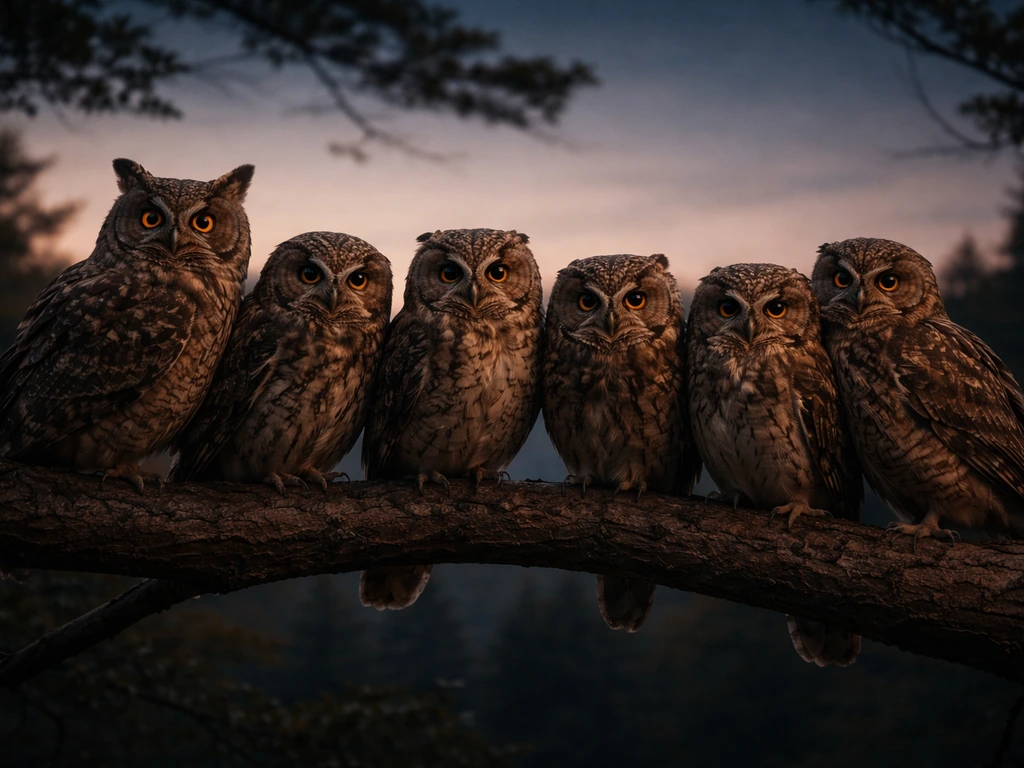
When someone searches for 'parliament definition bird,' they are almost certainly looking for the collective noun for owls. 'A parliament of owls' is the specific phrase you want. 'Parliament' is not the name of a bird species; it is the collective noun used to describe a group of owls gathered together. Once you know that, everything else falls into place.
Parliament Definition Bird: Meaning, Name Origins, and ID Help

James Ridgley
10 Apr 2026
What 'parliament' means in bird-related contexts
In everyday English, parliament refers to a country's legislative body, the formal assembly where laws are debated and passed. But in bird language, the exact same word takes on a completely different role: it becomes a collective noun, one of those vivid, old-fashioned group labels that English has collected over centuries. The collective noun for birds in general is simply 'birds' or 'a flock,' but specific species often carry far more colourful group names, and owls are a perfect example.
The phrase 'a parliament of owls' uses 'parliament' as a poetic analogy: a group of owls sitting together in the dark, motionless and seemingly deliberating, looks uncannily like a gathering of legislators in session. The word is not taxonomy. It does not appear on any scientific list of owl species. It is purely a language device, rooted in English literary tradition.
The bird you are actually looking for: owls
The bird that goes by the collective label 'parliament' is the owl, order Strigiformes. There is no single species called 'the parliament bird.' Instead, the phrase applies broadly to owls as a group: any gathering of owls can be referred to as a parliament. If you came here wondering which bird has 'parliament' as its collective noun, the answer is owls, full stop.
Owls are solitary hunters for most of the year, so seeing a group of them roosting together is unusual, which may be part of why the term is so striking and memorable. The usage is widely confirmed: major ornithological references, Wikipedia's entry on owls, and UK Parliament's own educational materials all describe 'a parliament' as the standard collective noun for a group of owls. The “Discover the UK Parliament!” educational PDF states that “a ‘parliament’ is also the name for a group of owls.” UK Parliament's own educational materials.
Spelling, pronunciation, and what it looks like in other languages

The correct English spelling is parliament, no variations. Common misspellings include 'parliement,' 'parliment,' and 'parliment' (dropping the middle syllable in writing). In the bird phrase, the full form is 'a parliament of owls,' with 'parliament' as a singular collective noun followed by 'of owls.'
The standard UK English pronunciation is /ˈpɑːləmənt/ (PAR-luh-munt). The middle syllable is often swallowed in natural speech, which is exactly why the word gets misspelled so often. Say it slowly: PAR - luh - munt, three syllables. American English follows the same pattern but with a flatter 'a' sound: /ˈpɑːrləmənt/.
In French, the equivalent word is parlement (same spelling as the Old French origin, no 'i' before the 'a'). The French collective noun tradition for birds is less developed than English, so 'un parlement de hiboux' (a parliament of owls) is understood but is not a standard French idiom the way it is in English. In other European languages the concept is typically translated literally rather than borrowed directly.
Where the word 'parliament' actually comes from
The etymology here is genuinely interesting. Parliament traces back through Middle English parlement to Old French parlement, which meant 'discussion, meeting, negotiation, assembly, or council.' That Old French noun came from parler, meaning 'to speak,' combined with the noun-forming suffix -ment. So at its root, parliament literally means 'a speaking' or 'a place of speaking.'
That origin is actually what makes the bird phrase so apt. When English speakers began applying collective nouns to animals, they often chose words that reflected the animal's perceived character or behaviour. Owls have long been associated with wisdom and solemn deliberation in Western culture, especially in Greek and Roman mythology where the owl was the symbol of Athena and Minerva, goddesses of wisdom. Calling a group of owls a 'parliament' plays on that reputation: these birds are wise, they sit in judgment, they deliberate. The word choice was always metaphorical and literary rather than scientific.
Common confusion: 'parliament' vs. similar bird terms
The biggest source of confusion is straightforward: people see the word 'parliament' in a bird context and assume it must be the name of a specific bird species, like 'robin' or 'swift.' It is not. It is a collective noun. If you look up 'parliament bird' expecting to find a species entry in a field guide, you will not find one, and that absence is the correct answer.
A second confusion comes from mixing up different bird collective nouns. English has dozens of these vivid group terms, and they are easy to confuse. For example, finches are associated with a different group name entirely: if you have been puzzling over the charm collective noun and which bird it belongs to, that is finches, not owls. Each species has its own term, and 'parliament' belongs specifically to owls.
There is also occasional confusion with similarly structured phrases. Some birds share their collective noun category with less obvious species. For instance, if you have come across the term 'conventicle' in a similar search, that belongs to a completely different bird altogether: the bird whose collective noun is a conventicle or tribe is not an owl, and mixing these up is an easy mistake when browsing word-puzzle clues or trivia.
| Collective Noun | Bird(s) It Refers To | Common Confusion |
|---|---|---|
| Parliament | Owls (order Strigiformes) | Sometimes mistaken for a species name |
| Charm | Finches (e.g., goldfinches) | Confused with other songbird group names |
| Conventicle or Tribe | Specific bird species (not owls) | Confused with 'parliament' in word puzzles |
| Flock | Birds in general | Used loosely for any bird group |
How to confirm you have the right bird name
The fastest check is to ask: is this phrase framed as a collective noun or a species name? If a source says 'a parliament of owls,' that is a collective noun construction (article + noun + 'of' + animal), not a species name. Species common names in English do not follow that pattern. You would never say 'a parliament of owls is a species of parliament,' because that is grammatically and logically incoherent. The phrasing itself signals the correct interpretation.
A second check: look for a scientific binomial name. Every bird species has a two-part Latin name, for example Bubo bubo for the Eurasian Eagle-Owl. The word 'parliament' has no binomial equivalent because it is not a species designation at all. If a source cannot supply a scientific name for 'parliament bird,' that confirms it is a collective noun, not a species.
A third practical check: cross-reference the standard dictionary definition of parliament (a legislative assembly) and then the bird usage side by side. Seeing both definitions together makes it immediately clear that the bird meaning is a metaphorical extension of the human institution, not a separate word entirely. Merriam-Webster and Collins both give the primary political definition, which is the lens through which the bird phrase should be read.
It also helps to understand the plural of bird and how English handles bird number generally, because collective noun phrases like 'a parliament of owls' sit at the intersection of grammar and ornithology in a way that trips people up. The noun 'parliament' is singular (one group), but 'owls' is plural (multiple individual birds). Getting comfortable with that structure helps avoid misreading these phrases.
How collective nouns fit into bird naming conventions
In formal ornithology, bird naming is governed by the International Ornithological Committee (IOC) and similar bodies, which maintain standardised lists of common names and scientific names for every recognised species. Collective nouns like 'parliament' are entirely outside this system. They do not appear in the IOC World Bird List. They are not regulated, debated in taxonomic committees, or linked to any scientific classification. They are language, not science.
That said, collective nouns are taken seriously by birders, naturalists, and language enthusiasts. Many of the most vivid ones, including 'parliament of owls,' trace back to medieval English hunting and falconry traditions, where knowing the correct term for a group of animals was considered a mark of education and breeding. These terms were collected and codified in books like 'The Book of Saint Albans' (1486), which is one of the earliest printed sources for English collective nouns.
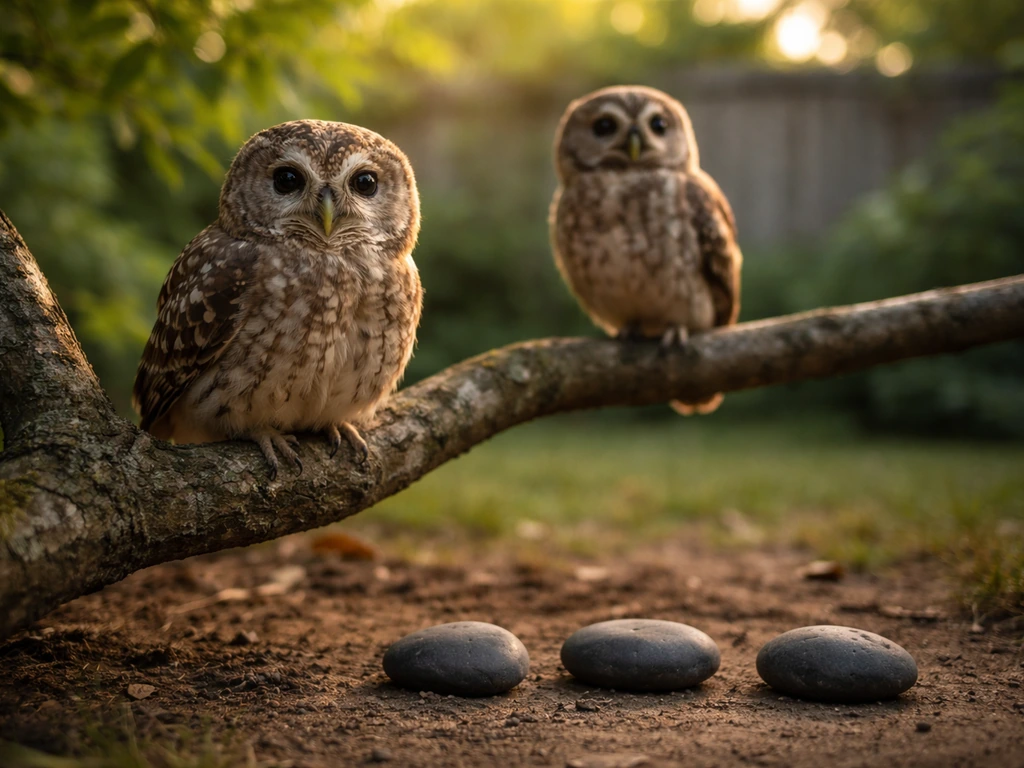
For practical birdwatching and field identification, collective nouns are colour and culture, not navigation tools. When you are in the field and you spot three owls roosting in a tree, calling them 'a parliament' is evocative and correct, but your field guide will identify each individual bird by species name, not by the group label. The two systems, collective nouns and scientific nomenclature, exist happily alongside each other without competing. Knowing both makes you a more rounded and interesting birder.
FAQ
Is there ever a “parliament bird” species name, or is it always a phrase?
Use “a parliament of owls” when you mean the group, but you would not say “the parliament bird.” In practice, writers usually keep it as a fixed phrase, then refer to the birds as “the owls” afterward for clarity.
How do I use “parliament” grammatically in a sentence?
If the sentence is built like “a parliament of X,” then X must be the animal. So it becomes “a parliament of owls” (not “a parliament for owls,” and not “a parliament in owls”). For multiple groups, you can say “parliaments of owls.”
Can you call it a “parliament” if you only spot one owl?
Whether you are talking about one owl roosting near others or several owls together, the term implies a gathering. If you see only one owl, “parliament” does not fit well, because it is meant for a group, so stick to “an owl.”
If multiple owl species are in the same area, does it still count as “a parliament of owls”?
Yes. Even though “parliament” refers to a group of owls, owls can belong to different owl species. The collective noun is about the group being owls, not about the species being the same.
What should I do if I want the collective noun for a bird other than owls?
The term is specifically a collective noun for owls in English. If you are looking for a similar “old-fashioned” group word for another bird type, you need that bird’s own collective noun, not a synonym or translation of “parliament.”
What are the most common misspellings of “parliament” in the owl phrase?
Spelling should always be “parliament.” “Parliement” and “parliment” are common error patterns, and “parliament” is also the standard spelling for the political institution, which can lead to guesswork.
Is “parliament of owls” useful for actual bird identification?
In field contexts, use the collective noun only as a descriptive, not as your identification method. For identification, rely on the species name from your guide, because “parliament” does not map to a single species with a diagnostic description.
Why can’t I find a scientific or Latin name for “parliament”?
No. Collective nouns are language conventions, not taxonomic categories. That means there is no official “binomial name” or formal scientific listing for “parliament,” and you should not expect it to behave like a species name.
What’s the fastest way to tell collective noun wording from a real species name?
A quick test is structure. “A parliament of owls” uses an article plus “of” plus an animal, which signals collective noun usage. If the phrase were a species name, you would not normally see “of owls” attached that way.
Next Article
How to Pronounce Mynah Bird (MY-nah vs my-NAY)
Learn how to pronounce mynah birds word mynah or myna, with syllables, stress, and quick self-check tips.