
The clue 'Rival bird is not on time (7)' is a 7-letter cryptic crossword entry. The most likely answer is OVERDUE, with DELAYED as a close second candidate. Both are 7 letters, both mean 'not on time,' and both fit the typical mechanic of a British-style cryptic where 'rival bird' supplies the wordplay and 'not on time' (or vice versa) acts as the definition. Check your grid's crossing letters to confirm which one fits.
Rival Bird Is Not on Time Crossword Clue Answer Help

James Ridgley
17 May 2026
What this clue is actually asking
Before diving into candidate answers, it helps to read the clue the way a cryptic solver does. In a cryptic crossword (especially British and Irish styles like the Irish Independent's 2-Speed Crossword, where this clue originates), every clue has two parts: a definition of the answer and a wordplay component. The surface reading ('Rival bird is not on time') is designed to sound like a normal English sentence, but it's a bit of misdirection. The real job is to figure out which part defines the answer and which part is the construction mechanic.
In this clue, 'not on time' is almost certainly the definition. It points directly to words like LATE, TARDY, OVERDUE, or DELAYED. The phrase 'rival bird' is the wordplay, and 'is' acts as a linking verb connecting the two parts. So the clue is essentially saying: build a word using the wordplay involving 'rival' and 'bird,' and that word means 'not on time.' The enumeration (7) tells you exactly how many letters you need.
Common crossword answers for 'rival bird' and 'not on time'
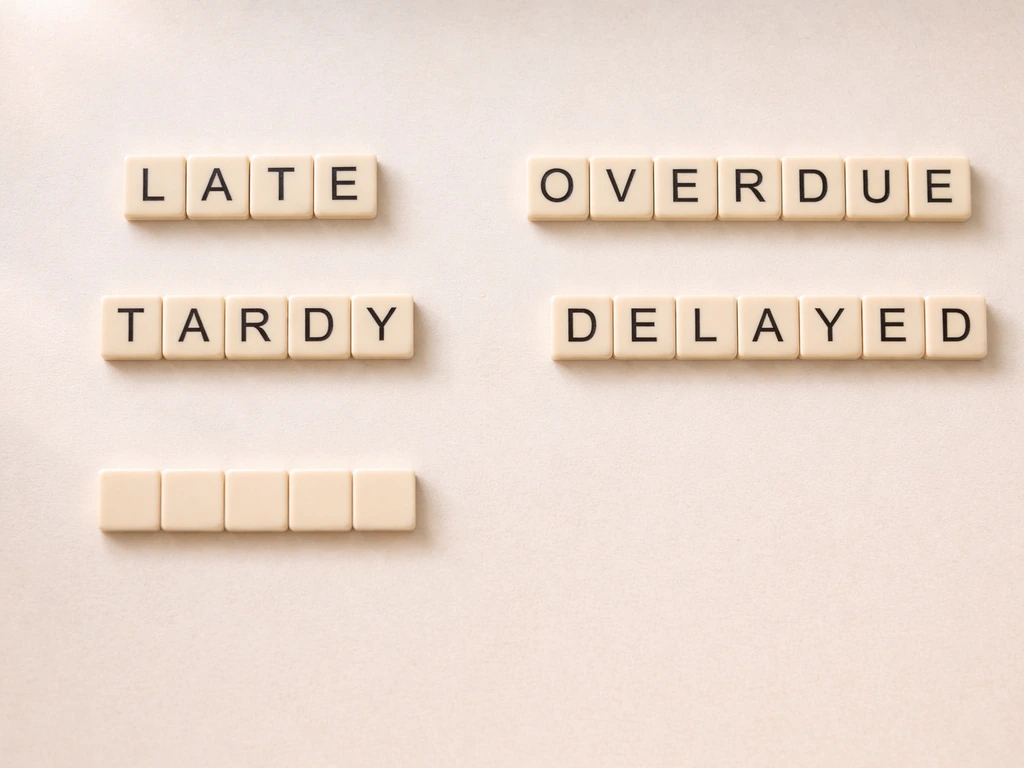
The 'not on time' side of this clue is well-documented in crossword databases. Here are the standard candidates by letter count:
| Answer | Letters | Fits (7)? |
|---|---|---|
| LATE | 4 | No |
| TARDY | 5 | No |
| OVERDUE | 7 | Yes |
| DELAYED | 7 | Yes |
Since the clue specifies 7 letters, you're immediately down to OVERDUE or DELAYED. TARDY and LATE are the most frequently cited crossword answers for 'not on time,' but they don't fit a 7-letter slot. Merriam-Webster defines TARDY explicitly as 'not on time: late,' and LATE is the shortest synonym, but neither works here. For the wordplay involving 'rival bird,' OVERDUE has a slight edge because it's more commonly constructed from component parts in cryptic clues, but DELAYED works too if the wordplay justifies it.
Using letter count, pattern, and cross letters to verify
The enumeration (7) has already done a lot of the heavy lifting. But cross letters are what separate OVERDUE from DELAYED definitively. Here's a practical approach:
- Write out both candidates in your grid slots: O-V-E-R-D-U-E and D-E-L-A-Y-E-D.
- Look at which crossing answers (the horizontal entries that intersect this down entry) you've already filled in. A confirmed crossing letter at position 1 (O vs D) immediately resolves the answer.
- If position 1 is blank, work your way through positions 2, 3, 4, and 5, which differ entirely between the two words.
- OVERDUE has a U at position 6 and E at position 7. DELAYED has E at position 6 and D at position 7. If you have the last letter confirmed, that also splits them.
- If no crossing letters are confirmed yet, solve surrounding clues first, then return to this one.
Pattern matching is especially useful if you've filled in a few letters already. For example, if you see V , OVERDUE is essentially confirmed. If you see D L _, DELAYED is your answer. Don't guess without at least one crossing letter if both candidates feel equally plausible.
The 'rival bird' angle: what bird name could be hiding here?
In cryptic crosswords, 'rival bird' as a wordplay component usually means you're combining a synonym for 'rival' with a bird name (or vice versa) to build the answer. If you enjoy this kind of puzzle, try spotting riddles where the answer is bird and the clue uses misdirection or wordplay rival bird. This is worth thinking through carefully, because bird names and rival-synonyms are common building blocks in British cryptics.
Synonyms for 'rival' in crossword language include FOE, ENEMY, NEMESIS, and OPPONENT, but the shorter forms (FOE, FOE, RIVAL itself) are more useful for letter-building. Common short bird names used in cryptic wordplay include JAY, TIT, OWL, EMU, HEN, and ROOK. If the constructor is embedding a bird name inside OVERDUE or DELAYED, here's what stands out: OVERDUE contains no obvious standalone bird name, but DOVE is close (O-V-E... not quite). DELAYED contains no clean bird substring either. This suggests the 'rival bird' wordplay might be working at a higher structural level, possibly as a compound where one word means rival and another is a bird that together anagram or combine into the 7-letter answer.
Another possibility is that 'rival bird' is itself a definition pointing to a bird species known for competition or aggression, with 'not on time' as the wordplay. Some birds are culturally associated with rivalry, like the ROBIN (territorial, known for aggressive behaviour) or the CUCKOO (which rivals host birds by parasitising their nests). The CUCKOO angle is particularly interesting because cuckoos are famously associated with time (cuckoo clocks), which might make 'not on time' feel like a sly surface reference. However, CUCKOO is 6 letters, not 7, so it doesn't fit the enumeration directly.
How 'not on time' works as a clue mechanic
In cryptic crosswords, 'not on time' functions as a definition indicator pointing to a word that means delayed, late, or overdue. It can also work as a modifier in wordplay, particularly in subtraction clues where 'not on time' might mean 'remove a time indicator (like T or HR or MIN) from a word.' The letter T is a common crossword abbreviation for 'time,' so 'not on time' could theoretically instruct you to drop a T from a longer word.
For the Irish Independent clue specifically, the most straightforward reading is that 'not on time' is the definition and maps directly to OVERDUE or DELAYED. The subtraction mechanic is a fallback interpretation worth knowing if straightforward reading doesn't produce a clean answer. Related clue mechanics you might encounter in the same puzzle include clues asking about bird behaviour or resting spots (similar to clues in this crossword niche like 'where a bird rests' or 'what a bird does with its beak'), which tend to pair a bird action or place with a second definition in the same cryptic structure.
Quick elimination strategy to nail the exact answer
Here's the fastest path from 'I have no idea' to 'confirmed fill' for this clue:
- Confirm the enumeration. The clue says (7), so you're working with a 7-letter answer. LATE and TARDY are out immediately.
- Write OVERDUE and DELAYED as your two live candidates.
- Check position 1 in your grid. O means OVERDUE; D means DELAYED. Done.
- If position 1 is empty, check positions 3 or 4. OVERDUE has E at position 3 and R at position 4. DELAYED has L at position 3 and A at position 4. One confirmed crossing letter resolves it.
- If you have zero crossing letters, leave this clue and solve two or three surrounding entries first, then return.
- Once you've confirmed the answer, fill it in and check that it doesn't violate any crossing entry you've already filled.
This elimination approach works for virtually any crossword clue where you've narrowed the field to two candidates. It's faster than re-analysing the cryptic wordplay from scratch, especially for a time-pressure solve. The same method applies to other bird-linked crossword clues where you've got two plausible fills and just need one letter to decide.
Pronunciation and spelling tips for OVERDUE and DELAYED
Since crossword accuracy depends on exact spelling, it's worth double-checking both candidates before you ink them in.
OVERDUE
Spelled O-V-E-R-D-U-E. Pronounced 'oh-ver-DYOO' (IPA: /ˌoʊvərˈdjuː/), or in American English 'oh-ver-DOO' (/ˌoʊvərˈduː/). The most common spelling mistake is writing OVER-DUE as two words or dropping the final E. In crossword grids, it always appears as one solid 7-letter string: OVERDUE. The stress falls on the last syllable, which sometimes trips people up when they're trying to recall the spelling from how it sounds.
DELAYED
Spelled D-E-L-A-Y-E-D. Pronounced 'dih-LAYD' (IPA: /dɪˈleɪd/). The common mistake here is misspelling the root DELAY before adding the past-tense ending: people sometimes write DELAID or DELAIED, but the correct form keeps the Y and adds ED to give DELAYED. In a crossword, the Y at position 5 is distinctive and easy to confirm from a crossing horizontal clue if you're uncertain.
If your grid confirms OVERDUE, you're done. If it confirms DELAYED, you're equally done. Either way, the clue 'Rival bird is not on time (7)' resolves cleanly to one of these two answers, and one crossing letter in the right position is all you need to lock it in with confidence. After you solve this cryptic clue, you might wonder what a bird does with its beak in everyday life what a bird does with its beak crossword clue. This is the sort of puzzle clue that shows up in crossword records connected with Paul, who painted Cat and Bird. If you're still stuck, practice the same kind of anagram and wordplay cleanup you would use for a “clean up as a bird does” crossword clue clean up as a bird does crossword. If you are also looking at Kylo whose surname sounds like a bird crossword, the main job is to match the intended wordplay to the most likely answer length and crossings.
FAQ
If I have no crossing letters yet, how can I still decide between OVERDUE and DELAYED for “Rival bird is not on time (7)”?
Start by checking whether the crossword’s 7-letter slots and nearby clues seem to form a pattern that favors one ending. For instance, if the intersecting clue you’ve solved gives you a confirmed letter at the final position of your answer, it typically distinguishes OVERDUE (ends with E) from DELAYED (ends with D). If you truly have nothing fixed, leave the entry unfilled and solve the crossings first, then come back, because the wordplay here can plausibly justify either candidate.
Does “rival bird” ever indicate an anagram rather than a straightforward definition/wordplay split?
It can, but you can test it quickly. If the letters available from crossings match an anagram of a bird name plus a rival synonym (or a rival word plus a bird word), then anagram mechanics are more likely. If the crossings don’t allow any bird word to visibly fit as a substring, the clue is more likely to be using “rival bird” as a single combined wordplay source rather than a literal anagram instruction.
Could “not on time” be a subtraction clue here, like removing “T” for time?
Yes, it’s possible in cryptics generally, but in this specific clue the intended answers are already very strong matches by definition and length. A subtraction reading would usually produce a candidate that shares most letters with a longer base word you can identify from crossings. If your crossings do not suggest a longer base that can lose T (or another time abbreviation like HR or MIN), stick with OVERDUE or DELAYED.
What if the enumeration is wrong in my puzzle, could the answer length be something other than 7?
Rarely, but mistakes happen. First confirm that the cell count you’re using is correct, including whether the clue includes any trailing punctuation or spacing that could indicate multiple components. If the grid truly has 7 cells for that entry, the answer almost certainly must be exactly 7 letters, which sharply limits you to OVERDUE or DELAYED given the definition.
Are OVERDUE and DELAYED always interchangeable, or can one be disqualified by crossword-style usage?
They’re close, but not always treated the same by constructors. “Overdue” often reads as more of a direct, noun-like or deadline-related “past the expected time,” while “delayed” feels more process-related. In practice, crossings decide it, but if one spelling creates an unusually awkward fit for a crossing letter you can’t fix elsewhere, prefer the other candidate and re-check the intersecting clue you used to justify the crossing.
What are the most common spelling errors to avoid when entering the answer into the grid?
For OVERDUE, the main slips are writing it with a hyphen or dropping the final E. For DELAYED, avoid swapping the ending to something like “-ied” or misspelling the root as DELAIED/DELAID. In a grid, the Y position is often the easiest letter to confirm once you get any crossing with a fixed Y-related position.
If my crossings confirm one answer, should I still revisit the cryptic parsing of “rival bird”?
You can, but it’s optional. Once the letter pattern confirms OVERDUE or DELAYED, the practical solver move is to lock the fill and move on. If you’re curious, use your confirmed word to see how “rival bird” could generate it, but don’t let a strained parse slow down the solve, especially when the definition “not on time” is so clean.
Next Article
Riddle Where the Answer Is Bird: How to Solve and Verify
Step-by-step tactics to solve a riddle whose answer is bird, with examples and checks for generic vs species names.