The Spanish word for the crane bird is grulla. That's it, that's the answer. Pronounced roughly 'GROO-ya' (or 'GROO-lya' depending on the region), it's a feminine noun and the standard term used by birders, field guides, and official wildlife bodies across the Spanish-speaking world. If you just needed that word to fill in a crossword, label a photo, or ask a birding question in Spanish, you're done. But if you want to know exactly which grulla fits the crane species you're looking at, or you want to avoid mixing it up with the very similar-sounding grúa (a construction crane), read on.
How Do You Say Crane Bird in Spanish

James Ridgley
22 Apr 2026
What exactly is a "crane bird" in English?
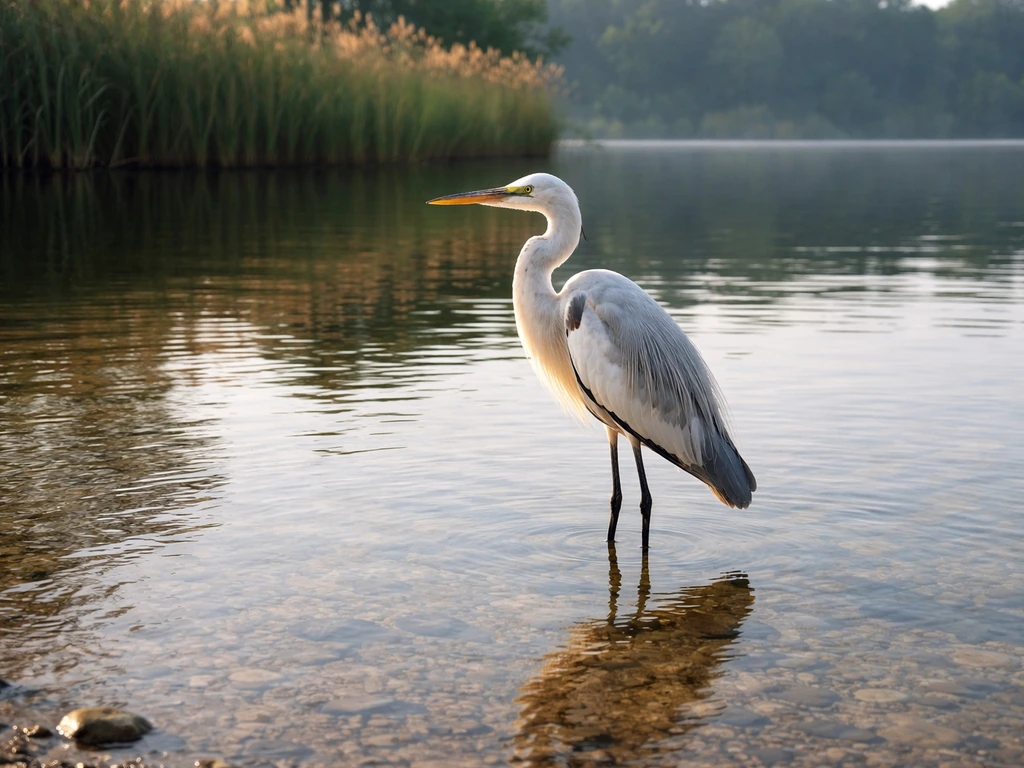
In the birdwatching world, a crane is a large, long-legged, long-necked wading bird belonging to the family Gruidae, in the order Gruiformes. To map it to the English wording you’re looking for, check the English common name of the specific crane species you mean. There are 15 living species in this family, distributed across every continent except South America and Antarctica.
These are the birds people picture when they say 'crane': tall, elegant, often found in wetlands and open grasslands, known for their dramatic courtship dances and far-carrying calls. This is a distinct biological group, not a catch-all term for any big wading bird. Fans of the TV series Better Call Saul may recognize this phrase from Croatian-language discussions, where it is often treated as a quirky fandom search term croatian bird better call saul.
Herons, for example, look superficially similar but belong to a completely different family (Ardeidae). Getting this distinction right matters when you're looking for the Spanish name, because the translation you need is specifically for the Gruidae family, not for herons or storks.
The Spanish translations you'll actually use
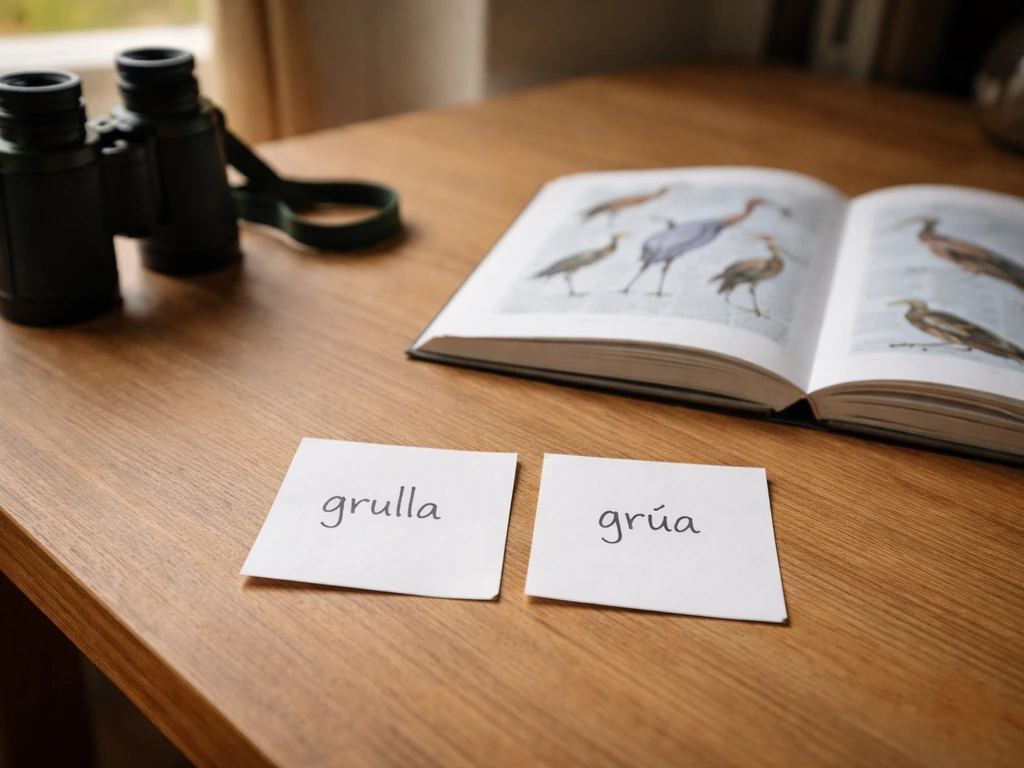
For the bird, the word you want is grulla. Spanish-language field guides, Audubon's Spanish birding resources, and official government wildlife documents in Spain all use grulla as the standard common name for cranes. Audubon lists the common crane as 'Grulla Común,' Spain's Ministry for Ecological Transition (MITECO) uses 'Grulla común (Grus grus)' in conservation records, and CITES documentation follows the same convention. You'll never see a Spanish birder write grúa when talking about the bird.
The one word to actively avoid in the bird context is grúa (with an accent mark over the u). That word refers to the construction machine, a crane used on building sites or for towing cars. The spelling looks close enough to cause confusion, especially for beginners, but the meaning is completely different. If someone hands you a Spanish–English dictionary entry, look for grulla (ave) not grúa (máquina). The distinction is clean and consistent across all Spanish-speaking regions: grulla for the bird, grúa for the machine.
How to spell and say grulla correctly
Spelling is simple: g-r-u-l-l-a. No accent mark, lowercase unless it starts a sentence or is part of a proper species name. The double-l (ll) is the part that trips people up in pronunciation, because Spanish ll is not pronounced the same way as English 'll' in 'full. ' In most of Spain and Latin America, ll sounds like the English 'y' in 'yes,' so grulla sounds like 'GROO-ya.
' In some parts of Argentina and Uruguay, ll is pronounced more like 'zh' (as in the 's' in 'measure'), so you'd hear something closer to 'GROO-zha. ' The IPA for the most widespread pronunciation is /ˈɡɾuʝa/, and Cambridge records the phoneme as /ˈɡɾuʎa/ reflecting the lateral variant used in more careful or formal Spanish speech.
| Pronunciation style | Region | Sounds like |
|---|---|---|
| 'GROO-ya' | Most of Spain, Mexico, much of Latin America | Like 'groovy' minus the 'vi,' ending in 'ya' |
| 'GROO-lya' | Formal/careful speech, some Andean regions | The ll is more like 'ly' blended together |
| 'GROO-zha' | Parts of Argentina, Uruguay | The ll sounds like the 's' in 'measure' |
For practical purposes, if you say 'GROO-ya,' any Spanish speaker will understand you immediately, regardless of their regional background. That's the safe, broadly understood pronunciation to go with.
Regional variation in Spanish usage
The word grulla itself is consistent across all Spanish-speaking regions. Unlike some bird names that vary significantly from country to country, grulla is understood and used everywhere as the standard term for cranes. What does vary slightly is the specific modifier attached to it. In Spain, you're most likely to encounter grulla común (the common crane, blank" rel="noopener noreferrer">Grus grus), since that's the species that winters in large numbers on the Iberian Peninsula.
The Spanish Wikipedia entry identifies the common crane as “la grulla común (Grus grus)” and places it within the cranes (Gruidae) context. The common crane is Grus grus and is part of the Gruidae family [the common crane, Grus grus](https://en.
wikipedia. org/wiki/Common_crane). In North America's Spanish-speaking birding communities, you're more likely to hear grulla canadiense (the sandhill crane, Antigone canadensis) or grulla trompetera (the whooping crane, Grus americana). These regional differences reflect which species are locally present, not a difference in the base word.
eBird, which is widely used by birders globally, allows users to set their language preference (including regional Spanish variants like 'Español (España)'), and common names can shift slightly depending on which regional checklist is active. So if you're seeing a slightly different phrasing on eBird versus a printed Latin American field guide, that's why. The core word grulla doesn't change, but the second part of the name (the species descriptor) might vary between Spanish-language authorities.
Matching the right Spanish name to the right crane species

Because all crane species in Spanish carry the base name grulla, you just need to know which qualifier follows it. Here are the most commonly referenced species with their Spanish common names:
| English common name | Scientific name | Spanish common name |
|---|---|---|
| Common crane | Grus grus | Grulla común |
| Sandhill crane | Antigone canadensis | Grulla canadiense |
| Whooping crane | Grus americana | Grulla trompetera |
| Grey crowned crane | Balearica regulorum | Grulla coronada / Grulla coronada cuelligrís |
| Sarus crane | Antigone antigone | Grulla sarus |
| Demoiselle crane | Grus virgo | Grulla damisela |
The pattern is consistent: grulla + a descriptive adjective that usually mirrors what English uses (common, Canadian, trumpeting/trompetera, crowned). If you know the English name of the species you're looking at, you can often predict the Spanish equivalent fairly accurately. The crowned cranes (genus Balearica) sometimes have longer compound names in Spanish, like 'grulla coronada cuelligrís,' which specifies the grey-necked variety. Official CITES and MITECO documents use this naming convention throughout.
How to double-check the Spanish name for any crane species
The most reliable way to confirm the correct Spanish name for a specific crane is to use the scientific name as your anchor. Common names, even within Spanish, can drift between sources, regions, and time periods. The scientific name never changes (or changes only through formal taxonomic revision, which you can track). Here's a practical workflow:
- Identify the bird's scientific name first. If you know the English name, look it up on Cornell Lab's All About Birds or the Integrated Taxonomic Information System (ITIS) to confirm the genus and species (e.g., Antigone canadensis for the sandhill crane).
- Search the scientific name directly on the Spanish Wikipedia page or the MITECO species database. Spanish Wikipedia pages for bird species nearly always list the 'nombre común en castellano' (common name in Castilian Spanish) right at the top.
- Cross-reference with eBird by switching your interface language to 'Español (España)' or 'Español (América Latina)' and searching the scientific name. The platform will display the common name in whichever regional Spanish variant you've selected.
- For official or conservation contexts, check CITES Appendix listings, which include Spanish common names alongside scientific names for all listed species.
- If you're using a field guide app like Merlin, switch the app's language to Spanish and search by scientific name to see the localized common name.
The scientific name + Spanish Wikipedia combination is honestly the fastest and most accurate method for everyday use. Type 'Grus grus' into Spanish Wikipedia and the article title and introduction will confirm 'grulla común' immediately. This approach works for any crane species and removes all ambiguity about regional name variation.
A note on bird naming in Spanish more broadly
Spanish bird naming follows the same general logic as English: most common names consist of the family-level base word (grulla, in this case) plus a qualifying descriptor (común, canadiense, trompetera, etc.). The family-level term grulla maps directly to the biological family Gruidae, so whenever you see grulla in a Spanish birding context, you know you're dealing with a true crane in the ornithological sense, not a heron, stork, or any other large wading bird. The ornithological group name in Spanish is Grúidos (the Spanish rendering of Gruidae), which you might encounter in more technical or academic texts, but in everyday birdwatching conversation and field guides, grulla is what everyone uses.
If you're exploring other aspects of bird language and naming in Spanish, the same principle of looking for base word plus qualifier applies to many other bird families. For example, you can say "esa ave tiene la cabeza pequeña" to describe that bird has a small head in Spanish. Questions like how to refer to specific birds by name, describe their features, or translate common phrases about birds follow patterns worth knowing across all the species you might encounter or discuss in Spanish. Each bird has a <a data-article-id="721772C6-C0E8-475A-A872-ABE9E0733CBB">cracker en español</a>. If you want to learn another bird-related phrase in this is a bird en español style, see the cracker en español guide.
FAQ
Is grulla always feminine in Spanish, and how do I use it in a sentence?
For cranes specifically, use grulla (feminine). To sound more complete in a sentence, you can say “una grulla” or “la grulla” (for a particular crane), and if you need the family in a more technical context you may see “grúidos” in academic Spanish.
How can I make sure I do not confuse grulla (the bird) with grúa (the machine)?
Yes, grúa and grulla look similar in writing, but they mean different things. Grúa (with an accent on the u) is the construction machine, while grulla has no accent and means crane (the bird). If you are typing, check the accent mark.
If I do not know the exact crane species, should I just say “grulla” or add a qualifier?
If you are speaking generally without naming a species, “grulla” is usually enough. If you need a specific crane, add the qualifier that matches the English species name, for example grulla común, grulla canadiense, or grulla trompetera.
What pronunciation should I use if I want to be understood across Spain and Latin America?
Pronunciation can vary with the regional sound of Spanish “ll.” A broadly safe option is to say it like “GROO-ya.” Even if someone pronounces “ll” differently in their region, they will still recognize the word as the crane.
What is the best workaround if a Spanish field guide uses a different-sounding crane name?
If you are working from a Spanish checklist or a bird report and something looks unfamiliar, anchor it to the scientific name and then translate using the Spanish common name found for that scientific species. Relying only on “common names” can cause mix-ups because they can shift between sources.
Do all crane species share the same Spanish base word, and how do qualifiers work in practice?
Because there are multiple crane species, the adjective can change while the base stays grulla. In practice, match the qualifier to the specific crane you are seeing, and if you are unsure, use a photo plus location and then verify via the scientific name.
Why might a crane name look slightly different between eBird and a printed field guide in Spanish?
Some Spanish sources may organize names by region or by the checklist language setting you selected (for example, an “Español (España)” preference). That can change how the species descriptor is displayed, so treat the base word grulla as stable and verify the species qualifier.
How do I say “I saw a crane” or describe one in Spanish using “grulla” correctly?
If your sentence is about an observation, use natural phrasing like “vi una grulla” (I saw a crane) or “esa grulla es de color...” (that crane is... ). The key is that the noun is grulla, and any species detail comes after as the qualifier.
Is there an accent mark in grulla, and what is the common spelling mistake to watch for?
If the goal is to learn the word in isolation, spell it g-r-u-l-l-a and do not add an accent. The accent mark is what causes the most common spelling confusion with grúa.
Next Article
How to Pronounce Mynah Bird (MY-nah vs my-NAY)
Learn how to pronounce mynah birds word mynah or myna, with syllables, stress, and quick self-check tips.