When someone says 'Garuda bird,' they are most likely referring to one of two real raptors depending on context. In South Asian birding, the bird most commonly associated with the Garuda name is the Crested Serpent-Eagle (Spilornis cheela). In Indonesian cultural and wildlife contexts, 'burung garuda' most often points to the Javan Hawk-Eagle (Nisaetus bartelsi), which is considered the real-life model for the national Garuda Pancasila symbol. If you are reading a field guide, submitting a bird sighting, or just trying to confirm the English name, Crested Serpent-Eagle is the answer you are most likely looking for.
What Is the Garuda Bird Called in English

James Ridgley
26 Apr 2026
The English name equivalents for 'Garuda bird'
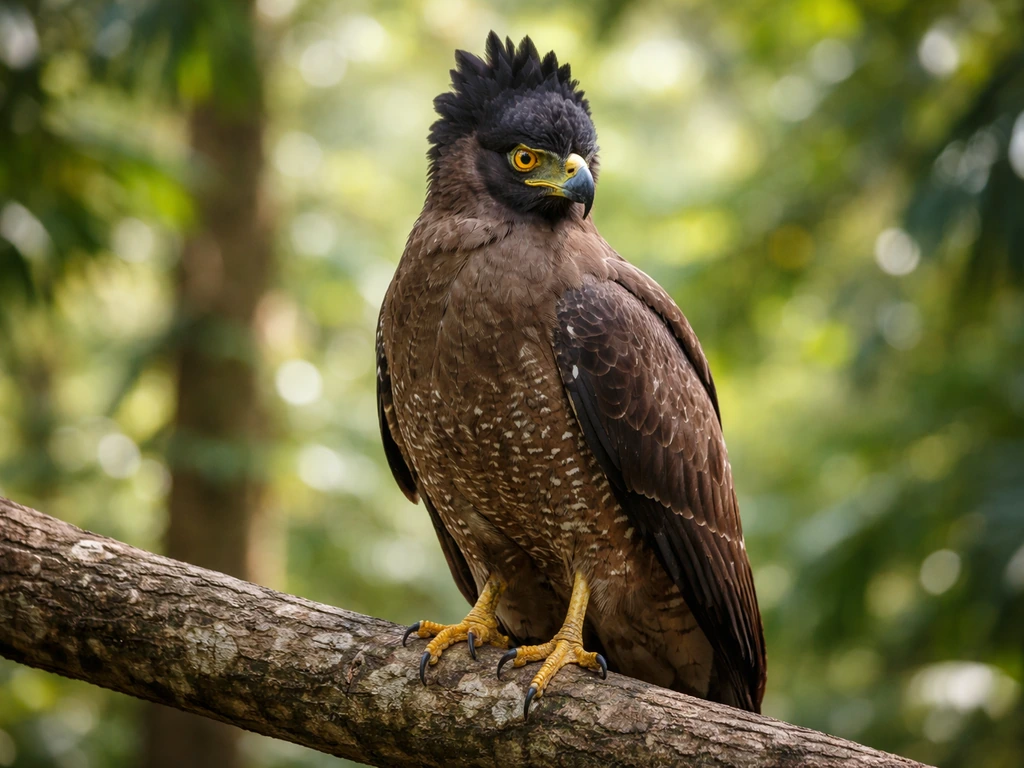
The primary English common name used by major birding authorities, including eBird and Cornell Lab's Birds of the World, is Crested Serpent-Eagle for Spilornis cheela. This is the canonical name you will find on species pages, field checklists, and observation databases across South and Southeast Asia. The name captures two of the bird's most striking features: its bold crest and its specialization in hunting snakes.
The second major English equivalent, tied specifically to Indonesian cultural symbolism, is the Javan Hawk-Eagle (Nisaetus bartelsi). Indonesian sources, including Kompas reporting, use the phrase 'burung garuda atau elang Jawa' (Garuda bird or Javan eagle) to describe this species as the living inspiration for Garuda Pancasila, Indonesia's national emblem. So the 'Garuda bird' in English can land on two different species pages, and knowing your context tells you which one.
| Context | English Name | Scientific Name | Key Identifier |
|---|---|---|---|
| South/Southeast Asian birding | Crested Serpent-Eagle | Spilornis cheela | Large crest, feeds on snakes, ~75 cm |
| Indonesian national symbolism | Javan Hawk-Eagle | Nisaetus bartelsi | Endemic to Java, model for Garuda Pancasila |
| General Hindu/Buddhist mythology | Garuda (mythological bird) | N/A | Divine eagle-like figure, not a real species |
How to confirm which bird 'Garuda' actually refers to in your situation
The fastest way to pin down the right species is to check three things: the geographic region, the source language, and any physical description you have. If someone from Nepal, India, Thailand, or the broader mainland Southeast Asia region is using the term, they are almost certainly pointing to the Crested Serpent-Eagle. If the conversation is specifically about Indonesia, and especially about national symbols, wildlife campaigns, or Javanese biodiversity, the Javan Hawk-Eagle is the more likely match.
Physical description is a reliable shortcut. The Crested Serpent-Eagle is a large raptor, roughly 75 cm in length, with a dramatic fan-shaped crest that spreads wide when the bird is alarmed. Historical natural history writing, including Douglas Dewar's Birds of the Indian Hills, specifically calls out the crest size as the bird's most memorable feature. If the bird being described has a prominent crest and is seen hunting snakes in forested terrain, Spilornis cheela is your match. If the description emphasizes a powerfully built hawk-eagle endemic to Java, Nisaetus bartelsi is the one.
Once you have a likely candidate, cross-check it on eBird or Birds of the World. Both platforms pair the English common name with the scientific name on the same species page, so you can confirm 'Crested Serpent-Eagle = Spilornis cheela' or 'Javan Hawk-Eagle = Nisaetus bartelsi' in seconds. eBird even assigns a species code (crseag1 for the Crested Serpent-Eagle) that makes database searches unambiguous.
Spelling, pronunciation, and variants you will encounter
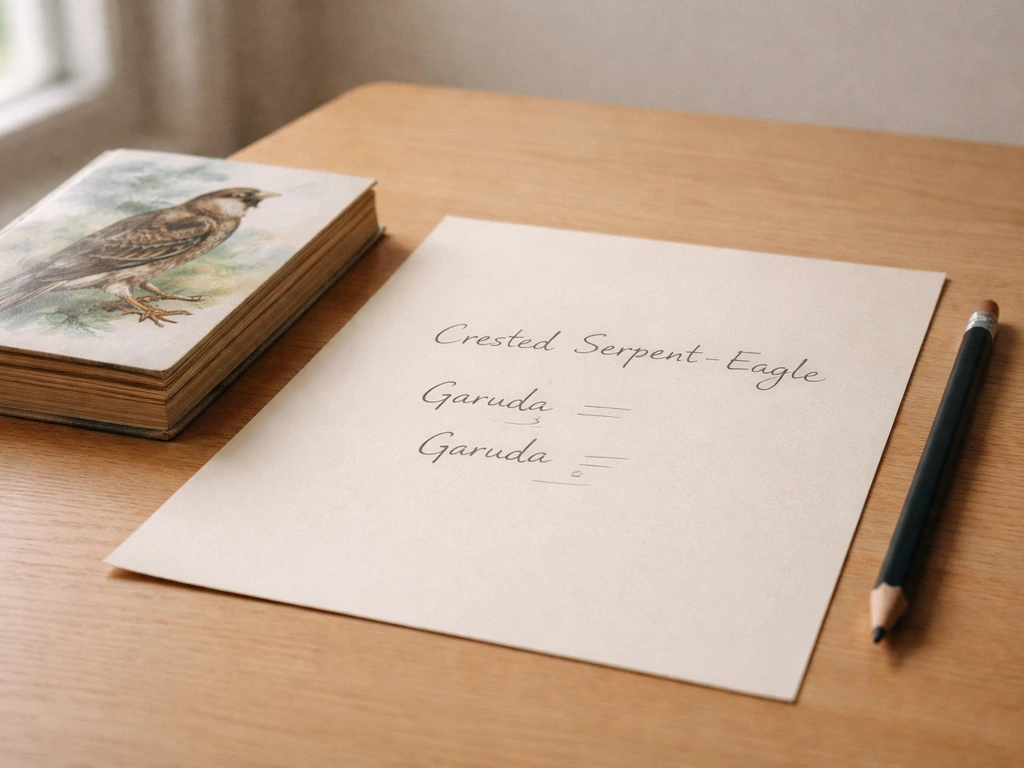
The standard English spelling for the more widely referenced species is Crested Serpent-Eagle, with a hyphen between 'Serpent' and 'Eagle.' eBird uses this hyphenated form as the official common name. In older natural history texts and some informal online sources, you may also see Crested Serpent Eagle without the hyphen, which refers to the same bird. Capitalization varies too: field guides tend to capitalize all words in a bird's common name (Crested Serpent-Eagle), while casual writing often lowercases it (crested serpent-eagle). Both are correct in their respective contexts.
For the word 'Garuda' itself, the standard English pronunciation is roughly gah-ROO-dah, with the stress on the middle syllable. The Sanskrit original is written garuḍa, and Wiktionary gives the IPA for the Sanskrit form as /ɡɐ.ɾu.ɖɐ/. In everyday English speech, the retroflex 'd' sound of Sanskrit gets softened to a regular 'd,' so most English speakers say gah-ROO-dah and are perfectly understood. You may also see the spelling Garuḍa (with a dot under the d) in academic or Sanskrit-focused texts, and Garulo in some older Pali-influenced transliterations.
- Crested Serpent-Eagle (hyphenated) — standard eBird / Birds of the World spelling
- Crested Serpent Eagle (no hyphen) — common in older field guides and informal writing
- crested serpent-eagle (lowercase) — used in running prose and natural history texts
- Garuda / Garuḍa / Garulo — alternate spellings of the Sanskrit/Pali source word
- Elang ular bido — Indonesian name for Spilornis cheela
- Elang Jawa / Burung Garuda — Indonesian terms for the Javan Hawk-Eagle
Where the name 'Garuda' actually comes from
Garuda originates in Hindu and Buddhist tradition as a divine, eagle-like being. In Hindu mythology, Garuda is the vahana (vehicle) of Vishnu, described as a powerful, golden-winged figure with the body of a man and the features of an eagle. The name comes from Sanskrit garuḍa, which scholars and Wiktionary trace through both Sanskrit and Pali (where it appears as garuḷa). If you are also wondering about the chise name meaning bird idea, it helps to trace how garuḍa is used as a word for an eagle-like bird in language histories Sanskrit garuḍa. The Smithsonian describes Garuda as a divine eagle carrying Vishnu, and Wikipedia's overview of the figure confirms it is a mythological bird revered across Hindu and Buddhist cultural spheres.
The reason real birds inherit this name is straightforward: large, crested raptors that soar impressively and hunt with power invite comparison to the mythological Garuda. The Crested Serpent-Eagle, with its bold crest and commanding presence, naturally picked up the Garuda association in South Asian folk naming. In Indonesia, the Javan Hawk-Eagle's regal appearance made it the government's chosen real-world embodiment of the Garuda symbol for the national coat of arms. So 'Garuda bird' is not a formal scientific label at all. It is a folk and cultural descriptor that got attached to different impressive raptors depending on where you are.
How different regions and communities use the Garuda bird label

In India and across the Himalayas into mainland Southeast Asia, 'Garuda bird' or just 'Garuda' in a wildlife conversation almost always means the Crested Serpent-Eagle. Birdwatchers in Nepal, India, and Thailand will recognize the phrase as pointing to Spilornis cheela without much ambiguity. The Thai birding lexicon, for instance, lists Crested Serpent Eagle directly as the English name for this raptor, and the bird is a commonly sighted species in forested hill regions.
In Indonesia, the term carries heavier national symbolism. 'Burung Garuda' is tied directly to Garuda Pancasila, and in wildlife and conservation circles it specifically invokes the Javan Hawk-Eagle (Nisaetus bartelsi). Indonesian reporting uses the phrasing 'burung garuda atau elang Jawa' to make the link explicit: the Garuda bird is the Javan eagle. This matters for anyone working with Indonesian birding lists, conservation documents, or educational materials, because you may need to translate 'burung garuda' as Javan Hawk-Eagle rather than Crested Serpent-Eagle for that context to make sense.
In pet naming, mythology discussions, and crossword clues, 'Garuda bird' might not refer to a specific living species at all. Puzzle setters sometimes use Garuda as a clue for 'eagle' in a general sense, drawing on the Hindu mythology angle. This is worth keeping in mind if you arrived at this question through a word game rather than a wildlife identification moment. Sibling topics on this site, like what the koyal bird is called in English or what the ghar bird is called in English, follow a similar pattern where a non-English vernacular name needs mapping to a precise English species name. If you are asking specifically about the ghar bird, that guide will help you map the vernacular name to the exact English species name the ghar bird is called in English. If you are looking for another vernacular name mapped to English, check that guide as well for the koyal bird what the koyal bird is called in English.
How to land on the right English bird name fast
If you need to verify the English name quickly, here is the most direct path depending on your situation. If you are here to map a non-English vernacular name to an English species name, you can use the same approach as in the guide on what the koyal bird is called in English.
- Identify your geographic or cultural context first. South Asia and mainland Southeast Asia = Crested Serpent-Eagle (Spilornis cheela). Indonesia, especially any national symbol context = Javan Hawk-Eagle (Nisaetus bartelsi). Mythology or crossword puzzle = Garuda as a general mythological eagle figure.
- Search eBird for 'Crested Serpent-Eagle' to reach the Spilornis cheela species page, or 'Javan Hawk-Eagle' for Nisaetus bartelsi. Each page gives you the confirmed English common name, scientific name, range maps, and photos for a visual match.
- If you have a physical description of the bird, use the crest as your key feature. A large fan-shaped crest in a forest raptor strongly suggests the Crested Serpent-Eagle. A powerfully built hawk-eagle on Java without the dramatic spread crest points to the Javan Hawk-Eagle.
- Check Birds of the World (Cornell Lab) if you want the authoritative species account, including the standardized English common name and full taxonomy. This is the reference to cite if nomenclature accuracy matters for your purpose.
- If you only have a local language term, note what language it is in. Indonesian 'elang ular bido' = Spilornis cheela (Crested Serpent-Eagle). Indonesian 'elang Jawa' or 'burung garuda' = Nisaetus bartelsi (Javan Hawk-Eagle). Hindi or Nepali 'Garuda pakshi' will almost always resolve to the Crested Serpent-Eagle.
- When in doubt, report both possibilities: 'The Garuda bird is most likely the Crested Serpent-Eagle (Spilornis cheela) in a South Asian context, or the Javan Hawk-Eagle (Nisaetus bartelsi) in an Indonesian context.' This covers the ambiguity honestly and lets your reader self-select.
FAQ
What English spelling should I use when searching the species, Crested Serpent Eagle or Crested Serpent-Eagle?
If you want the English name used in bird databases, use the hyphenated form “Crested Serpent-Eagle” for Spilornis cheela. Without the hyphen, it is still the same species, but hyphenated spelling is the one you will most reliably match in checklists and search boxes.
If someone says “burung garuda” in Indonesia, which English bird name should I use?
If your source is Indonesian and it says “burung garuda atau elang Jawa,” translate it as “Javan Hawk-Eagle” (Nisaetus bartelsi), not “Crested Serpent-Eagle.” The “burung garuda” phrase is specifically tied to Indonesian symbolism in a way the South Asian usage is not.
What should I do if I see “Garuda bird” in an Indonesia-focused post, but I am not sure it is about the national symbol?
Even within Indonesia, context can change the intended meaning. For wildlife talk and education, “Garuda bird” is often used for the Javan Hawk-Eagle, but for a strict bird-identification task you should rely on range (Java and nearby areas) plus the bird’s built type and crest to avoid confusion with other crested raptors.
How can I tell the Crested Serpent-Eagle and Javan Hawk-Eagle apart from a short description or photo?
If you are looking at a photo, the fastest visual discriminator mentioned in the article is the crest behavior: the Crested Serpent-Eagle shows a dramatic fan-shaped crest when alarmed, while the Javan Hawk-Eagle is the larger hawk-eagle model associated with Java. If the description emphasizes snake-hunting in forested hills plus a prominent crest, it points strongly to Spilornis cheela.
Should I trust “Garuda bird” as a label, or verify it some other way?
If you land on eBird or Birds of the World, do not assume the common name alone. Confirm that the common name on the species page pairs with the scientific name (Spilornis cheela or Nisaetus bartelsi), since “Garuda bird” itself is not a formal scientific label and can be reused loosely.
What if “Garuda bird” shows up in a crossword or mythology discussion, not a birding context?
If you encountered “Garuda” through a crossword or myth reference rather than wildlife, it may be pointing to “eagle” in a general mythology sense, not a specific living raptor. A practical check is to see whether the clue mentions a location or bird-like traits such as crests and hunting behavior, which is what turns it into an identification question.
Does capitalization matter when I write the bird name in English?
“Garuda” is a proper-name word, and the bird name usage varies by writing style. For search and citations, use the standard common name capitalization from bird databases (Crested Serpent-Eagle), but for casual writing, lowercase is usually fine because it still refers to the same species.
Next Article
How to Pronounce Mynah Bird (MY-nah vs my-NAY)
Learn how to pronounce mynah birds word mynah or myna, with syllables, stress, and quick self-check tips.