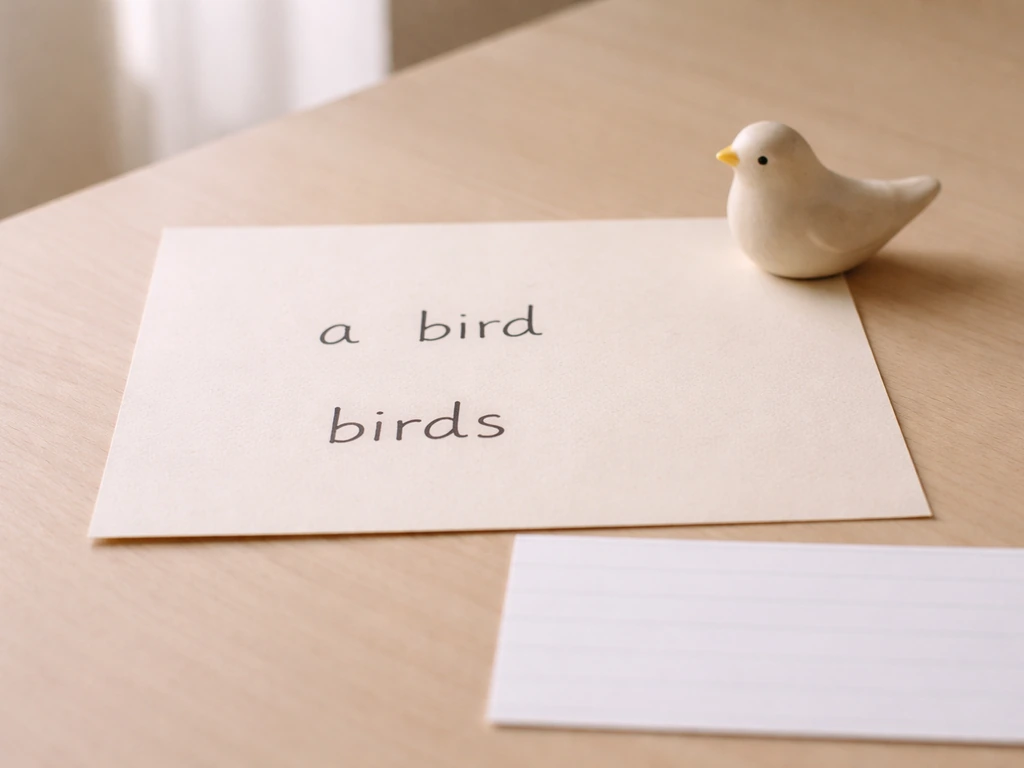
"Bird" is a noun, not a pronoun. The Cambridge English Dictionary classifies [bird as a noun \[C\] (“CREATURE”)](https://dictionary.cambridge.org/us/dictionary/english/bird). Every major dictionary, from Cambridge to Merriam-Webster to Oxford, classifies it as a countable noun (marked [C]), which means it names a thing, takes articles like "a" or "the", and forms a plural ("birds"). Pronouns are a completely different category: words like "it" or "they" that stand in for a noun after you've already named it. "Bird" never does that job.
Bird Is Noun or Pronoun? Clear Rules and Examples

James Ridgley
19 May 2026
Quick verdict: "bird" is a noun, not a pronoun
If you're checking a grammar homework answer or settling a quick dispute, you can stop right here: "bird" is a noun. It refers to a creature, it belongs to a category of words that name things, and it behaves exactly the way nouns behave in English sentences. It is not a pronoun, not a verb, and not an adjective (though it can act as a modifier in compounds, which is a separate thing we'll cover below).
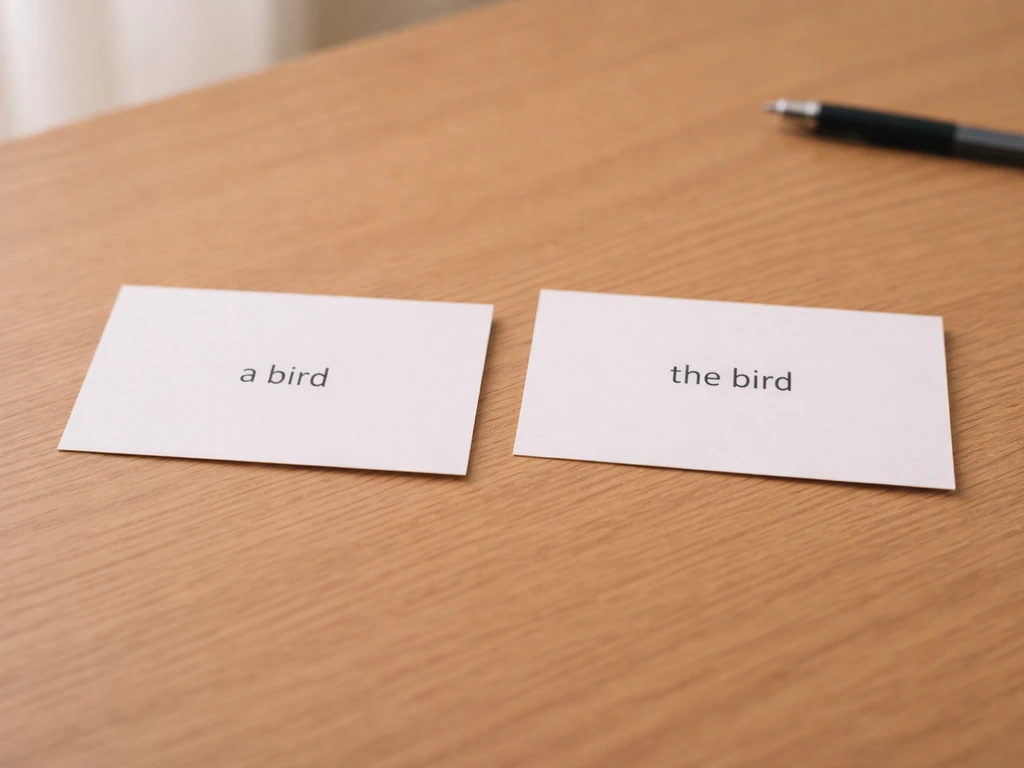
The fastest test: can you put "a" or "the" in front of it? Yes, "a bird" and "the bird" both work perfectly. That article test alone tells you it's a noun. Pronouns ("it", "they", "he", "she") never take articles in front of them. If you still wonder, check the guide on is bird a pronoun for a direct parts-of-speech comparison. You would never say "a they" or "the it".
What kind of noun "bird" is
"Bird" is a common noun, which means it refers to a general category of creature rather than one specific named individual. Proper nouns are capitalized names for specific things (think "Robin" as a pet's name, or "American Robin" as a species name). "Bird" stays lowercase in ordinary use because it's the general word for the whole animal group.
It's also a countable noun, meaning you can have one bird or many birds. Countable nouns take singular and plural forms and work with "a", "an", or "the" in the singular, and with numbers or quantifiers in the plural. Here's how that plays out:
- Singular: "a bird", "the bird", "this bird", "one bird"
- Plural: "birds", "the birds", "three birds", "some birds"
- Collective: "a flock of birds" (where "flock" is the collective noun and "birds" is its plural countable noun)
"Flock" is worth noting because collective nouns for bird groups (flock, murmuration, colony, parliament) often come up in word puzzles and trivia. The noun doing the naming work is still "bird" or "birds" inside that phrase. The collective noun just describes how they're grouped.
How "bird" works in sentences (with real examples)

Nouns fill specific roles in a sentence: subject, object, or complement. "Bird" can fill any of these slots, and spotting which role it's playing is a good way to confirm it's a noun and not anything else.
| Sentence role | Example | What "bird" is doing |
|---|---|---|
| Subject | A bird landed on the fence. | Names the thing doing the action |
| Direct object | She spotted a rare bird. | Names the thing receiving the action |
| Complement | That creature is a bird. | Names what the subject is |
| Object of preposition | He photographed a flock of birds. | Follows a preposition as part of a noun phrase |
In every single one of those examples, "bird" is doing the work of naming a thing. That is what nouns do. Nothing in those sentences could be replaced by "bird" functioning as a stand-in for something already mentioned. That second job, the standing-in job, belongs to pronouns.
How pronouns relate: when "it" and "they" replace "bird"
This is the part that causes the most confusion, and it's worth being precise about it. Pronouns like "it" and "they" can replace "bird" or "birds" in a sentence, but that doesn't make "bird" a pronoun. It makes "bird" the antecedent, which is the noun that a pronoun refers back to.
Here's how pronoun substitution works in practice: you introduce the noun first, then use a pronoun to avoid repeating it. The pronoun does the replacing; the noun does the naming. They are two different words doing two different jobs.
- "A large bird flew overhead. It disappeared into the trees." ("It" replaces "a large bird"; "bird" is the antecedent noun.)
- "Three birds landed on the roof. They stayed there for an hour." ("They" replaces "three birds"; "birds" is still a countable plural noun.)
- "The bird looked injured. The ranger picked it up carefully." ("It" refers back to "the bird"; "bird" named the creature first.)
According to Britannica and Cambridge, pronouns are specifically words that replace a noun or noun phrase. Cambridge defines “they” as a pronoun, including when it refers to people, animals, or things. "It" (third-person singular) and "they" (third-person plural, or singular in informal use) are classic examples. "Bird" is never used this way. You would not say "The robin flew south; bird stayed warm all winter" with "bird" standing in for another noun. That sentence simply doesn't work, which is a clean signal that "bird" is not a pronoun.
Common mistakes and how to check your answer fast
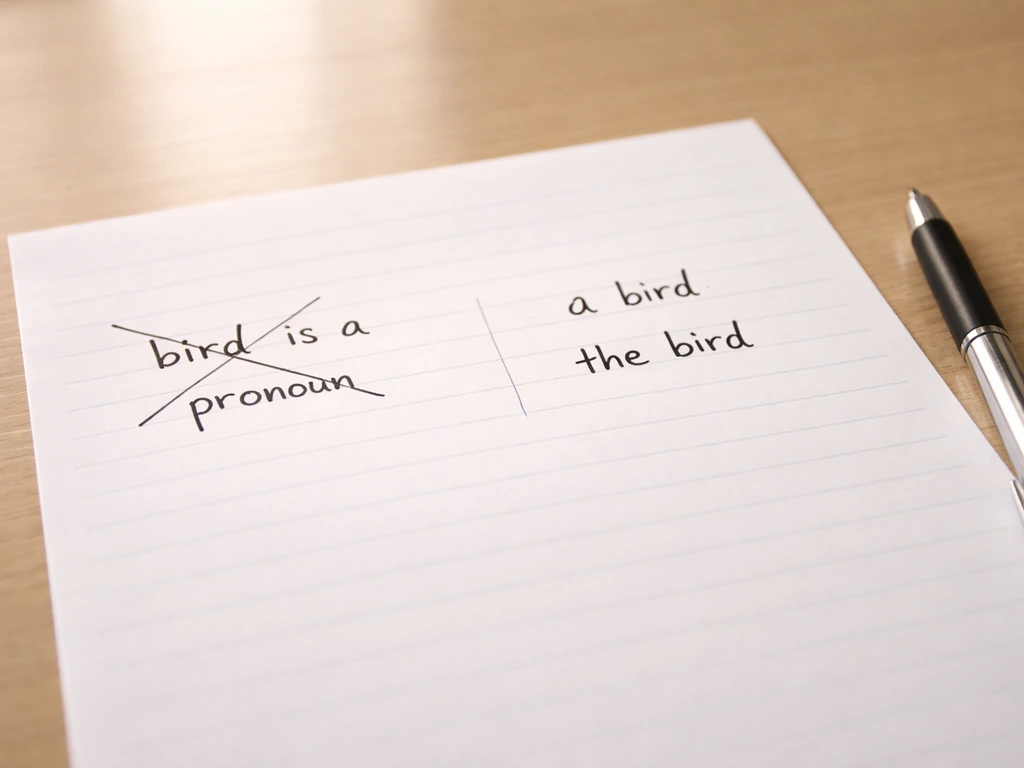
A few mix-ups come up regularly, especially among learners doing parts-of-speech exercises. Here are the most common ones and the quickest way to correct them.
Mistake 1: Thinking "bird" is a pronoun because pronouns can replace it
The logic goes: "I can use 'it' instead of 'bird', so maybe 'bird' is a pronoun too." That's backwards. The fact that a pronoun can replace "bird" tells you "bird" is a noun (the antecedent), not that "bird" is a pronoun itself. Pronouns substitute for nouns; they don't share the noun's classification.
Mistake 2: Thinking "bird" is a verb or adjective
In phrases like "bird watching" or "bird flu", "bird" acts as a modifier (it describes what kind of watching or what kind of flu). But modifying another noun doesn't change "bird" into an adjective or verb. It's still a noun functioning as a noun modifier, which is a common and well-established pattern in English. Compare: "chicken soup", "stone wall", "bird flu". The first word is a noun in each case, just modifying the second noun.
The three-second check
- Put "a" or "the" in front of the word. "A bird" works? Noun confirmed.
- Try to use it as a stand-in for another word already mentioned. "The robin sang; bird flew away" makes no sense, so it's not a pronoun.
- Check if it names a person, place, thing, or idea. "Bird" names a creature. Noun confirmed again.
"Bird" in bird names and naming contexts
On a site focused on bird naming and nomenclature, it's worth seeing how "bird" actually behaves inside names. In ornithology and field guides, "bird" appears in two main ways: as a generic standalone noun and as a component of specific compound names.
Generic use
When someone says "that bird over there" or "a bird of prey", "bird" is functioning as a common noun in its most basic sense: a general category label. Cambridge defines "bird of prey" as a fixed noun phrase, with "bird" as the head noun. It names a type of creature without specifying the species.
"Bird" inside species and compound names
In many common names, "bird" is either the head noun or a modifier. Think of "lyrebird", "catbird", "songbird", or "bird of paradise". In all of these, "bird" is doing noun work. It is not a pronoun substituting for anything; it is the naming word itself, either anchoring the compound or modifying another element. This is consistent with how organizations like the U.S. Fish and Wildlife Service standardize common bird names: the words in those names are nouns (and noun modifiers), never pronouns.
Species names like "American Robin" use a proper adjective ("American") combined with a common noun ("robin"), and when someone refers to "the bird" in that context, the word "bird" steps back to its generic common-noun role. The pronoun "it" or "they" would then replace the full noun phrase in follow-up sentences, but "bird" itself never transforms into a pronoun to do that job.
If you're curious about the finer points of whether "bird" ever masquerades as something else grammatically, the related question of whether it could ever be called a pronoun is worth exploring on its own, and the noun type question (common vs. proper, collective, etc.) goes even deeper than what fits here.
Spelling, pronunciation, and related word notes
For word-puzzle fans, crossword solvers, and anyone double-checking spelling: "bird" is spelled B-I-R-D. The UK pronunciation is /bɜːd/ (sounds like "berd" with a long, open vowel, no distinct "r" sound in standard British English). In American English it rhymes with "heard" and "word", with a clear rhotic "r" sound.
A few homophones and near-homophones are worth knowing. "Burd" (an archaic or dialect word) and "burred" (past tense of "burr") are listed as homophones of "bird" in some references. None of these change the part of speech of "bird" itself. Whether you're reading it, writing it, or hearing it, it's still a noun. Starting with bird homophones meaning, remember that these look-alike words do not change the part of speech of “bird”.
If you're exploring related grammar territory, the adjective form of bird-related words ("avian", "ornithological") and the question of what adjective "bird" produces are covered separately. So, the adjective of bird-related language is typically "avian" (as in "avian species"). And for anyone interested in homophones specifically in the context of bird language, that's a niche but genuinely interesting corner of bird nomenclature worth its own look.
FAQ
If I use “it” after “bird,” does that make “bird” a pronoun?
No. In “The bird is here,” “bird” is the subject noun. In “The bird, it is here,” “it” is the pronoun doing the substitute job, and “bird” remains the noun. The presence of a pronoun nearby does not change the part of speech of “bird.”
In phrases like “that bird over there,” is “bird” still a noun?
In “The bird over there is loud,” “bird” is still a noun, even though “there” and “over” help locate it. Only the replacement word like “it” or “that one” would be a pronoun, not the noun “bird.”
What if “bird” appears next to a proper noun like “American Robin”?
“Bird” can stay a common noun even when it follows a proper name. For example, “Robins are a type of bird” treats “bird” generically, lowercase and not as a name. Proper nouns are the specific capitalized names, like “American Robin,” not the generic category word.
Is “bird” an adjective in “bird flu” or “bird watching”?
“Bird” can be modified by other words like an adjective without becoming one. In “bird flu,” “bird” labels a type of flu (noun used as a modifier). You would not call it an adjective because it does not take the adjective behavior like comparison (for example, “more bird flu” does not work).
Does “bird” stay a noun in subject, object, and complement positions?
Yes. You can use “bird” in many sentence roles: “Birds sing” (subject), “I saw a bird” (object), “The prize was the bird” (complement). Because it can be slotted into typical noun positions, it is a noun in each case.
Is “bird” ever treated as uncountable, like “furniture”?
No. “Bird” has a plural form “birds,” but it is not a plural-only word. “Bird” refers to countable individuals, so “One bird” and “Many birds” both fit standard usage.
In “a flock of birds,” what role does “birds” play, and is “bird” still a noun?
The noun head inside a collective phrase is still “bird(s).” For example, “A flock of birds is migrating” uses “flock” as the group label, but “birds” is the actual noun referring to the creatures. That means you can test agreement by the whole noun phrase, not by converting “bird” into something else.
How do I handle antecedents on parts-of-speech questions?
If your worksheet asks whether “bird” is noun or pronoun, the correct choice is noun. The test becomes tricky only when students confuse pronoun reference with pronoun identity. “Bird” is the antecedent, meaning it is what a pronoun refers back to.
Next Article
Starting with Bird Homophones Meaning: Solve the Puzzle
Find bird word homophones, match sounds to spellings, and learn each meaning to solve the phrase puzzle.