Quick answer: "bird" as a noun, verb, or adjective
Yes, "bird" is a noun. That's its primary, default job in English, and if you're writing a sentence and wondering whether you've used it correctly, the noun reading is almost certainly the right one. Cambridge, Merriam-Webster, and Collins all lead with the noun entry: a creature with feathers, wings, and (usually) the ability to fly. But here's the fuller picture. Merriam-Webster also includes a separate intransitive verb entry for "bird," and "bird" can appear in front of other nouns in a modifier role. So depending on the sentence, "bird" could technically be wearing three different grammar hats. The sections below break down each case so you can identify exactly what's happening in your sentence.
| Part of speech | Example | How common? |
|---|
| Noun | A bird landed on the feeder. | Very common — the default use |
| Verb (intransitive) | We birded along the coast all morning. | Uncommon — informal/hobby context |
| Noun modifier (adjective-like) | She bought a bird feeder. | Common — but it's still a noun, not a true adjective |
How "bird" works in real English sentences
As a noun, "bird" behaves exactly the way you'd expect a countable noun to behave. You can make it plural (birds), put an article in front of it (a bird, the bird), and slot it into subject or object position without any fuss. Collins also points out that "bird" carries a second noun sense meaning "a person," always with a qualifying adjective in front of it: think "rare bird" or "odd bird" to describe someone unusual. That sense is alive and well in everyday speech even if it doesn't appear in field guides.
- Subject position: "The bird perched on the highest branch."
- Object position: "We spotted a bird through the binoculars."
- With a qualifier (person sense): "She's a rare bird in this industry."
- Plural: "Hundreds of birds flew south last October."
- Possessive: "The bird's call echoed across the marsh."
Notice that every one of those examples passes the basic noun test: you can swap "bird" for another noun ("creature," "animal," "person") and the sentence still makes grammatical sense. That substitution trick is one of the fastest grammar checks you'll use, and we'll revisit it in the testing section below.
If you mean "bird" as a verb

Merriam-Webster does list "bird" as an intransitive verb, and its usage-label system matters here: the verb sense is informal and tied almost entirely to the birdwatching hobby. To "bird" means to observe and identify wild birds as a leisure activity, the same activity more formally called birdwatching or birding. You'll hear it most often among serious hobbyists: "We birded the river delta for three hours" or "She's been birding since she was twelve." Wikipedia notes that "birding" and "birdwatching" are used interchangeably by many enthusiasts, which explains why the verb form "to bird" feels natural to that crowd but can sound odd to everyone else.
A few practical rules for using "bird" as a verb correctly: it's almost always intransitive, meaning it doesn't take a direct object. Collins defines “bird-watching” and also labels “birdwatch” as an intransitive verb Collins labels “birdwatch” as an intransitive verb.
Merriam-Webster uses its functional labels approach to explain how it structures entry information, including distinctions that affect transitive versus intransitive usage usage-label system. You bird a location or bird with a friend, but you don't "bird" a species the way you'd "spot" one.
Stick to past tense ("we birded"), present participle ("she's been birding"), or simple present ("they bird every weekend") and it reads naturally in that hobby context. Outside that context, most readers will find it unusual, so if you're writing for a general audience, "birdwatch" or "go birdwatching" is the safer choice.
If you mean "bird" as an adjective
This is where a lot of people get tripped up. "Bird" appears in front of nouns all the time: bird feeder, bird bath, bird call, bird song. It looks like an adjective doing a modifying job, but in standard English grammar it's actually a noun modifier, which is a different animal (so to speak). Cambridge's grammar guidance is clear on this: English very commonly builds compound nouns using a noun-plus-noun pattern, where the first noun restricts or describes the second. In "bird feeder," both words are nouns. "Bird" isn't describing a quality of the feeder the way "red" or "large" would; it's telling you what the feeder is for.
The practical test: can you put "very" in front of it? You can say "a very large feeder" but not "a very bird feeder." That "very" test instantly rules out true adjective status. So if someone asks you to label the parts of speech in "bird feeder," the correct answer is noun (bird) plus noun (feeder), not adjective plus noun. The exception would be if you invented a sentence like "Her personality is quite bird" to mean something bird-like, which would be creative but non-standard and would raise eyebrows in most contexts.
Grammar checks to identify the part of speech
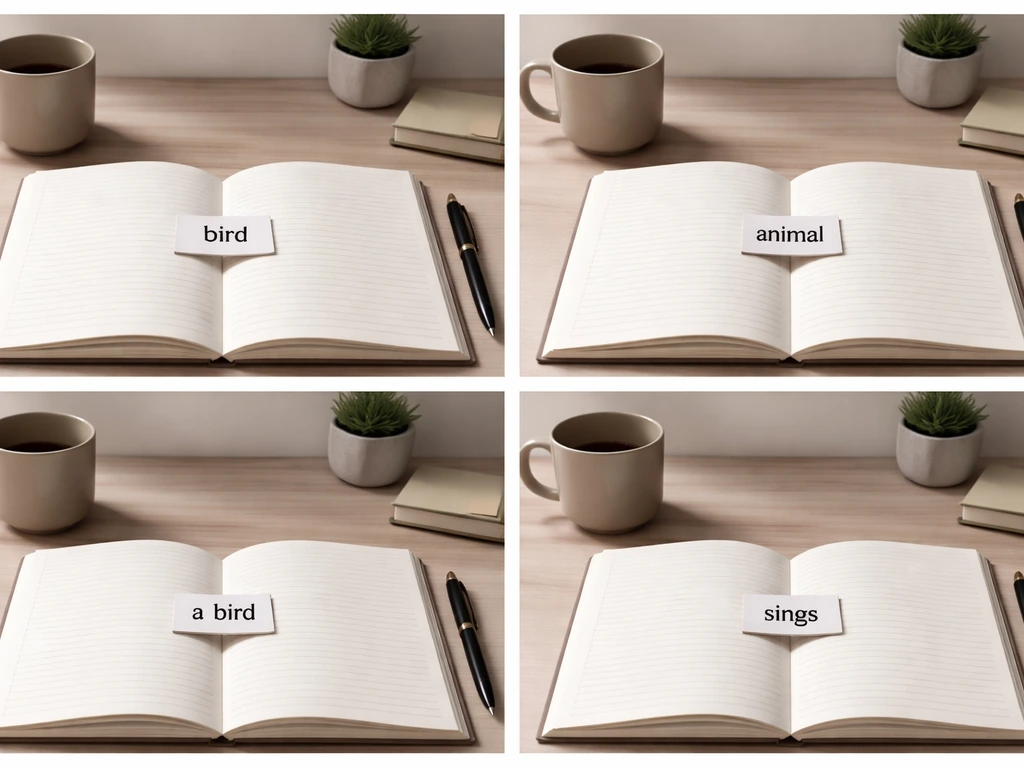
Here are four fast tests you can run on any sentence to figure out what role "bird" is playing.
- Substitution test: Replace "bird" with a clear noun like "animal" or "creature." If the sentence still makes sense grammatically, "bird" is functioning as a noun.
- Article test: Can you put "a" or "the" directly before "bird" in that position? If yes, it's a noun. ("A bird flew past" works; "a bird feeder" has the article before the whole compound, not just "bird.")
- "Very" test: Put "very" in front of "bird." If it sounds wrong ("very bird feeder"), it's not a true adjective. True adjectives accept "very" in front of them.
- Conjugation test: Can you change the tense? If "bird" can become "birded" or "birding" and still make sense in context, it may be functioning as a verb. "We birded the wetlands" is a legitimate (if informal) sentence.
Run all four tests on your sentence and the answer almost always becomes obvious. If "bird" passes the substitution and article tests, it's a noun. If it's stuck in front of another noun without an article of its own, it's a noun modifier (still a noun, just modifying). If you can conjugate it and you're in a birdwatching context, it's a verb.
"Bird" and words built from it
While we're talking about how "bird" behaves, it's worth knowing that English has a whole cluster of bird-related word forms built on different roots. If you're interested in words with ornith meaning bird, you'll find a parallel vocabulary set rooted in Greek: ornithology, ornithologist, ornithological. Those are all clearly nouns or adjectives built from a root, whereas plain "bird" in English is a standalone Anglo-Saxon word that shifts roles more subtly. Knowing both vocabulary streams helps if you're doing crossword puzzles or word-building exercises.
It's also worth noting that "bird" sounds identical to no other common English word, which keeps it simple on the homophone front. That said, if you've run into tricky bird homophones meaning questions in a word puzzle context, those situations usually involve specific bird names (like "tern" sounding like "turn," or "heron" near "heroin" in some accents) rather than the base word "bird" itself.
Spelling, pronunciation, and capitalization in bird-naming contexts
The generic word "bird" is spelled b-i-r-d, pronounced with a stressed vowel that rhymes with "heard" and "word" (IPA: /bɜːrd/ in American English). There's no capitalization in standard use because it's a common noun, not a proper name. But capitalization becomes important the moment you move from the generic word to an official species name.
The International Ornithologists' Union (IOC) recommends capitalizing official English names of bird species. So it's "a bird" (generic, lowercase) versus "a Yellow-throated Warbler" (species name, capitalized). The American Ornithological Society follows the same logic: capitalization helps readers immediately see whether you're pointing to one specific species or using a descriptive phrase. Getting this wrong can introduce genuine ambiguity in field guides and checklists, especially with names that include common adjectives like "gray" or "solitary."
If you're working with scientific names alongside common ones, the rules shift again. Under both Chicago and MLA style conventions, Latin binomial names are italicized, with the genus capitalized and the species epithet in lowercase: for example, the House Sparrow is <em>Passer domesticus</em>. The IUCN's style guidance follows the same principle in running text. These rules don't affect how "bird" itself is spelled or capitalized, but they matter enormously if you're writing a bird species entry and "bird" appears as part of a compound name or description next to a Latin term.
Hyphenation in compound bird names
IOC hyphenation rules for English bird names are specific: hyphens appear in compound names only under certain conditions, such as when both parts of the name are themselves bird group names (like "Oystercatcher" is one word, but "Pigeon-Hawk" gets a hyphen because both parts are bird names). The word "bird" alone doesn't trigger hyphenation rules unless it's part of a formal species name. In everyday prose, "bird feeder," "bird bath," and "bird call" are typically written as two words or closed up as one (birdfeeder, birdbath) depending on the style guide and how established the compound is.
Bonus: when "bird" plays with meaning in creative ways
If you've seen "bird" used in a punny or figurative way, you might enjoy knowing that it occasionally shows up in informal vocabulary as a synonym for something else entirely. For example, there's a classic usage in British English where "bird" means a person, and in slang it can signal various other meanings depending on region. On the more playful linguistic side, if you're curious about a bird that is a synonym for nuts, that's a fun example of how bird names double as everyday English words with completely unrelated meanings. It's a good reminder that "bird" and its relatives live in a rich corner of English where grammar, vocabulary, and wordplay overlap.
Similarly, if you're working through a puzzle that asks what is a bird homophone, the answer typically points to specific bird names rather than the word "bird" itself. Knowing that "bird" is a noun (and occasionally a verb) helps you narrow down what part of speech a puzzle clue is targeting.
What to do next: nail the part of speech in your sentence
If you just need a quick answer for a homework question or grammar exercise, here it is: "bird" is a noun. Write that down with confidence. If you're dealing with a sentence where "bird" sits right before another noun (like "bird song" or "bird call"), it's still a noun functioning as a modifier, not an adjective. If you're writing in a birdwatching context and want to use "bird" as a verb, that's legitimate but informal, and you'll want to stick to intransitive constructions.
For anyone working on a specific bird name, a pet name, or a crossword clue, pay attention to capitalization. A capital B in a bird name signals a proper species name with specific meaning. A lowercase "bird" is the generic English noun that's been naming feathered creatures since at least the 10th century. The word is simple, the grammar is mostly straightforward, and the four quick tests above will resolve any edge case you throw at them.