If you're staring at a crossword clue that says 'common marsh bird,' the answer is almost certainly SORA (4 letters), RAIL (4 letters), EGRET (5 letters), or BITTERN (7 letters), depending on how many squares you have to fill. SORA is the single most common answer in major puzzle databases, especially for 4-letter grids, but the right pick depends entirely on your letter count and any crossing letters you already have. Here's how to nail it quickly.
Common Marsh Bird Crossword Clue Answers and How to Verify

James Ridgley
21 Apr 2026
What 'common marsh bird' usually points to in crossword puzzles
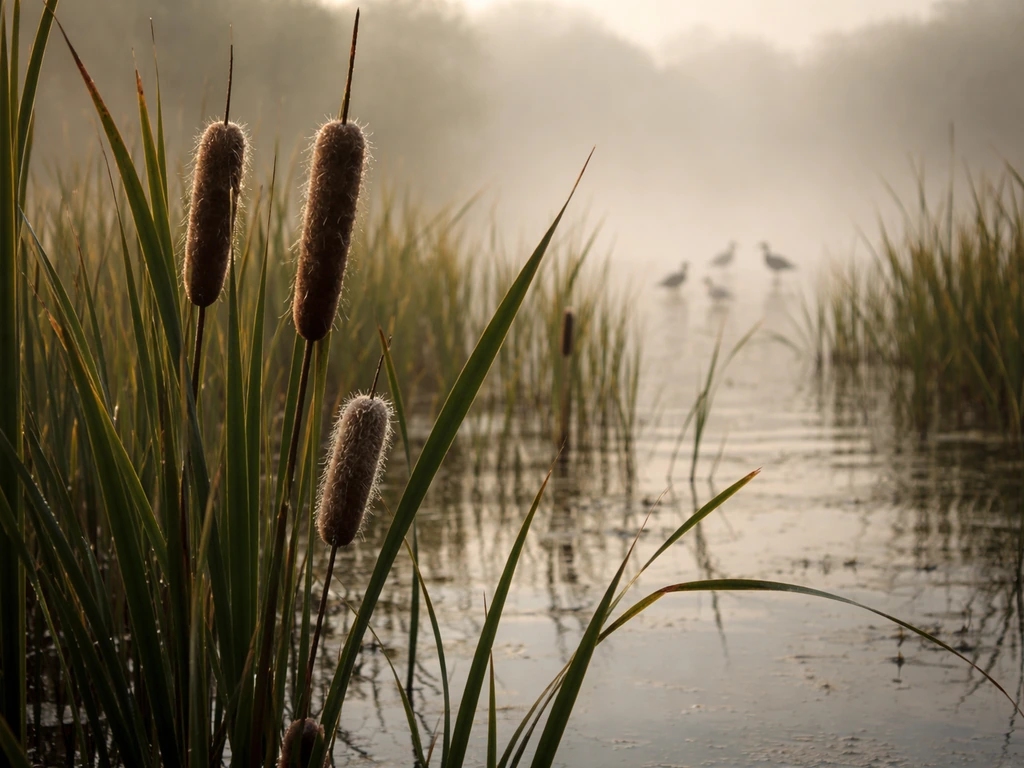
Crossword compilers use 'marsh bird' as a broad habitat clue that can legally point to any wading or wetland bird. In practice, though, puzzle setters gravitate toward a short list of names that fit neatly into grids and that crossword databases have validated over decades of use. The word 'common' in the clue is almost always filler (it just signals a well-known species) rather than a reference to a bird with 'Common' in its official name. So you're not hunting for an obscure specialist species; you're looking for a recognizable wetland bird whose English name happens to be short, clean, and vowel-friendly.
The reason marsh birds dominate crossword fill is partly structural. Words like SORA, IBIS, RAIL, and EGRET are packed with common letters, alternate vowels and consonants nicely, and have appeared in enough published puzzles that they're considered 'crossword-safe' entries. SORA in particular shows up in the New York Times crossword with striking regularity, including documented solutions going back at least to 2018. If you solve puzzles often enough, you'll start to recognize SORA the way you recognize OREO or ERIE, not because you know the bird, but because the puzzle trained you.
Most likely answers and how to confirm them
The confirmed, widely accepted answers for 'common marsh bird' crossword clues span four to seven letters. Here are the main candidates, along with the key facts you need to confirm each one at the grid.
| Answer | Letters | Key confirmation check | Notes |
|---|---|---|---|
| SORA | 4 | S-O-R-A; no alternate spellings | Top answer in NYT and major databases; small, secretive rail |
| RAIL | 4 | R-A-I-L; also a type of fence, watch for wordplay | Generic family name; often used when setter wants ambiguity |
| IBIS | 4 | I-B-I-S; confirm crossing letter 2 is B | Wading bird; also appears in urban/Egyptian mythology clues |
| EGRET | 5 | E-G-R-E-T; two E's, one G | White wading bird; sometimes clued as 'snowy marsh bird' |
| SNIPE | 5 | S-N-I-P-E; ends in E | Also a verb meaning to shoot from cover; watch for double meaning |
| STILT | 5 | S-T-I-L-T; also a noun for long poles | Long-legged wading bird; less common in American puzzles |
| BITTERN | 7 | B-I-T-T-E-R-N; double T | Streaky brown heron relative; used for 7-letter grids |
The fastest confirmation method is your letter count first, then your crossing letters. If you have four squares and the third letter is confirmed as R, your answer is SORA. If the second letter is confirmed as B, it's IBIS. Five squares with a confirmed final E narrows it to SNIPE or EGRET, and if the second letter is G, it's EGRET. Seven squares almost always means BITTERN.
Crossword solver tactics: pattern matching, wordplay checks, and exclusions
Pattern matching is your primary tool. Before you guess blindly, fill in every crossing answer you can and note which positions in the marsh-bird answer are already locked in. Even one confirmed letter usually eliminates two or three candidates from the shortlist above.
Watch for wordplay signals in the clue wording. If the clue reads 'Common marsh bird, perhaps' or 'Marsh bird of a sort,' the setter might be gesturing at a genus or family name like RAIL rather than a specific species. If the clue has a question mark at the end ('Marsh bird?'), there may be a pun or secondary meaning in play. SNIPE doubles as the act of long-distance shooting, RAIL can mean a fence component or a verb meaning to complain, and STILT is a prop or a children's circus toy. A question mark in the clue is your cue to consider those double meanings.
On exclusions: if you're working a British cryptic crossword, the answer pool shifts slightly. British setters are more likely to use BITTERN, HERON, or COOT (4 letters) because those birds are culturally familiar in the UK. SORA is a North American bird and appears far less often in British-style puzzles. COOT is worth adding to your shortlist specifically for British crosswords with a 4-letter slot.
- Always count your squares before guessing, not after
- Lock in crossing letters first, then narrow the candidate list
- Check for question marks or hedging words ('perhaps,' 'of a sort') that signal wordplay
- For British crosswords, add COOT and HERON to your shortlist
- For American crosswords (NYT, USA Today, LA Times), SORA is the default 4-letter answer
Bird ID basics for marsh habitats

You don't need to be a birder to use these clues correctly, but a quick sense of what each candidate looks like helps you remember the names. Marsh birds cluster into a few visual types, and knowing which is which prevents you from second-guessing yourself.
The rail family (SORA, RAIL)
Rails are small-to-medium secretive birds that skulk through cattails and reeds. The sora is one of the most common rails in North America, about the size of a large sparrow, with a stubby yellow bill and a gray-brown streaked body. The sora (also called the blank" rel="noopener noreferrer">sora rail or Carolina crake) is a small marsh-dwelling bird in the rail family Rallidae (genus Porzana). You'll hear a sora's descending whinny long before you see one. The word 'RAIL' in crossword context usually refers to the entire Rallidae family, which includes coots, gallinules, and crakes as well as soras.
Wading birds (EGRET, IBIS, BITTERN, STILT)
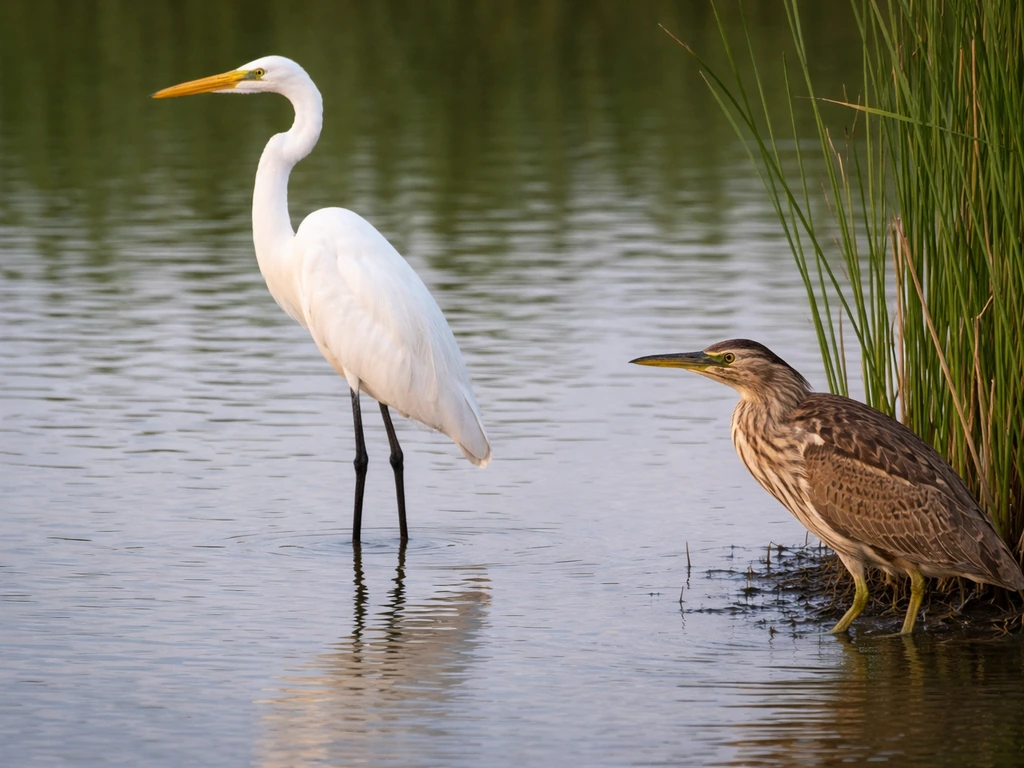
Egrets are tall, white, long-necked wading birds with black legs and yellow bills (Great Egret) or yellow legs (Snowy Egret). They stand motionless in shallow water hunting fish. The ibis is a curved-bill wading bird, either all-white (Snowy Ibis) or glossy dark (Glossy Ibis), common in coastal marshes and the American South. The bittern is a stocky, streaky brown bird related to herons that freezes with its bill pointed skyward to camouflage against reeds, which is a classic ID trick. Black-necked Stilts are unmistakable: long pink legs, black-and-white bodies, and they're extremely vocal.
Look-alikes to avoid
The most common false match in puzzle solving is confusing HERON (5 letters) with EGRET. Both are tall wading birds, and some crossword clues use them interchangeably, but they're technically distinct birds. If your clue says 'great marsh bird,' HERON becomes a strong 5-letter candidate alongside EGRET. Similarly, CRANE (5 letters) is a large marsh and grassland bird that occasionally appears as a crossword answer. It's worth knowing that 'snipe' is a real marsh bird (not just the fictional prey in a snipe hunt), so SNIPE as a crossword answer is ornithologically accurate.
Pronunciation, alternative common names, and regional naming differences
Spelling in a crossword is rigid, but it helps to know the pronunciation and alternate names so you can recognize the bird if the clue uses a synonym or a regional variation.
| Bird | Standard spelling | Pronunciation | Alternative / regional names |
|---|---|---|---|
| Sora | SORA | SOR-uh (rhymes with 'flora') | Sora rail, Carolina crake, ortolan (historical, inaccurate) |
| Rail | RAIL | RAYL (one syllable) | Water rail (UK), marsh hen (informal American) |
| Ibis | IBIS | EYE-bis | Sacred ibis (Old World), white ibis (American), curlew (folk name, inaccurate) |
| Egret | EGRET | EE-grit or EH-grit | White heron (common folk name), plume bird (historical) |
| Bittern | BITTERN | BIT-urn | Stake driver, thunder pumper (from its booming call), bog bull |
| Snipe | SNIPE | SNYPE (one syllable) | Common snipe, Wilson's snipe (North American species) |
| Stilt | STILT | STILT | Black-necked stilt, lawyer bird (regional American folk name) |
The regional naming differences matter most for EGRET and BITTERN. In older British English, egrets were routinely called 'white herons,' and crossword clues in British publications may use that phrasing to point toward EGRET. The bittern has an exceptionally colorful set of folk names, all derived from its booming foghorn-like call: 'stake driver,' 'thunder pumper,' and 'bog bull' are all documented American folk names. If a clue references the call or a 'booming marsh bird,' BITTERN is your target.
Why these birds have these names: etymology notes
SORA is believed to be derived from a Native American word, though the exact origin language is debated among ornithologists. It entered English through early American naturalist literature in the 18th century and has been the bird's standard common name ever since. The name has no descriptive meaning in English, which is partly why it's so crossword-friendly: it's just four clean letters with no room for variant spellings.
EGRET comes from the Old French aigrette, meaning a small heron or a plume, which itself traces back to Old High German heigir (heron). The 'aigret' or 'aigrette' was the name given to the long ornamental breeding plumes that egrets grow in spring, and those plumes were so commercially valuable in the 19th century millinery trade that egrets were hunted to near-extinction in North America. The Audubon Society was founded largely in response to that slaughter, so the word EGRET carries real conservation history.
BITTERN traces to Old French butor and before that to a Latin-influenced form combining butio (a type of heron) with the suffix suggesting a taurus or bull, a nod to the male's deep, resonant booming call. RAIL comes from Old French rasle or raale, thought to be imitative of the bird's grating, rasping call. IBIS is a direct borrowing from Latin ibis, which came from Greek ibis, which was borrowed from ancient Egyptian. It was one of the few Egyptian words to survive into modern scientific and common usage essentially unchanged.
Quick cheat sheet: answers by grid length and clue variation

Use this as your first-stop reference the next time a marsh bird clue shows up. Start with your letter count, then check the clue wording for any modifiers that narrow it further.
| Grid length | Best answer | Runner-up | Use this if... |
|---|---|---|---|
| 4 letters | SORA | RAIL or IBIS | SORA for American puzzles; RAIL if clue says 'marsh bird family'; IBIS if second letter is B |
| 4 letters (British) | COOT | RAIL | Clue is from a UK publication or cryptic format |
| 5 letters | EGRET | SNIPE or HERON | EGRET if clue mentions white or wading; SNIPE if wordplay is hinted; HERON if clue says 'great' |
| 5 letters | STILT | CRANE | STILT if long legs are mentioned; CRANE if clue references grassland/wetland overlap |
| 6 letters | HERON | GODWIT | HERON fits most 6-letter marsh clues; GODWIT for shorebird-specific clues |
| 7 letters | BITTERN | PELICAN | BITTERN is the dominant 7-letter marsh bird in crossword databases |
| 8+ letters | SANDPIPER | FLAMINGO | SANDPIPER for shorebird clues; FLAMINGO if the clue has a tropical or pink angle |
A few clue variations worth bookmarking: 'Secretive marsh bird' almost always means SORA or BITTERN (both are famously reclusive). 'Booming marsh bird' or 'marsh bird known for its call' points to BITTERN. 'White marsh bird' or 'plumed marsh bird' means EGRET. 'Sacred marsh bird' can mean IBIS (the sacred ibis was revered in ancient Egypt). 'Marsh bird with long legs' usually means STILT or EGRET. And if you see 'marsh bird, informally' with a question mark, consider SNIPE, which doubles as slang and internet culture terminology.
If you enjoy solving bird-themed crossword clues more broadly, the same pattern-matching logic applies to clues like 'common bird of prey,' 'common urban bird,' or 'common black bird,' where a short list of crossword-safe species names does most of the heavy lifting. For a clue like common black bird, use the same shortlist method to narrow down to crossword-safe species names.
If your clue is that exact phrase, you can usually solve it by the same shortlist method used for marsh-bird clues common bird of prey. The marsh bird category is actually one of the more predictable ones because the habitat is specific enough to cut the candidate pool down fast. Master this shortlist and you'll rarely be stumped by a wetland clue again.
FAQ
If the clue is “common marsh bird” but I have no crossing letters yet, what’s the best first guess?
Start with SORA when the entry length is 4. If the length is not 4, use the shortest match that fits the square count from the main list (RAIL for 4, EGRET for 5, BITTERN for 7). Once you get even one crossing letter, switch to the shortlist rule instead of committing early.
Can “common marsh bird” ever mean a bird whose name starts with “common,” like “Common ____” (for example, Common Teal)?
Usually no. In these crossword constructions, “common” is filler meaning “well-known,” not part of an official species name. So the answer is picked from crossword-safe marsh birds, not from “Common ___” bird species names.
What should I do if the grid forces a plural form, like “rails” or “egrets”?
Most “marsh bird” clues are singular in crossword entries. If the slot is clearly plural, treat it as a red flag and check whether the plural form is allowed by crossings, then reassess against other candidates with that same length and ending pattern.
How do I handle a clue that includes a habitat modifier like “coastal marsh” or “freshwater marsh”?
Use the modifier to rank candidates, not to expand the list. For coastal marsh language, EGRET and IBIS typically become more likely than very reed-skulking birds. For freshwater marsh language, SORA and BITTERN can move up because they align better with reedbed settings.
If I suspect the answer is EGRET, how do I avoid the HERON trap when the clue includes “great”?
Treat “great” as a pointer to the specific word used by the setter. When “great” appears, both HERON and EGRET become plausible at 5 letters, but a confirmed crossing letter early will decide. If you can lock the final two letters, EGRET usually becomes distinguishable immediately.
What if the answer length doesn’t match the main shortlist, for example 6 letters?
Don’t force the shortlist. Re-check the exact number of squares, and scan for less common marsh birds that crossword compilers still reuse at that length. The article’s four to seven letter candidates are common, but not exhaustive for every grid.
Can “marsh bird” clues point to a different kind of wetland bird than the ones listed?
Yes, because “marsh” is a broad habitat label and setters sometimes stretch to adjacent wetland birds. If crossings strongly contradict the standard candidates, use crossings to identify the final word first, then verify whether it is a wetland bird even if it was not in the usual marsh-bird shortlist.
What’s the quickest way to use the clue punctuation, like a question mark at the end?
When you see a question mark, treat it as a prompt for double meaning or pun-based entries. That means your answer might be a word that also has another definition (like a verb or object), so test the candidate against both the letter pattern and the thematic fit.
I’m in a British-style cryptic. How should “common marsh bird” differ from American style?
Expect the candidate pool to shift toward UK-familiar wetland birds, and COOT becomes worth adding for 4-letter grids. Also be more open to HERON and BITTERN showing up more often in British publications than SORA, which is comparatively less common there.
How can I tell whether “secretive marsh bird” is meant to be SORA or BITTERN?
Both are reclusive, but BITTERN is more strongly tied to acoustic themes in crosswords. If the clue wording hints at being heard, “booming,” or call-related, choose BITTERN. If it’s only about stealth or hiding in reeds with no call reference, SORA is the cleaner default.
If the clue says “plumed marsh bird” or references ornaments, what should I look for?
That phrasing usually targets EGRET, because the crossword shorthand for “plumes” aligns with egret breeding plumes. Still, verify with crossings, since “white heron” clues in older British usage can be an EGRET signal too, not a HERON answer.
Are there common crossword spelling variants I should worry about for these marsh-bird answers?
Generally, these answers have stable spellings in major crossword databases. The real risk is choosing the wrong bird with a similar habitat, not misspelling. Use letter count plus one confirmed crossing letter first, then confirm the exact word against the grid pattern.
Next Article
How to Pronounce Mynah Bird (MY-nah vs my-NAY)
Learn how to pronounce mynah birds word mynah or myna, with syllables, stress, and quick self-check tips.