
"Bird plus letter" does not have a single fixed meaning. What that letter actually stands for depends entirely on where you saw it: a field checklist, a banding report, a breeding atlas, a school worksheet, or a word puzzle. That ambiguity is the whole problem, and once you know which system you're looking at, the letter clicks into place immediately. This guide walks you through every common context so you can decode it fast.
What Does Bird Plus Letter Mean? How to Decode It

James Ridgley
20 Apr 2026
What "bird + letter" usually refers to (and why it's confusing)

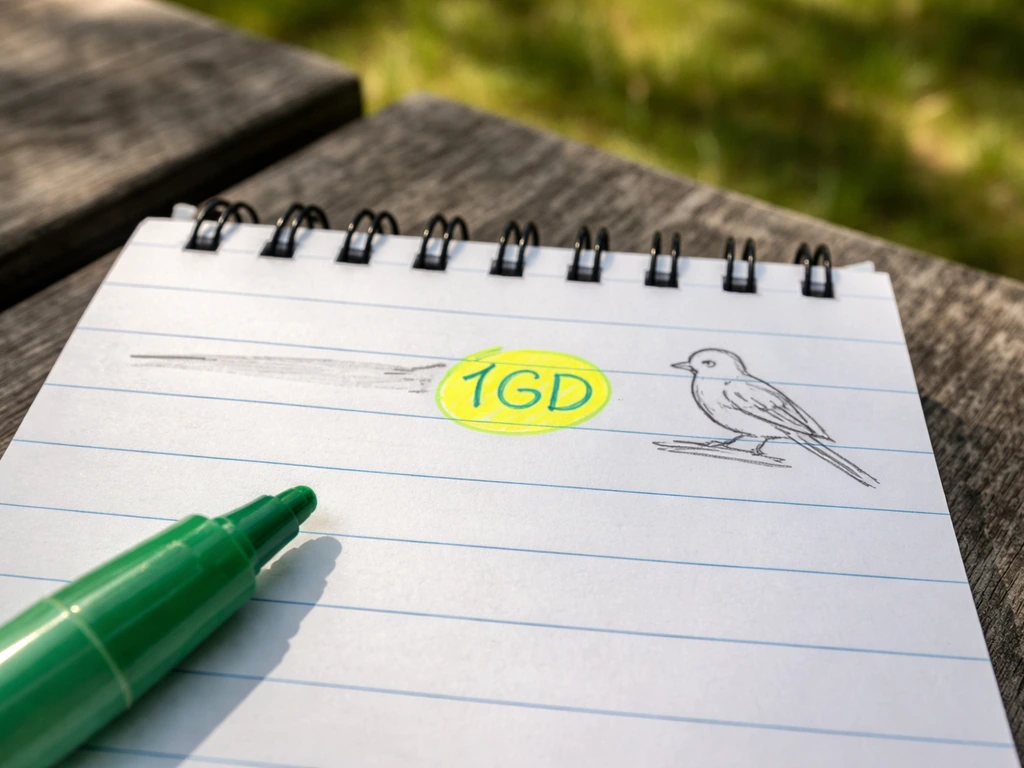
When people search for what a bird plus a letter means, they've almost always run into one of four things: an abundance or occurrence code on a checklist (like "C" for common or "R" for rare), a banding or marking code on a bird's tag or ring, a life-stage or sex shorthand (like "M" for male or "juv" for juvenile), or a simple alphabetical label used in a document, game, or worksheet to organize birds without implying any biological meaning. The same letter, say "R," can mean "rare" on a printed bird chart, an eBird status code in a regional atlas, a banding reference number, or literally just the letter R in "Robin R" on a school worksheet. That's why the source document always has to be your first stop.
This kind of ambiguity comes up a lot on this site, especially for readers exploring how bird names and notations work across different contexts. Related questions like what a specific letter prefix or suffix means in a bird's formal name ("B is for bird," "S is for bird") touch a different angle of the same puzzle. But if your letter is attached to a bird name or species slot in a list rather than standing alone as an initial, you're almost certainly in checklist or classification territory, not etymology.
Common letter codes in birding checklists and atlases
The most common place people encounter a letter next to a bird entry is on a species checklist, whether printed or digital. These letters describe how often or reliably a species is expected in a given area and time period. They say nothing about the bird's identity or name; they're purely about status.
eBird, the most widely used birding platform in the world, uses a specific set of single-letter abundance and status codes in its atlas and checklist reporting tools. The full set includes A, B, C, E, F, H, I, N, O, P, R, S, T, W, and Y. Each one maps to a defined category: C is common, F is fairly common, U is uncommon, R is rare, and so on. Other systems, like regional printed checklists, use slightly different sets. The Piedmont Bird Club's field checklist, for example, uses C, F, U, R, and I (irruptive) as its five abundance codes.
eBird also uses a completely separate letter system for breeding evidence. These breeding codes (like NB for no breeding, S for singing, T for territory, and others) appear in atlas entry contexts and can easily be confused with abundance letters if you don't know which column you're reading. The key point: one letter system describes how often you see the bird, the other describes what behavior was observed. They coexist in the same tools but answer totally different questions.
| Letter | Abundance/Occurrence Meaning | System |
|---|---|---|
| C | Common | eBird, most printed checklists |
| F | Fairly common | eBird, Piedmont-style checklists |
| U | Uncommon | Many regional printed checklists |
| R | Rare | eBird, printed checklists (e.g., wigrr.com charts) |
| I | Irruptive | Piedmont Bird Club and similar |
| W | Winter visitor | eBird atlas codes |
| S | Summer visitor / Singing (breeding) | Context-dependent: atlas vs. breeding code |
| NB | No breeding evidence | eBird breeding code system |
Bird banding and marking codes: letters that track individuals
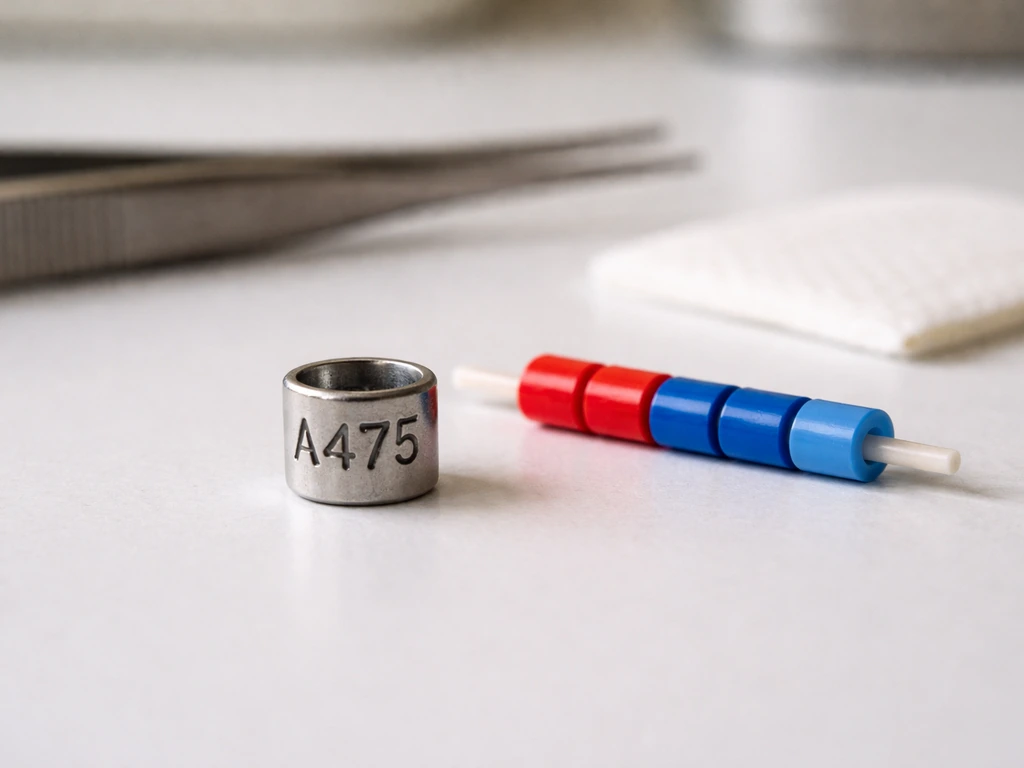
Bird banding is a practice where researchers fit birds with a small metal or plastic ring (band) marked with an alphanumeric code. These codes identify individual birds across their lifetimes. In North America, the U. S.
Geological Survey (USGS) Bird Banding Lab coordinates the system. The blank" rel="noopener noreferrer">USGS Bander Portal is the environment where banders use codes to report banding and encounter data to the lab.
A letter in a banding code is part of an identifier string, not a status description. If you see a bird with a colored flag on its leg stamped with a letter or letter-number combo like "E7" or "GW," that code links back to a capture database that records the species, capture location, date, age, and sex.
Color bands are also used in long-term studies where individual birds are tracked visually without recapture. Researchers assign specific color sequences and letter combinations to each bird. For example, a shorebird might wear a yellow flag with the letter A above a metal band. If you photograph or observe that bird and report the combination, researchers can tell you exactly where and when it was banded, how far it has traveled, and what species it is.
Erie Bird Observatory notes that when you report banded shorebirds, you provide the band information and the color flag plus an alphanumeric code, along with the date and location report the combination. If you've encountered a letter on an actual bird (or a photo of one), the North American Bird Banding Lab's online reporting tool or a regional equivalent is the right place to look it up.
Subspecies, sex, and life-stage shorthand
Letters also appear as shorthand for a bird's identity within a species. This is common in field guides, research papers, and ID checklists where space is tight. The most familiar examples are M (male), F (female), juv or J (juvenile), imm (immature), and ad (adult). Some guides add letters for subspecies or morphs, like "ssp." followed by an abbreviated name, or a single-letter code for a recognized geographic race.
In taxonomy charts and field guide plates, you'll sometimes see a species illustrated multiple times with labels like "M," "F," "juv," or "br" (breeding plumage) and "non-br" (non-breeding plumage). These are not separate birds; they're the same species shown at different life stages or in different sexes. If the letter attached to your bird name is one of these, you're looking at a life-stage or sex descriptor, not a status code or individual marker.
How to decode it fast

The fastest way to figure out what any bird-plus-letter notation means is to follow three steps in order: find the legend, match the source, and verify the bird name.
- Find the legend. Almost every document or app that uses letter codes includes a key somewhere: at the bottom of a checklist page, in a help section, on a sidebar, or in an introductory paragraph. On eBird, the glossary in the Help Center lists every code. On printed checklists, look for a box labeled 'Abundance Codes' or 'Status Codes.' If you're looking at a field guide plate, check the caption or the guide's introduction.
- Match the source. Ask yourself: is this a digital checklist or atlas (eBird, iNaturalist, Audubon app)? A printed regional bird list? A banding report or flagging study? A field guide? A school worksheet or game? Each source type has its own code set. A letter that means 'fairly common' on eBird might mean something completely different in a banding context.
- Verify the bird name. Once you've identified the code system and decoded the letter, confirm the full English name of the bird using a trusted reference like the American Ornithological Society's official checklist, the Cornell Lab's species pages, or a current field guide. Names change as taxonomy is updated, so checking the current accepted name matters, especially for species that have been split or lumped recently.
- Check the spelling and pronunciation. Once you have the bird's name, look up how it's spelled and pronounced. This is especially useful for less familiar species. Resources like the Audubon Society's species guide and the Cornell Lab's All About Birds pages include audio pronunciations alongside the written name.
When the letter is a label, not a code: puzzles, games, and pet naming
Not every bird-plus-letter situation involves a scientific or birding system. Sometimes a letter next to a bird name is purely organizational: think crossword clues, word puzzles, school worksheets, or informal pet-naming conventions. If you see "Bird A," "Bird B," or "Parrot P" in a game or worksheet, the letter is almost certainly just an alphabetical label or an initial used to organize entries. It carries no taxonomic, status, or banding meaning whatsoever.
In word puzzles and crossword contexts, a clue like "bird + letter" can sometimes be asking you to add a letter to the word BIRD (or a bird's name) to make a new word, or to identify a bird whose name starts with or contains a specific letter. After all, many bird-plus-letter puzzles are really just asking you to think about wordplay and how letters change meanings bird + letter. This is a completely different reading, and it's worth recognizing because the solving strategy is totally different: instead of looking up a code system, you're working with language and wordplay. Related explorations on this site, like what it means when a specific letter "stands for" a bird type (such as "B is for bird" or "S is for bird"), cover exactly this kind of linguistic and puzzle-based angle.
For pet owners, a letter attached to a bird's name is almost always just a nickname or an initial. Someone naming their budgie "Kiwi K" or "Mango M" is using the letter as a playful tag, not referencing any formal system. If you're choosing a name for a pet bird and wondering whether the letter suffix means anything official, it doesn't. Use it however you like.
Pronunciation, spelling, and naming once you've identified the bird
Once you've decoded the letter and confirmed which bird you're dealing with, the next practical step is getting the name right. Bird names in English follow a mix of conventions that can trip people up, especially for species with names borrowed from other languages or named after historical figures.
The American Ornithological Society (AOS) maintains the official English-language checklist for birds of North and Middle America. Their naming decisions are the standard reference for English bird names in the Americas. For the rest of the world, the International Ornithologists' Union (IOU) publishes its own world bird list with agreed English names. If you want to know whether you're spelling a bird's name correctly, checking against one of these two sources settles it. Common misspellings tend to cluster around compound names ("grey" vs. "gray" depending on region), hyphenation ("Red-tailed Hawk" vs. "Red tailed Hawk"), and capitalization (major style guides for birding capitalize species names: American Robin, not american robin).
For pronunciation, the best free resource is the Cornell Lab's All About Birds website, which includes audio clips of species vocalizations alongside the species account. But for the spoken name itself (as opposed to the bird's call), practical phonetic guides are helpful. A few common stumbling blocks: "Ptarmigan" is pronounced TAR-mi-gun (the P is silent), "Phoebe" is FEE-bee, and "Anhinga" is an-HING-uh. The European context adds another layer, since some bird names used in British English differ from their American equivalents, a topic that comes up directly when asking what letter is a European bird versus an American one.
Etymology is also worth a quick look once you've identified a species. Many bird names contain built-in clues about the bird's appearance, behavior, or discovery history. "Kingfisher" literally describes a king-sized fisher. "Osprey" traces back through French and Latin to a root meaning bone-breaker. Knowing where a name comes from helps you remember it, spell it confidently, and understand why it looks the way it does on paper.
A quick reference for the most common letter systems
| Context | What the letter means | Where to find the legend |
|---|---|---|
| eBird checklist / atlas | Abundance, occurrence, or status code (C, F, U, R, I, W, S, etc.) | eBird Help Center glossary |
| eBird breeding atlas | Breeding behavior/evidence code (NB, S, T, etc.) | eBird Help Center: Understanding Breeding Codes |
| Printed regional bird checklist | Abundance or seasonality (usually C, F, U, R, with occasional extras) | Legend box on the checklist itself |
| Bird banding / leg flag report | Individual ID code linking to a capture database | USGS Bird Banding Lab or regional banding program database |
| Field guide plate captions | Sex or life stage (M, F, juv, ad, br, non-br) | Caption below the plate or guide's introduction |
| Taxonomy chart / subspecies list | Subspecies abbreviation or morph label | Chart header or footnotes |
| School worksheet / word game / puzzle | Alphabetical label or initial (no scientific meaning) | Document instructions or puzzle rules |
| Pet naming / informal shorthand | Personal nickname initial (no formal meaning) | Context of the conversation or owner's choice |
FAQ
I saw “R” next to a bird in an online checklist, does that always mean rare?
Not always. “R” commonly means rare in eBird-style abundance codes, but some regional checklists or different columns use different letter sets. Check the legend or the column header in the exact tool you’re using, then confirm whether the letter is in the status or abundance column (not the breeding evidence or notes column).
How can I tell the difference between an abundance letter and a breeding evidence code?
Look for multi-part formatting and placement. Abundance codes are usually single letters tied to frequency expectations, while breeding evidence codes are often placed in a behavior/observation context and may be two-letter abbreviations (for example, “NB” or “S” for specific evidence). If the letter appears where behaviors are listed, treat it as breeding evidence, not abundance.
If the letter appears like “E7” or “GW” on a bird photo, is it a status code?
Usually no. In banding, the code is part of an identifier string, so the letter and numbers together point to a specific record. Status codes typically appear in legends attached to checklists, not stamped on rings or colored flags.
What if the same letter means something different across regions or platforms?
That’s expected. Some systems use different sets of letters or different mappings for the same letters. The reliable approach is to use the legend in the exact document, then, if needed, match the checklist name or publisher to the correct code table.
My checklist shows a letter next to the species name, but I can’t find a legend. What should I do?
First, inspect the table structure, often there’s an unlabeled header, hover tooltip, or side panel that contains the key. If nothing is available, try viewing the same checklist on another page or refresh the page, then compare with any known default code sets used by that platform. Don’t guess, because one-letter systems are easy to misread.
Does “M,” “F,” “juv,” or “br” mean the bird is a different species?
No. Those labels typically describe sex, age, or plumage state shown in field guide plates or ID charts. They indicate which version of the same species you’re looking at, not a separate taxon, and they are not abundance or breeding-status codes.
In a bird banding context, how do I interpret a letter alone versus a letter-number combo?
A single letter by itself is less likely to be meaningful on a real band compared to an alphanumeric string. In many systems, the letter is only part of a composite identifier. If you see only a single letter, it may be a simplified caption, or the rest of the code may be outside the photo frame.
Could “bird plus letter” be a word-puzzle question instead of a birding code?
Yes. In puzzles or worksheets, the letter often modifies a wordplay rule, such as adding a letter to “BIRD” to form a new word, or identifying a bird whose name contains that letter. If there’s no checklist or legend, and the context looks like language-based clues, treat it as a puzzle rather than a biological notation.
If I want to report a banded bird I saw, what details matter most besides the letter?
Capture as much of the identifier as you can, including any digits, colors, and placement (for example, which leg and which side the color flag is on). Also record date, location (nearest town or coordinates if possible), and your best ID of species. The identifier alone may not be enough if parts of the code are hard to read.
Are pet-bird letters ever official or informative?
Usually not. If it’s just “Kiwi K” or “Mango M,” it’s typically an owner’s labeling choice, not a scientific code. If you want an actual meaning, the only “key” is your household convention, not any formal birding system.
Next Article
B is for Bird Guide: Spelling, Pronunciation, and Names
B is for bird guide with spellings, easy phonetics, bird names vs scientific names, origins, and multilingual options.