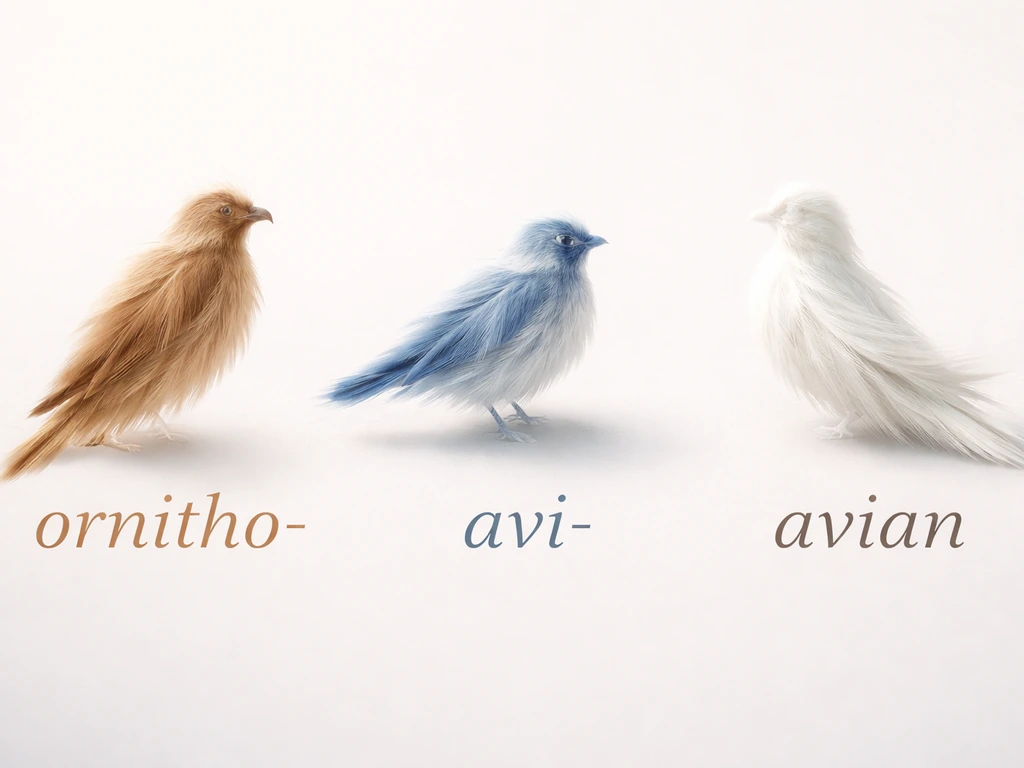
The answer is AVI. In the NYT Mini crossword, the clue "Prefix meaning 'bird' or 'flight'" points to that three-letter combining form, and once you know it, the whole clue makes sense. The prefix avi- comes from Latin <em>avis</em>, meaning "bird," and it shows up in words like <em>aviary</em> (a place for keeping birds) and <em>aviator</em> (someone who flies). The "flight" part of the clue isn't referring to a separate Greek root about wings, it's pointing to aviation and the idea that birds fly. That's the disambiguation you need right away before going further.
Prefix Meaning Bird or Flight in Bird Names NYT Puzzle Guide

James Ridgley
12 Apr 2026

What "bird" vs "flight" actually means in prefix clues

Crossword clues, especially at the NYT level, love to exploit double meanings. When you see a clue like "prefix meaning 'bird' or 'flight,'" the puzzle is telling you that a single prefix can be associated with both concepts, not that there are two different answers. The word "or" here is doing the job of "and also," hinting that the prefix has evolved to cover both birds as creatures and flight as the thing birds famously do. That's avi-: it originates as a Latin word for bird, but because aviation borrowed it to describe human flight, the prefix now lives comfortably in both worlds.
This matters because there are other prefixes that relate to birds or wings in a more purely Greek, scientific direction. If the clue said "wing" instead of "flight," or if you were looking at a taxonomy question rather than a puzzle, you'd be in different territory entirely. Keeping that distinction clear is how you avoid going down the wrong path.
The main prefixes tied to birds
There are two major combining forms English uses for "bird": one Latin, one Greek. Avi- is the Latin one. It's short, versatile, and familiar from everyday vocabulary. Ornith- and ornitho- are the Greek versions, used almost exclusively in scientific and technical language. Collins Dictionary gives the origin of blank" rel="noopener noreferrer">ornitho- as Greek ornis (gen. ornithos), “bird,” and describes it as a combining form meaning “bird.”. If you want to go deeper on the Latin side, a dedicated look at the prefix meaning bird gives you the full breakdown, but here's the quick version:
| Prefix | Language Origin | Core Meaning | Familiar Example |
|---|---|---|---|
| avi- | Latin (avis) | Bird; also flight by extension | aviary, aviator, avian |
| ornith- | Greek (ornis/ornithos) | Bird | ornithology, ornithopter |
| ornitho- | Greek (ornis/ornithos) | Bird (full combining form) | Ornithorhynchus, ornithology |
The ornitho- / ornith- distinction is minor: ornith- is simply the form used before a vowel, while ornitho- appears before consonants. Both come from Greek <em>ornis</em>, genitive <em>ornithos</em>, meaning "a bird." Merriam-Webster confirms that ornith- is a direct variant of ornitho-, and the Canadian Language Portal treats ornitho- as the standard combining form for scientific English. You'll see both in real species names and scientific terms, so it helps to recognize them as two faces of the same root.
The prefixes tied to flight and wings

Now for the flight-and-wing side. The Greek root pter- (also written ptero-) means "feather" or "wing," and it comes from Greek <em>pteron</em>. Etymonline traces that word all the way back to a Proto-Indo-European root associated with rushing or flying. One important spelling note: the initial "p" is silent in English. So <em>pterodactyl</em> is pronounced "teh-roh-DAK-til," not "peh-teh-roh...", this trips people up constantly, and it matters when you're checking a crossword answer letter by letter.
The suffix form -ptera shows up all over insect and animal taxonomy. <em>Neuroptera</em>, for example, literally means "nerve-wing," using Greek <em>pterón</em> for the wing part. And the word <em>ornithopter</em> is a direct mashup: ornitho- (bird) + pteron (wing), referring to an aircraft that flies by flapping its wings like a bird. That word is worth knowing because it shows how ornith- and pter- can combine, which is a common source of confusion when you're trying to figure out which root a clue is targeting.
For crossword purposes, clues about "flight" that expect a very short answer (three or four letters) almost always want avi-, not pter- or ptero-. That's because pter- is less commonly seen as a standalone prefix clue in mainstream puzzles, and its silent-p spelling makes it harder to use as a clean fill answer.
How to match a prefix clue to the right answer fast
NYT crossword clue logic follows a few reliable patterns that help you zero in on an answer quickly. If you've already worked through the prefix meaning bird crossword clue type of question before, some of this will feel familiar. Here's the decision process I run when I hit a prefix clue:
- Check the letter count first. AVI is 3 letters. ORNITH is 6. ORNITHO is 7. PTER is 4. The box count rules out most wrong answers immediately.
- Look at whether the clue says 'bird,' 'flight,' or both. 'Bird or flight' together points to avi- because it's the only prefix that genuinely bridges both concepts in everyday English vocabulary.
- Look for cross letters you've already filled in. If the second letter is V, you've got AVI locked in.
- If the clue says 'wing' or 'feather' instead of 'flight,' shift your thinking toward pter- or ptero-.
- If it's a science or taxonomy-style clue, ornith- or ornitho- becomes more likely regardless of letter count.
- Verify by asking: does the prefix attach naturally to common English words? Avi- gives you aviary, avian, aviation — all recognizable. That familiarity is a good confirmation signal.
For the specific puzzle case here, the clue is unambiguous once you know it: "prefix meaning bird or flight" with a 3-letter answer is AVI, full stop. If you want the complete breakdown of why a 3-letter answer specifically fits, the article on prefix meaning bird or flight 3 letters walks through that in detail.
Where these prefixes show up in real bird names

The prefix ornitho- is everywhere in scientific bird nomenclature. The most famous example outside ornithology proper is the platypus, whose genus name is <em>Ornithorhynchus</em>. That name is built from Greek <em>ornis/ornithos</em> (bird) plus <em>rhynchos</em> (snout or bill). GBIF's taxonomy records translate the full species name <em>Ornithorhynchus anatinus</em> as roughly "duck-like bird-snout", the genus describes the beak's bird-like appearance, while the species epithet (<em>anatinus</em>) comes from Latin for "duck-like." So one animal's scientific name combines a Greek bird-prefix with a Latin duck word. That kind of mixing is completely normal in scientific naming.
Avi- roots show up more in common English words than in species names directly, but avian (meaning "of or relating to birds") is used constantly in both casual birding and scientific literature. Avifauna, meaning the bird life of a particular region, is another key term built on avi-. On the Greek wing-root side, pterodactyl is the most recognizable pter- word for most readers, from <em>pteron</em> (wing) plus <em>daktylos</em> (finger), describing the wing-finger structure of the prehistoric flying reptile.
It's also worth noting how bird-related prefixes can attach to other bird-anatomy concepts. The word bill meaning bird comes up in contexts where you're parsing what part of a bird name refers to the beak versus other features, and that connects directly to the rhynchos element in Ornithorhynchus. Understanding one piece helps you decode the others.
Pronunciation and spelling traps to watch out for
The biggest spelling confusion around these prefixes comes from pter-. People either forget the leading "p" entirely when writing it, or they try to pronounce it when they shouldn't. In English, pter- is always pronounced starting with a "T" sound: pterodactyl is "TAIR-oh-dak-til," not "p-TAIR-oh-dak-til." This comes up in crossword verification, if you're counting letters, the "p" is there on the page even though your mouth doesn't say it.
For ornitho- and ornith-, the pronunciation is straightforward: "OR-nih-thoh" and "OR-nith." The tricky part is knowing which form to use in a given scientific name. The rule is that ornith- (no final vowel) comes before roots that start with a vowel, while ornitho- (with the connecting vowel) comes before consonants. Wikipedia's list of commonly used taxonomic affixes spells this out and is a fast reference when you're checking a specific spelling in a species name.
Avi- is the easiest of the three. It's two letters plus a hyphen, pronounced "AY-vee" as a prefix, and it doesn't have silent letters or vowel-harmony rules to worry about. Avian is "AY-vee-en," aviary is "AY-vee-air-ee." The only confusion I see regularly is people mixing up avian (adjective) with aviation (noun about human flight) and losing track of which one the prefix comes from. The answer is: both. They both trace to Latin <em>avis</em>.
One more point worth flagging: the crossword world sometimes uses "crop" in bird-related clues in ways that seem unrelated to prefixes but actually connect to bird anatomy vocabulary. If you've ever wondered why, looking into crop meaning bird clarifies the anatomical term alongside other bird-specific vocabulary you'll encounter in puzzle contexts.
Other bird-adjacent clues worth keeping in your toolkit
While you're building out your crossword vocabulary around birds, a few adjacent clue types come up regularly and are worth recognizing. "Limbless prey for a bird" in a four-letter format is a clue pattern that points to a specific word, and if you've hit that one and wondered what it means, the limbless prey for a bird 4 letters meaning explains the answer and logic clearly. Similarly, the limbless prey for a bird 4 letters linkedin meaning addresses a slightly different search context for the same clue that circulates on professional platforms.
Another one that pops up: origami bird clues. If you've seen a puzzle reference a common origami bird crossword answer, that's a separate type of bird word puzzle entirely, but it's the kind of thing that shows up alongside prefix clues in themed mini-puzzles. Building your vocabulary across all these bird-related clue types makes any bird-themed crossword much faster to solve.
Your checklist for solving future bird-name prefix questions
Use this every time you hit a bird prefix clue you're not sure about, whether it's a crossword or a scientific name you're trying to decode:
- Count the letters in the answer slot first — this eliminates most wrong candidates immediately.
- If the clue says 'bird or flight' and the answer is 3 letters, the answer is AVI.
- If the clue involves 'wing' or 'feather' and is 4+ letters, consider PTER or PTERO — and remember the P is silent when you say it aloud.
- If the clue is science or taxonomy-focused and involves bird names, look for ORNITH or ORNITHO depending on what follows it.
- Verify unfamiliar species name prefixes against Wikipedia's list of taxonomic affixes or Merriam-Webster's combining forms — both are fast and free.
- Remember that avi- is Latin and ornith-/ornitho-/pter- are Greek. Mixed-root scientific names are common and normal.
- For pronunciation checks: avi- = AY-vee, ornitho- = OR-nih-thoh, pter- = TER (silent P in English).
- If you're stuck on a bird crossword clue with a specific letter count, use a crossword solver filtered by pattern and length as a last resort — but understand why the answer works so you recognize it next time.
The underlying logic is always the same: trace the prefix to its source language, check the core meaning, and match it to the clue's framing. Once you've done that with avi-, ornith-, and pter-, you've covered the vast majority of bird-prefix questions you'll ever encounter in puzzles or scientific reading.
FAQ
If the clue says “prefix meaning bird or flight,” how do I know it’s AVI and not ORNITH- or PTERO-?
In NYT Mini-style prefix clues, “bird” or “flight” usually signals AVI specifically when the answer length is 3. If the entry is longer, you may be seeing ORNITH- (scientific) or PTERO-/PTER- ideas, so always sanity check against the given number of letters before committing.
Does the clue wording “prefix meaning” always mean a combining form, or can it mean a whole word?
Look for the key word “prefix.” If the clue were asking for a full word meaning “bird” (or “bird flight”), the answer could change. But when it explicitly asks for the combining form, AVI is the common short fill used for bird-related prefix clues.
Why does the clue mention “flight” if the root comes from Latin for “bird”?
Because “avi-” is Latin and “aviation” is human flight, some solvers try to overthink the “flight” part. In this clue, “flight” is more like a hint pointing to contexts where birds fly, not a requirement to reference a separate “wing” root.
What’s the most common mistake when verifying possible answers for bird or wing-related prefixes?
The spelling trap is mostly with pter-. Crosswords keep the P on the page even though English speakers often start sounding it as a T. If you’re choosing between fills that differ by that first letter, count carefully using the grid, not your pronunciation habits.
How can I double-check my answer if the puzzle also contains words like avian or aviary?
AVI can appear in both “bird” and “human flight” vocabulary, so it’s easy to mix it up with aviation-related answers. When you see AVIAN or AVIARY elsewhere in the puzzle, that’s a strong confirmation that the prefix is AY-vee, not ornith- or pter- variants.
Does the broader theme of the crossword (science vs general vocab) change the best answer?
If the puzzle is clearly using a scientific naming theme, ornith- becomes more likely than avi-. As soon as you see longer entries that resemble taxonomy forms, treat ORNITH- as the default contender and reserve AVI for short, mainstream clue fills.
When a clue uses “or” in this style, does it mean two different answers are acceptable?
For multi-word clues, the “or” often means “also associated with,” not that the clue designer is searching for two separate roots. In practice, you still pick one prefix that can link both ideas, and AVI is the usual single-root fit for the exact Mini clue shown.
Next Article
Prefix Meaning Bird: What It Means and How to Identify It
Learn what the prefix meaning bird is, spot it in bird names, and pronounce and identify the correct word part.