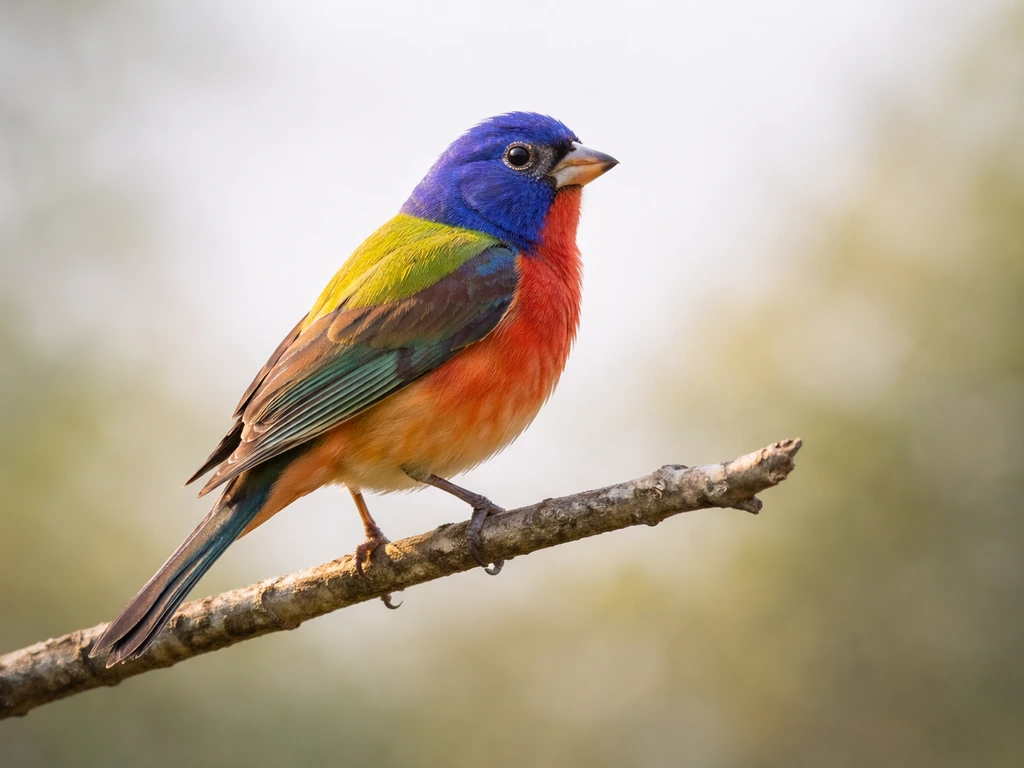
Yes, 'painted bird' is English, but it is almost never used as a standalone species name. In everyday birding English, when someone says 'painted bird,' they are almost always referring to the Painted Bunting (Passerina ciris), a strikingly colorful songbird native to the southern United States and Central America. The word 'painted' describes its appearance so vividly that it stuck as part of the common name, but the full name always pairs it with a second noun. If you have just seen the phrase 'painted bird' somewhere and are trying to pin down the exact species, the Painted Bunting is your most likely answer, though a handful of other 'painted' species names exist and are worth knowing.
Is the Painted Bird in English? Identify the Species

James Ridgley
25 Apr 2026
What 'painted bird' actually means in everyday English
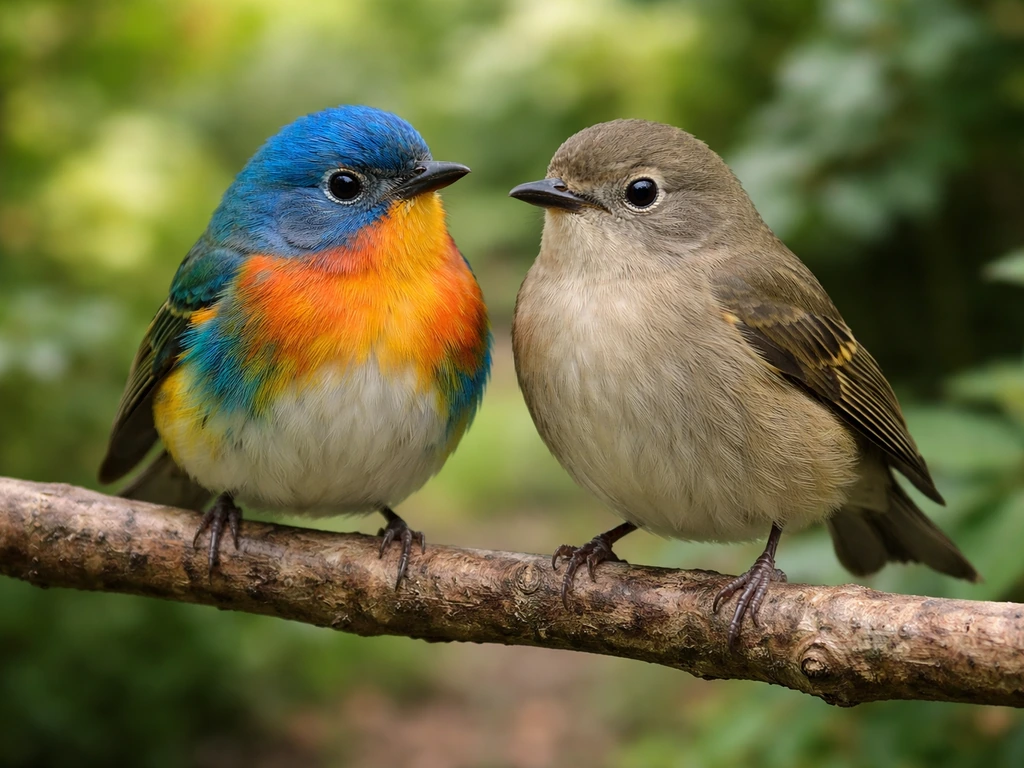
In plain English, 'painted' when applied to a bird is a descriptive adjective meaning the bird looks as though it has been colored by hand, usually because it displays unusually vivid, multi-color plumage. The word has been used in bird common names for centuries precisely because it was the most intuitive way to describe something that looked almost artificially bright. When you hear 'painted bird' in casual conversation, it is shorthand, not a formal species label. The official common names in English birding always include a second noun, such as 'bunting,' 'redstart,' or 'whitestart,' to make the name species-specific.
You will see this pattern in birding media constantly. PBS Nature, for example, ran a headline about a 'Colorful Painted Bird' sighting in Brooklyn's Prospect Park, and the body of the article immediately clarified it as the 'painted bunting (Passerina ciris).' That kind of shortcut in headlines is exactly why the standalone phrase circulates, but it is always resolved to a full species name the moment any detail is given.
Is it a common English name or just a generic description?
'Painted bird' by itself is a generic description. It is not listed in Merriam-Webster, Collins, Britannica, or any major English bird reference as a standalone species name. What IS listed as a fixed, dictionary-level species name is 'painted bunting.' Merriam-Webster defines it directly as a brightly colored bunting found from the southern U.S. to Panama, with the scientific name Passerina ciris. blank" rel="noopener noreferrer">Wiktionary treats 'painted bunting' as a fully lexicalized noun phrase, meaning it functions like a proper noun in English bird nomenclature, not just two words stuck together. So the distinction matters: 'painted bird' is descriptive shorthand, while 'painted bunting' is the real common name.
The most likely species matches, and why the mapping gets confusing
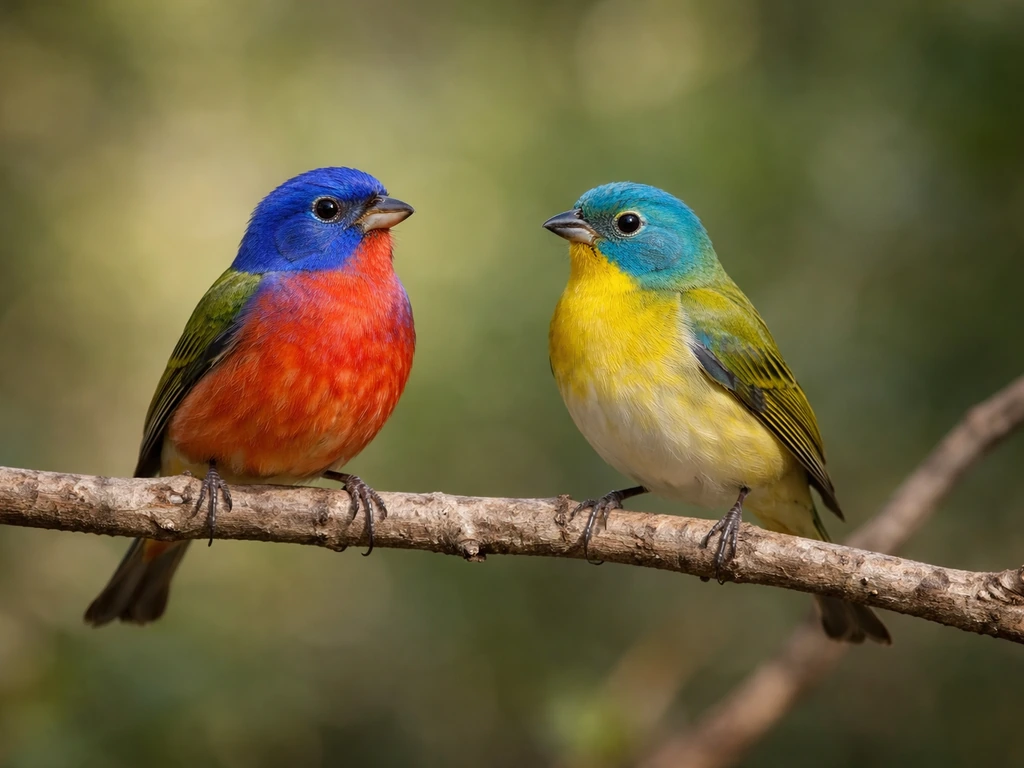
When someone says 'painted bird' without more context, there are a few English species names it could resolve to. The Painted Bunting is by far the most common referent, but it is not the only one. Here are the main candidates:
| Common Name | Scientific Name | Key Feature | Range |
|---|---|---|---|
| Painted Bunting | Passerina ciris | Blue head, red underparts, green back (male) | Southern U.S. to Panama |
| Painted Redstart | Myioborus pictus | Black, white, and red warbler-like bird | Southwestern U.S. to Nicaragua |
| Painted Whitestart | Myioborus pictus | Alternative name for Painted Redstart in some references | Same as above |
The ambiguity arises because 'painted' is such a general adjective that multiple species have earned it as part of their common name. Britannica has separate species articles for both 'painted bunting' and 'painted redstart,' which means a reference to a 'painted bird' in print or online could technically point to either. The Kern Audubon Society notes that the Painted Redstart is not closely related to the American Redstart despite sharing the 'redstart' label, which is itself a reminder that common names can mislead. If someone abbreviates either name to just 'painted bird,' you genuinely cannot be sure which species they mean without more context.
English spelling and how to pronounce it
If the species is the Painted Bunting, the spelling is always two words, both capitalized when used as a proper species name: Painted Bunting. In informal prose, lowercase 'painted bunting' is also acceptable and common. The pronunciation is straightforward:
- Painted: PAYN-tid (IPA: /ˈpeɪntɪd/) — rhymes with 'sainted'
- Bunting: BUN-ting (IPA: /ˈbʌntɪŋ/) — the 'u' is short, like 'fun'
- Full name: PAYN-tid BUN-ting — stress falls on the first syllable of each word
For the Painted Redstart, the pronunciation follows the same logic: PAYN-tid RED-start, with stress on 'PAYN' and 'RED.' There is no tricky vowel shift or silent letter in any of these names. If you are using either term in a crossword, a quiz, or a pet name context, both are spelled exactly as they sound, with no hyphens.
How to confirm the exact species you are looking for

The most reliable way to pin down the exact species behind 'painted bird' is to cross-reference the English common name with the scientific (Latin) name. Scientific names are universal and do not change across languages or regions, which makes them the anchor for any identification question.
For the Painted Bunting, the mapping is: blank" rel="noopener noreferrer">Painted Bunting = Passerina ciris. This is confirmed by Merriam-Webster, Britannica, Cornell Lab of Ornithology's All About Birds guide, the U.S. Fish and Wildlife Service, the U.S. Geological Survey, and the World Bird Names database. That is about as solid as a common-name-to-scientific-name match gets. If your source uses the scientific name Passerina ciris anywhere, the English common name is Painted Bunting, full stop.
For the Painted Redstart, the match is: Painted Redstart = Myioborus pictus. Cornell Lab's All About Birds maintains a separate sightings map entry under 'Painted Redstart,' and the Macaulay Library catalogs it under the same name. If your source mentions a warbler-like bird with black, white, and red coloring in the American Southwest, Myioborus pictus is almost certainly what is meant.
Cross-language naming and translation issues
One reason 'painted bird' surfaces as a search query is that people encounter the phrase as a translation or rough rendering from another language and want to know what it maps to in English. En español, búsquedas como “this is a bird en español” suelen referirse al nombre que usa esa especie en guías o conversaciones a translation or rough rendering from another language. This is a genuinely tricky area of bird nomenclature, because common names rarely translate word-for-word across languages, and the word for 'painted' in Spanish, French, or another language may be applied to a completely different species than the English 'painted bunting.'
In <a data-article-id="D7B17D8A-1930-4504-9D2A-2F4FF229EF80">Spanish, for instance</a>, the Painted Bunting is most commonly called 'colorín sietecolores' or 'azulillo arcoiris' depending on the region, not a direct translation of 'painted.' If someone is reading a Spanish-language bird guide and sees a term that literally means 'painted,' it may not map to Painted Bunting at all. This is the same challenge that comes up with other bird name translations, like figuring out how a crane or a bunting is referred to across different languages, where the descriptive adjective in one language does not carry over directly to the official English common name. If you are trying to find the Spanish name for a crane bird, the key is to start from the scientific name so you do not end up with the wrong species crane or a bunting.
The safest cross-language workflow is to always locate the scientific name in your non-English source first, then look that scientific name up in an English reference like Cornell's All About Birds or the World Bird Names database. That bypasses the translation problem entirely. A bird named something meaning 'painted' in Croatian, Spanish, or any other language might correspond to a completely different species in English, or it might be the Painted Bunting, but you cannot know without checking the Latin name. If you are trying to identify the bird from a show context, the phrase “croatian bird better call saul” is a good clue to search the exact episode or scene that uses it.
Quick steps to get to the right English name today
- Check your original source for a scientific name. If it says Passerina ciris, the English name is Painted Bunting. If it says Myioborus pictus, the English name is Painted Redstart.
- If there is no scientific name, look at the bird's description. Multi-colored (blue, green, red) and found in the Americas? Go with Painted Bunting. Black, white, and red with tail-fanning behavior in the Southwest? That's the Painted Redstart.
- Search Cornell Lab's All About Birds (allaboutbirds.org) using the phrase 'painted bunting' or 'painted redstart' to reach the official species page with photos, range maps, and the confirmed scientific name.
- If you are working from a non-English source, copy the scientific name from that source and paste it into the World Bird Names search or Cornell's eBird taxonomy to get the accepted English common name.
- For crossword or puzzle contexts, 'painted bird' clues almost always resolve to BUNTING or PAINTED BUNTING as the answer, since it is the far more recognizable common name in general-audience English.
- If you are still unsure, search '[species name] Passerina ciris' or '[species name] Myioborus pictus' side by side to compare images and confirm which bird matches your context.
The bottom line: 'painted bird' in English almost always means the Painted Bunting (Passerina ciris), one of the most visually striking songbirds in North America. The phrase only becomes genuinely ambiguous when it is used as a shortcut for another 'painted' species name like Painted Redstart, or when it surfaces as an imprecise translation from another language. If your search is also related to each bird has a cracker en español, remember that Spanish wording can shift which “painted” species people mean compared with English another 'painted' species name like Painted Redstart. Use the scientific name as your anchor whenever possible, and the English common name will follow quickly from any reputable birding database.
FAQ
If I see the phrase “painted bird” on a sign or social media post, what should I do to confirm the species?
Look for any extra clue in the same post, location, date, or photo details, then map it to the full English common name by checking whether the context points to a bunting or a warbler-type bird. If the post includes even a partial scientific name, use that as the fastest anchor, because common-name shortcuts are ambiguous.
Is “painted bird” acceptable in birding conversation if I do not mean a specific species?
It is acceptable as a generic description of a vivid-looking bird, but many listeners will assume Painted Bunting. If you want to stay unambiguous, say something like “a painted bunting-looking bird” or add a second identifier such as color pattern or region.
Could “painted bird” refer to a bird outside North America?
It can in the sense that people might use the phrase loosely to describe vivid plumage, but the fixed common-name candidates in standard English birding are region-tied. Painted Bunting is associated with the southern U.S. to Central America, while Painted Redstart is tied to specific parts of the Americas, so region helps narrow it fast.
How do I tell whether someone means Painted Bunting or Painted Redstart when the source only says “painted bird”?
Check the implied bird family or behavior description. Painted Bunting is a finch-like songbird labeled as a bunting, while Painted Redstart is treated like a redstart, often described in terms of its black, white, and red contrast. If you cannot verify, treat it as unresolved rather than guessing.
Are “Painted Bunting” and “Painted bunting” different species names?
No, they refer to the same species. Capitalization changes with style, but spelling and wording do not. For clarity in reports, keep it as Painted Bunting (both words capitalized as a proper common name).
What if a bird guide uses a translated phrase that literally means “painted” in another language?
Do not assume the English common name will match word-for-word. The “painted” adjective in another language can label a different species entirely. The reliable workflow is to find the scientific (Latin) name in the non-English source first, then look up the English common name from that scientific name.
In birding databases, why does “painted bird” not show up as a species entry as often as “painted bunting”?
Because “painted bird” is usually an imprecise shorthand rather than a standardized common name. Databases typically index by fixed common names, where the second noun (bunting, redstart) makes the label specific enough for consistent records.
If I’m writing a caption or taking notes, what’s the best way to format the name?
Write the full common name with the second noun (Painted Bunting or Painted Redstart) and, if possible, include the scientific name. That prevents future confusion when someone later sees only “painted bird” and has to guess between multiple candidates.
Next Article
How Do You Say Crane Bird in Spanish
Learn how to say crane bird in Spanish, including grulla and grúa, with pronunciation and species matching tips.