"Caique" is pronounced kah-EEK in American English (roughly /kɑːˈiːk/) and ky-EEK in British English (/kaɪˈiːk/). Either way, the stress lands hard on that second syllable: the "-eek" part. Two syllables, second one stressed. That's the whole thing.
How to Pronounce Caique Bird Correctly in English

James Ridgley
21 May 2026
What bird people actually mean by "caique"
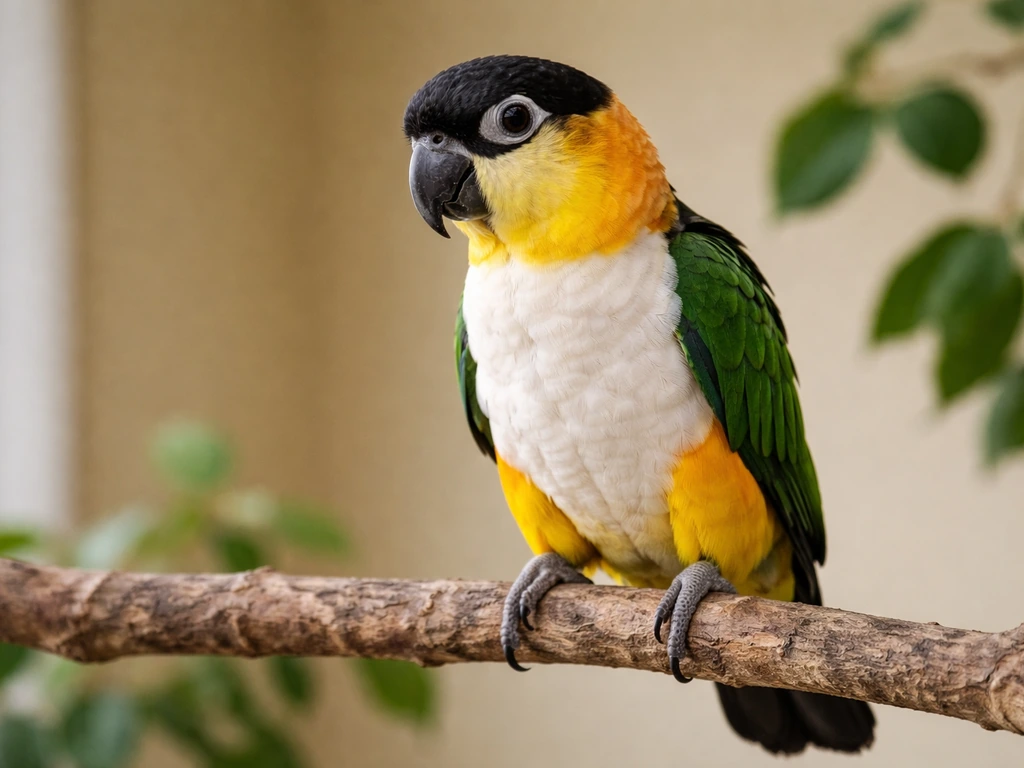
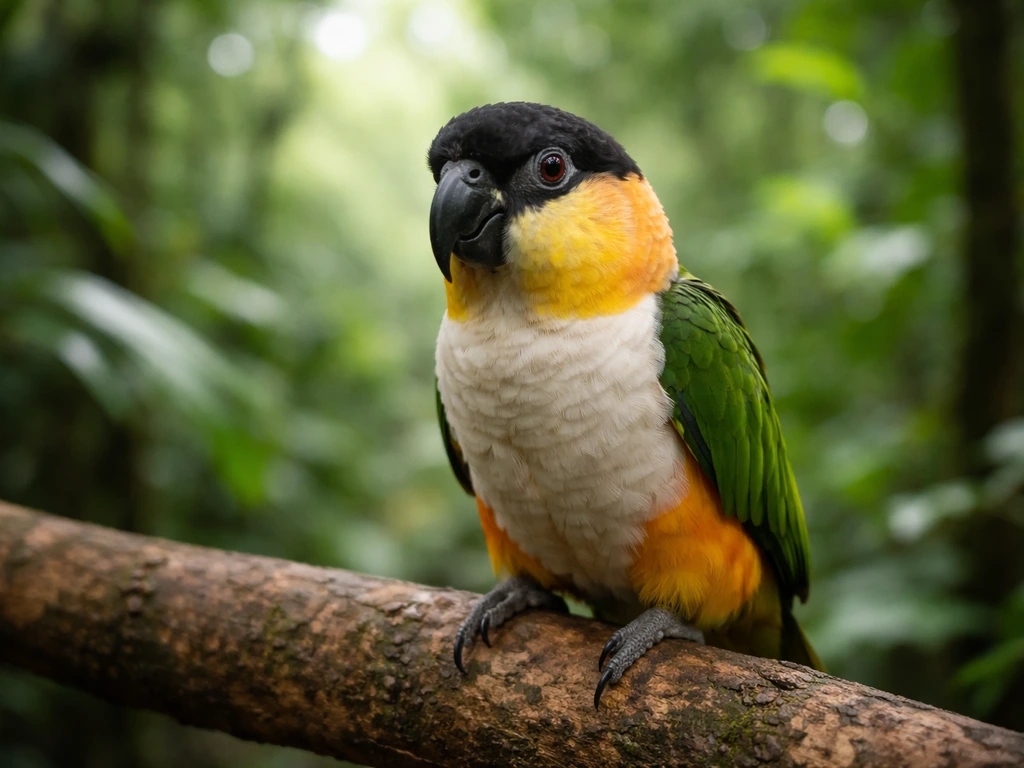
When birders, parrot keepers, or pet store staff say "caique bird," they almost always mean one of the small, stocky parrots in the genus Pionites, native to the Amazon Basin in South America. Depending on which taxonomic authority you follow, Pionites contains two to four species. The two you'll hear about most often are the white-bellied caique (Pionites leucogaster) and the black-headed caique (Pionites melanocephalus), sometimes also called the black-capped parrot. Both species are popular in aviculture because of their bold, playful personalities and striking color patterns.
The World Parrot Trust and most field guides list the black-headed caique under that exact common name, alongside aliases like "black-capped parrot." WebMD's pet care content identifies both Pionites leucogaster and Pionites melanocephalus as the caiques most commonly kept as pets. So if someone at a bird fair or in an online parrot forum says "caique," you can be confident they're talking about a Pionites parrot, not anything else.
The correct English pronunciation, phonetic guide included
Here's the pronunciation laid out as clearly as possible, with both practical phonetic spelling and IPA for anyone who reads that notation.
| Accent | Phonetic spelling | IPA | Stress |
|---|---|---|---|
| American English | kah-EEK | /kɑːˈiːk/ | Second syllable (-EEK) |
| British English | ky-EEK | /kaɪˈiːk/ | Second syllable (-EEK) |
Cambridge Dictionary lists both of these as correct. Merriam-Webster gives /kä-ˈēk/, which matches the American form. The "eek" at the end is a long, clean /iːk/ sound, like the end of the word "seek" or "creek." Hold it just a beat longer than you might expect.
Syllable breakdown and where to put the stress

"Caique" is two syllables, full stop. It's not three. Think of it as two distinct parts: the opener ("kah" or "ky") and the stressed closer ("-EEK"). Cambridge's sound-by-sound phoneme mapping breaks the word into /k/ + /aɪ/ (or /ɑː/) + /iː/ + /k/, but in natural speech those middle vowel sounds blur into a smooth two-beat sequence. The first syllable is unstressed and relatively short. The second syllable gets all the weight. If you've ever said "antique" or "technique," you already know the rhythm: it's that same back-heavy stress pattern.
- Syllables: cai-QUE (two syllables)
- Stress: falls on the SECOND syllable (-QUE / -EEK)
- Rhythm: similar to "a-NTIQUE" or "u-NIQUE"
- The final "-eek" sound rhymes with "seek," "creek," and "week"
Mistakes people make and how to dodge them
The three most common caique pronunciation errors all come from the spelling. The word looks vaguely Portuguese or Spanish to English speakers, and that visual impression pulls people in the wrong direction.
- Stressing the first syllable: saying KAY-eek or KAH-eek with the emphasis up front. The stress belongs on the second syllable, not the first. Think "kai-EEK," not "KAI-eek."
- Pronouncing it as three syllables: something like "kah-EE-kweh" or "KAY-ee-kay." This happens when people try to decode the "-que" ending as Spanish (like "porque" or "caique" as if it were a Spanish cognate). It's not. The "-que" is silent-ish: the whole word ends in just the /k/ sound, producing two clean syllables.
- Saying "KAY-eek" in American English: The first vowel in American English is /ɑː/ (the "ah" in "father"), not /eɪ/ (the "ay" in "say"). Saying "KAY-" as the opener is a British-adjacent pronunciation for Americans, according to Cambridge's documented US/UK split.
- Saying "KAH-eek" in British English: The reverse problem. UK pronunciation uses /kaɪ/ ("ky" or "kye") for the first vowel, not the flat "ah" of the American version. If you're in the UK and say "kah-EEK," you'll still be understood, but the documented British form is closer to "ky-EEK."
The fastest fix for any of these is to anchor your memory to a rhyming word you already know. "Unique" ends the same way: "-EEK." Build from there.
Where the word "caique" actually comes from
Understanding the etymology helps explain why the pronunciation is what it is, and why the spelling looks so unusual in English. "Caique" came into English from French (caïque), which borrowed it from Italian (caicco), which got it from Ottoman Turkish (قایق, kayık). The original Turkish word referred to a light rowing boat: long, narrow, and fast. Britannica describes the traditional caïque as a Turkish vessel designed for speed on the water. Merriam-Webster records the first known use in English as 1625, specifically for this boat meaning.
So how did a Turkish rowing boat become an Amazonian parrot? That's a naming quirk from early European naturalists. The parrots were likely given the name as a phonetic borrowing or informal label that stuck in regional usage and eventually became the standardized common name in ornithology. The boat connection is now essentially irrelevant in birding contexts, but it does explain the French-style spelling (the "-que" ending, the accent that sometimes appears over the "i" in caïque) and the non-obvious English pronunciation. The word was always pronounced with that back-stressed "-EEK" because that's how it arrived from Turkish through French.
US vs UK and other pronunciation variations
The clearest documented variation is the first-vowel difference between American and British English that Cambridge Dictionary records. In the US, the opener is /ɑː/ ("ah"), giving kah-EEK. In the UK, it's /kaɪ/ ("ky" or "kye"), giving ky-EEK. Both versions stress the second syllable identically, and both are correct within their respective accents. Wiktionary lists both IPA variants as well, confirming this isn't a case of one being right and one being wrong.
In practice, the difference between US and UK speakers is subtle enough that neither group will confuse the other. The more significant divide is between people who've actually heard the word said aloud versus those encountering it only in print. First-time readers who try to decode the spelling from scratch are the ones most likely to land on three syllables or misplace the stress, regardless of accent. Community pronunciation platforms like Forvo have American English audio recordings available for "caique," so you can hear the spoken version rather than just interpreting IPA. That's genuinely useful if you're not confident reading phonetic notation.
Bird name pronunciation in general can follow some tricky patterns. If you’re looking for how to pronounce cockatiel bird, it helps to start with the standard syllable breakdown and stress so you say it the way native speakers do. If you've ever wrestled with bird names like "chough" (pronounced "chuff") or wondered about the right way to say "potoo," you already know that English bird names regularly defy spelling expectations. If you want the same kind of help for how to pronounce potoo bird, look for a phonetic guide or native audio, because bird-name spelling can be misleading. If you also want to learn how to pronounce the chough bird, the same idea applies: rely on a phonetic guide rather than the spelling how to pronounce chough bird. Caique fits that tradition: the spelling is French-derived, the sounds are not remotely what the letters suggest, and the only reliable guide is phonetic notation or audio.
Practice drills and how to lock in the pronunciation
The most effective way to nail a tricky pronunciation is to use it out loud in short, repeated bursts. Here's a quick drill you can run through in under two minutes.
- Say the rhyme anchor three times: "seek, creek, week" -- then add "caique" at the end of the chain. This trains your mouth to land on the same "-EEK" sound.
- Practice the full word slowly: "kah... EEK." Pause between syllables at first. Then speed up: "kah-EEK, kah-EEK, kah-EEK."
- Use it in a sentence: "I saw a black-headed caique at the bird fair." Say the whole sentence three times at natural speaking speed.
- Listen and compare: pull up the Forvo audio for "caique" (search "caique" on Forvo and select the English recording) and say the word immediately after hearing it. Repeat until your version matches.
- Check a second source: look up "caique" in the Cambridge Dictionary online. Both the UK and US audio buttons are on the same page, so you can hear both variants back to back.
Reliable references for verifying bird name pronunciations
For confirming caique specifically, Cambridge Dictionary and Merriam-Webster are your two most authoritative written references in English. If you want to practice, try saying "tanager bird" a couple of times, then compare your phrasing to a native audio clip. blank" rel="noopener noreferrer">Cambridge gives you both UK and US audio. Merriam-Webster's stress-marked entry (/kä-ˈēk/) is unambiguous about syllable weight. Wiktionary is a solid secondary check because it documents variant IPA forms that the major dictionaries sometimes consolidate. For community audio, Forvo has user-submitted English recordings that let you hear the word from real speakers rather than synthesized voice.
For bird-specific name conventions, the World Parrot Trust's species accounts and the Cornell Lab of Ornithology are good references for confirming which common names are considered standard. Neither provides audio pronunciation guides, but they at least confirm that "caique" is the accepted English common name for Pionites parrots, so you know you're using the right word when you say it.
FAQ
If I hear “caique” in a bird shop, does it always mean the Amazon Basin parrots (Pionites), or could it mean something else?
In English birding and pet contexts, “caique” almost always refers to small Pionites parrots. If the conversation is about a different animal (for example, a different parrot genus), ask which common name or species they mean, because “caique” is fairly specific even if people use it casually.
What are the most common mispronunciations people make when they read “caique” and how can I self-correct quickly?
Yes, but only one pronunciation matches typical English practice. Avoid “KAY-ik” or “ka-ih-KEY.” Use two syllables with hard stress on the second, “kah-EEK” (US) or “ky-EEK” (UK). If you accidentally add a third beat, you likely shifted the stress away from “-eek.”
Should I choose “kah-EEK” or “ky-EEK” depending on where I am, or will either be understood?
Either accent version is fine in conversation, but consistency helps. If you are speaking in the UK, “ky-EEK” will sound most natural; if you are speaking in the US, “kah-EEK” will. Listeners will usually understand both, since stress on the final syllable stays the same.
I keep saying it with the wrong number of syllables. How can I practice the rhythm so I land on the correct two-beat pattern?
The spelling can tempt you into reading it like a three-syllable word. A reliable mental check is: start softly, then hit “Eek” with the most weight. Practice by saying just the last part, “Eek,” then add the opener “kah” or “ky” before it.
Is there a practical way to confirm I’m pronouncing the final “-eek” correctly (not just the stress)?
When you want to verify your pronunciation without relying on spelling, record yourself saying “caique” after you review the stress pattern, then compare it to a native audio clip. Also check that the final vowel is a long “ee” sound, not a short “ih” or “eh.”
Is it correct to say “caique bird,” and does it matter whether I name the white-bellied or black-headed caique?
If you are using it as an informal label, “caique bird” is redundant but understandable. In more precise settings, people may specify “white-bellied caique” or “black-headed caique.” If you are unsure, ask which one they mean, since “caique” can be used for multiple species.
Do I need to worry about the French accent mark (like in caïque) when pronouncing “caique” in English?
The “accent mark” you might see in the related French form (caïque) is not something English speakers generally use when pronouncing “caique.” English learners should ignore that visual cue and focus on the two-syllable English rhythm: “kah-EEK” (US) or “ky-EEK” (UK).
In natural speech, does the pronunciation change, and how do I handle the “blurring” without losing the two-syllable pattern?
Yes. In quick speech, the middle vowel can blur, but the structure should remain two syllables with final stress. If you hear yourself stretching the first syllable too long, shorten it and then emphasize “-eek.”
Next Article
How to Pronounce Potoo Bird Correctly (IPA Guide)
Learn the correct everyday pronunciation of potoo bird with syllables, IPA, common mistakes, and similar bird-name confu