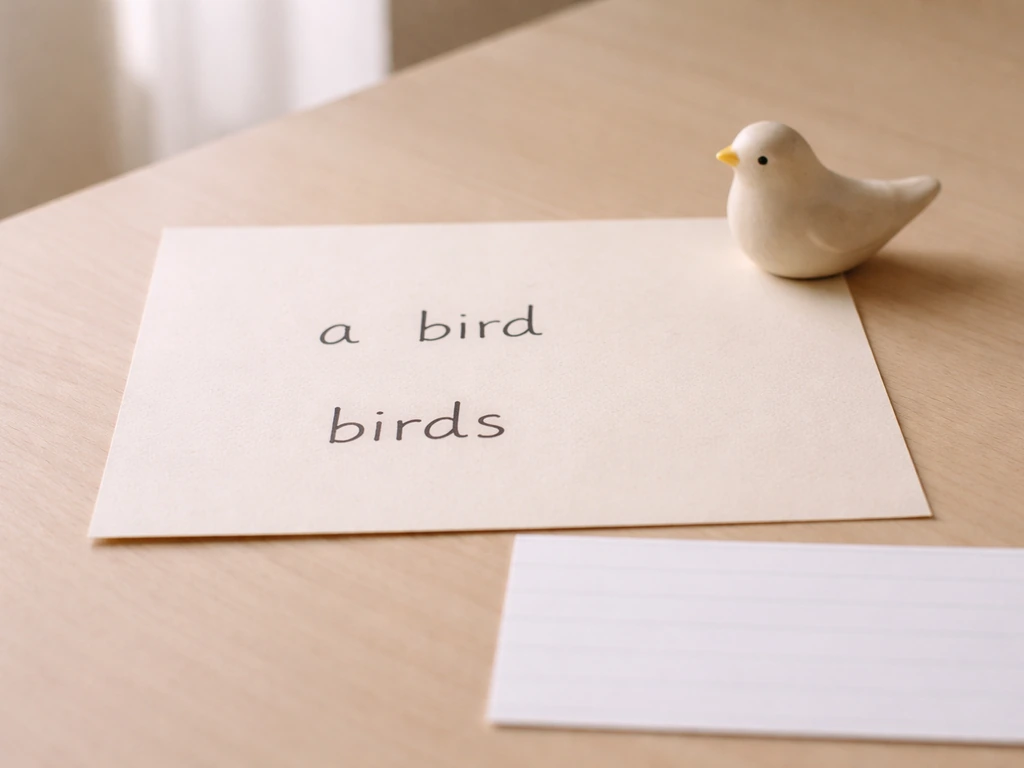
No, "bird" is not a pronoun. In standard English grammar, "bird" is a noun, full stop. Every major dictionary, from Cambridge to Merriam-Webster to Collins, labels it as a countable noun. It never stands in for another noun the way a pronoun does. If you're trying to confirm this for a grammar test, a homework assignment, or just to settle a curiosity, the answer is straightforward: "bird" is always a noun, no matter how it shows up in a sentence.
Is Bird a Pronoun? How to Tell Noun vs Pronoun

James Ridgley
2 Jun 2026

Pronouns vs Nouns: A Quick Refresher
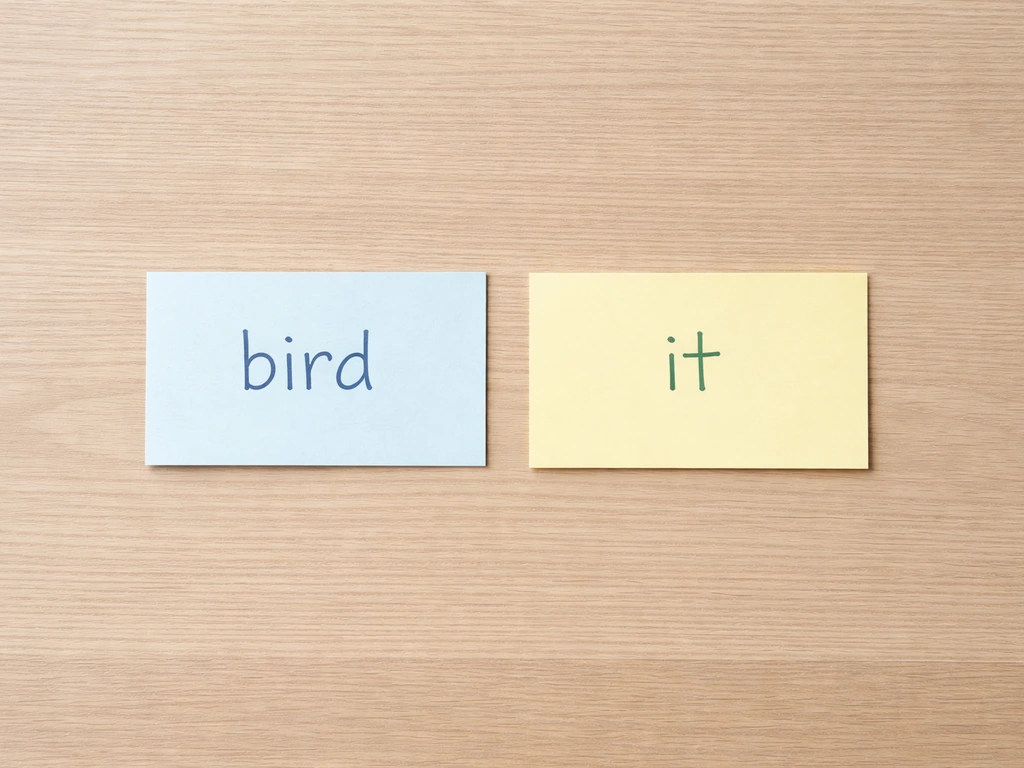
A pronoun is a word used instead of a noun or noun phrase. Think of it as a stand-in, a substitute that takes the place of a name or thing you've already mentioned (or that's obvious from context). Words like "it," "they," "this," "that," "who," "someone," and "anybody" are all pronouns. They work because you can drop them into a sentence without needing an article or adjective in front of them, and the sentence still makes sense.
A noun, on the other hand, is a word that names a person, place, thing, or concept. Nouns can take articles ("a bird," "the bird"), can be pluralized ("birds"), and can be made possessive ("the bird's feathers"). Pronouns typically can't do any of those things without losing their pronoun identity. You'd never say "a it" or "the who," but you absolutely say "a bird" or "the birds" without a second thought.
Does "Bird" Function as a Pronoun in English?
It does not. Cambridge Dictionary labels "bird" explicitly as "bird noun [C]" (that [C] means countable noun). Collins does the same, listing it plainly as "NOUN." There is no pronoun sense, no secondary pronoun usage, and no grammatical context in standard English where "bird" steps into pronoun territory. It names a thing (a feathered animal, or informally a person in British English slang), and naming things is what nouns do.
Here's the practical test: can you replace "bird" in a sentence with a known pronoun like "it" or "they"? Yes, you can, and that replacement actually shows the difference. "The bird flew away" becomes "It flew away." The word "it" is the pronoun doing the substitution work. "Bird" was the original noun that "it" replaced. That relationship right there is exactly why "bird" is a noun and "it" is a pronoun.
Testing "Bird" in Real Sentence Roles
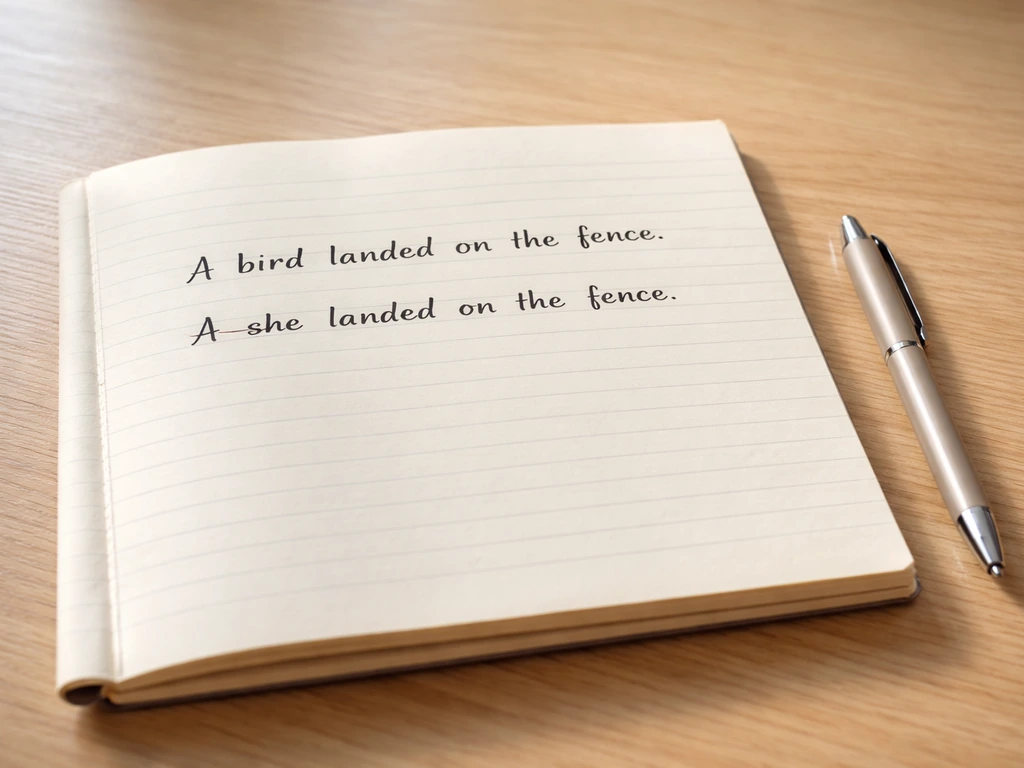
One of the clearest ways to confirm a word's part of speech is to test it in different sentence roles. "Bird" passes every noun test and fails every pronoun test.
| Sentence Role | Example with "Bird" | Noun or Pronoun? |
|---|---|---|
| Subject | A bird landed on the fence. | Noun (takes article "a") |
| Object | I watched the bird for an hour. | Noun (takes article "the") |
| Possessive | That bird's nest is empty. | Noun (takes possessive 's) |
| Plural subject | Two birds flew overhead. | Noun (pluralizes to "birds") |
| After adjective | A small bird hopped closer. | Noun (modified by adjective) |
Notice what each example has in common: "bird" is always accompanied by or capable of being accompanied by a determiner ("a," "the," "that"), an adjective ("small"), or a number ("two"). Pronouns don't work that way. You can't say "a it" or "small they." The moment you can stick an article or adjective directly in front of a word and have the sentence still work, you're almost certainly looking at a noun.
Common Confusions: "That," "It," and Generic References
The confusion around "is bird a pronoun" often comes from a couple of legitimate grammar puzzles worth untangling.
"That bird" vs "that" as a pronoun
Words like "that," "this," "these," and "those" are demonstratives, and they can function as either determiners or pronouns depending on how they're used. In "that bird is singing," "that" is a determiner modifying the noun "bird." But in "that is singing" (where you point at the bird without naming it), "that" becomes a pronoun because it's standing alone in place of the noun. Cambridge grammar explicitly notes this dual role for demonstratives. The key distinction: when "that" is followed by "bird," it's a determiner and "bird" is still the noun. When "that" stands alone, it's the pronoun.
Generic references and "bird" as a concept
Sometimes "bird" gets used in a very general, almost abstract way, like "Bird is the word" (the famous song phrase) or "Bird can't fly from a cage it doesn't know it's in." Even in these poetic or philosophical constructions, "bird" is still functioning as a noun. It may lack an article in front of it, which can look unusual, but English allows nouns to be used without articles in certain generic or stylistic contexts. This is not a pronoun; it's a bare noun. Compare it to "Love is blind" or "Life goes on," where the nouns drop their articles for rhetorical effect.
"It" as the pronoun stand-in for a bird
When we talk about a bird in everyday speech, we often swap to "it" after the first mention: "A finch landed on the branch. It stayed there for ten minutes." That "it" is the pronoun. "Finch" (and by extension "bird") was the noun. The pronoun's whole job is to refer back to that noun so we don't have to keep repeating it. This is the pronoun-noun relationship in action, and it makes it very clear which word is which.
"Bird" in Species Names, Idioms, and Titles: Still a Noun
On a site focused on bird naming and nomenclature, it's worth being specific about this: "bird" never shifts to a pronoun when it appears in species names, compound terms, idioms, or titles. It stays a noun in every single one of those contexts.
Take "bird of paradise. Cambridge Dictionary lists “bird of paradise” as a noun [C] [Cambridge labels this as “noun \[C\]”](https://dictionary.cambridge.org/us/dictionary/english/bird-of-paradise). " Cambridge labels this as "noun [C]" and Merriam-Webster lists it as a noun as well. Britannica does the same. The word "bird" inside that compound name is functioning as a noun component of a larger noun phrase. The same applies to terms like "bird flu," "bird call," "bird dog," or "bird watcher." In these compound forms, "bird" is either the head noun or a noun modifier, but it is never a pronoun.
Idioms are no different. "A bird in the hand is worth two in the bush," "kill two birds with one stone," "the early bird catches the worm" -- in every one of these, "bird" or "birds" is a noun. Idioms don't change a word's grammatical category; they just give it a figurative meaning. And if you're curious about related grammatical questions, like what type of noun "bird" is or what the adjective form of bird looks like, those are worth exploring separately since they build on the same foundational understanding that "bird" is, at its core, a noun. If you want the direct answer to what type of noun "bird" is, that is covered in the related section on bird is which type of noun. The adjective form of bird is commonly used to describe birds or bird-like traits.
Quick Grammar Test + Your Next Steps
If you ever need to confirm whether a word is a noun or a pronoun in a sentence, run it through this short checklist. It works for "bird" and for any other word you're unsure about.
- Can you put "a" or "the" directly in front of it and have it make sense? If yes, it's almost certainly a noun. ("A bird" works. "A it" doesn't.)
- Can you add an adjective in front of it? Nouns accept adjectives; pronouns generally don't. ("A colorful bird" works. "A colorful it" doesn't.)
- Can you pluralize it by adding -s or -es? Nouns do this regularly. Most pronouns don't ("birds" is a noun plural; "its" is a possessive pronoun, a completely different word).
- Does it replace another noun, or does it name something itself? Pronouns replace; nouns name. "Bird" names a thing. "It" replaces the name.
- Can you make it possessive with 's? "Bird's" works as a noun possessive. Try that with a true pronoun: you'd say "its" not "it's" in the possessive sense, which is a distinct pronoun form, not a noun construction.
For your next steps: if you're working through a grammar exercise and "bird" appears, mark it as a noun, countable. If you want a broader refresher on pronouns versus nouns after this, see bird is noun or pronoun for how to classify “bird” correctly in context. If you're studying pronoun types (personal, relative, demonstrative, indefinite, possessive), look for words like "it," "who," "that" (when used alone), "someone," or "anybody," not for "bird. blank" rel="noopener noreferrer">Pronouns are used in place of nouns, and examples of main pronoun types include personal, relative, demonstrative, and indefinite pronouns. " And if you're here because you came across "bird" in a species name or a bird-related compound term and weren't sure of its role, the answer is the same: it's a noun component in a noun phrase, and you can check the exact spelling, pronunciation, and meaning of any specific bird name in a dedicated ornithological dictionary or reference guide. Starting with bird homophones meaning can also help you distinguish real word forms from similar-sounding terms.
FAQ
Can “bird” be a pronoun in sentences like “Birds migrate”?
No. Even when “bird” is used generically (for example, “Birds are migratory”), it’s still a noun. The generic meaning comes from using a plural noun, not from turning the word into a substitute for another noun.
Does “birds” ever become a pronoun inside common idioms?
Usually, no. Words like “birds” can be parts of fixed phrases, but they still function as nouns within the phrase (for example, “kill two birds with one stone”). What changes is the meaning of the whole expression, not the grammatical category.
Is “bird” a pronoun when it appears in a title, song lyric, or slogan?
No, “bird” does not become a pronoun in titles either. In things like “The Early Bird Catches the Worm,” “bird” is the noun being described (with “early” as an adjective), not a stand-in for “it” or “they.”
How do I tell whether “bird” is in noun phrase form versus pronoun phrase form?
“Bird” can follow determiners, and that’s the key. If you can naturally say “a bird,” “the bird,” “this bird,” or “that bird,” the grammar is noun phrase territory. Pronouns generally can’t take an article like “a.”
In “A bird landed, and it stayed,” which word is the pronoun and which is the noun?
Yes, this is one common misconception. “It” is the pronoun that replaces the earlier noun (“the bird” or “a bird”). But “bird” itself stays the noun, even if it’s the first mention in the sentence.
What about headline style, like “Bird found in engine”? Is that different from normal sentences?
Not in standard English. Pronouns do the referring work, while “bird” keeps naming. Even if you omit the article in a headline style like “Bird found in engine,” “bird” is still the noun that the missing article is just implying stylistically.
Can “bird” become a possessive pronoun, like “bird’s”?
No, “bird” cannot be possessive as a pronoun (for example, you would not write “their bird” as a pronoun using “bird” itself). “Bird’s” is possessive noun form (the bird’s feathers), while pronouns show possession with separate pronoun words (“its,” “their”).
How can I tell whether “that” is a determiner or a pronoun when I see “that bird…”?
It depends on the sentence, but “bird” itself remains a noun. You might see “that” act as a determiner (“that bird”), or as a pronoun when it stands alone (“That is amazing”). The test is whether “bird” follows immediately after “that.”
Does “bird” ever act like a pronoun inside species names or bird-related compounds?
No. In species and scientific-style terms, “bird” stays a noun component even when it’s used like a modifier (for example, “bird species,” “bird watcher”). The whole unit is a noun phrase, not a pronoun.
If I try substituting “it” for “bird,” how do I interpret what I find?
Run a substitution check: replace the word with “it” or “they.” If the original sentence needs a determiner or sounds ungrammatical after substitution (for example, you do not replace “a bird” with “it” without also adjusting structure), that pattern indicates the original word was a noun, and “it” is what would replace it, not the original word itself.
Next Article
Bird Is Noun or Pronoun? Clear Rules and Examples
Find out if bird is noun or pronoun with clear rules, sentence examples, and common mistakes corrected fast.