Toucan is spelled exactly as it sounds: t-o-u-c-a-n. Six letters, no doubled consonants, no silent extras. If you came here mid-crossword, mid-Google search, or mid-text to a friend, that's your answer. The word you want is toucan, and Merriam-Webster, Cambridge, and Britannica all agree on that exact spelling.
How Do You Spell Toucan the Bird? Correct Spelling and Pronunciation

James Ridgley
23 Mar 2026
The correct spelling of toucan

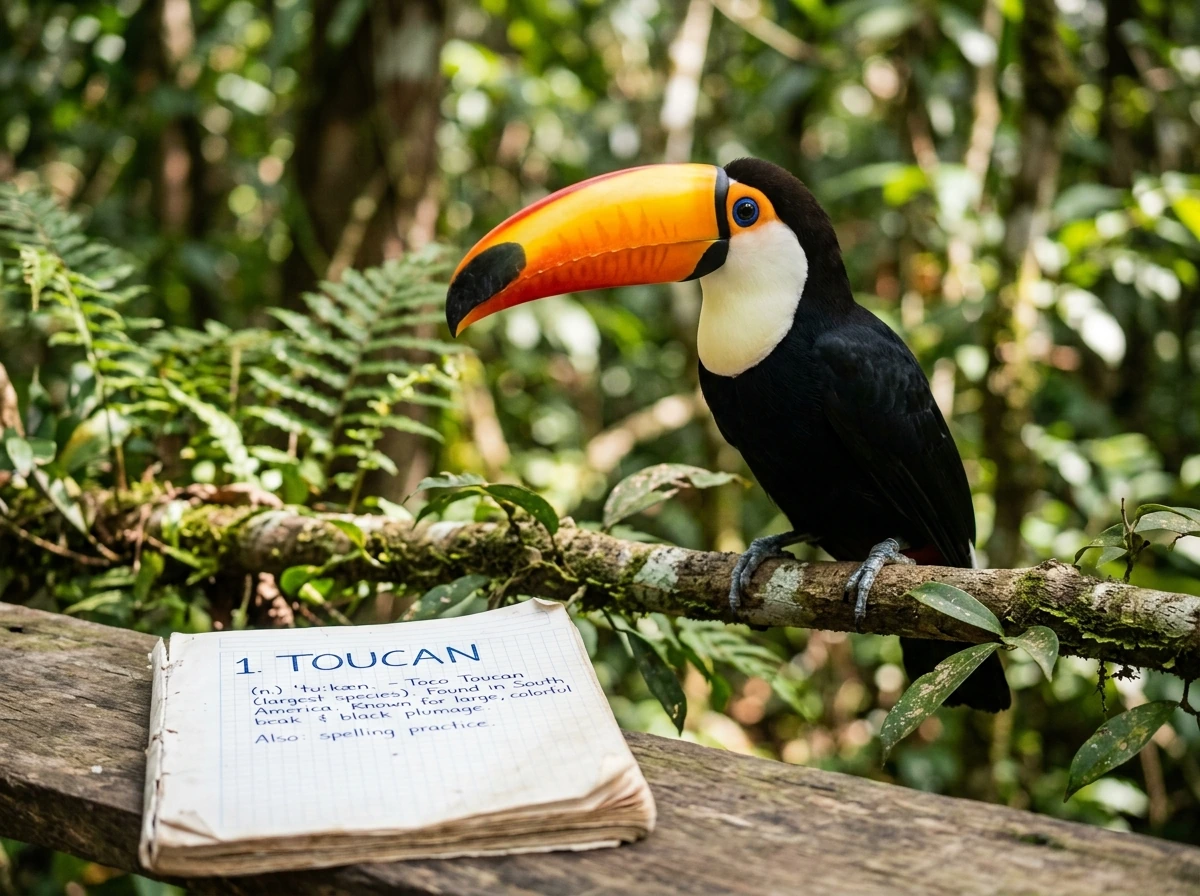
The standard English common name for the bird is toucan, lowercase, spelled t-o-u-c-a-n. That's it. Merriam-Webster lists it as the headword, Cambridge Dictionary lists it the same way, and the U.S. Fish and Wildlife Service uses 'Toucans' as the official common name for the entire family Ramphastidae. There are no accepted alternate spellings in standard English. You won't find a variant like 'tucan' or 'tocan' in any reputable dictionary because those forms don't exist as correct spellings.
The name refers to a large group of birds in the family Ramphastidae, known for their oversized, colorful bills. Britannica notes that 'toucan' appears in the common names of around 15 species, and if you include closely related aracaris and toucanets, the group stretches to about 35 species total. Britannica notes that “toucan” appears in the common names of around 15 species, and including closely related aracaris and toucanets brings the total to about 35 around 15 species, and about 35 species total. So 'toucan' is both a specific common name and a broader group label, but the spelling never changes regardless of which species you mean.
Common misspellings and how to fix them
The two misspellings that trip people up most often are 'tucan' and 'tocan.' Both are missing the letter u in different spots, which tells you something: the u in 'toucan' is genuinely easy to overlook or misplace because it sits quietly between the t and the c without making a strong sound of its own.
| What you typed | What's wrong | The fix |
|---|---|---|
| tucan | Missing the 'o' after 't'; the 'ou' becomes just 'u' | Add the 'o' back: t-o-u-c-a-n |
| tocan | Missing the 'u' after 'o' | Insert the 'u': t-o-u-c-a-n |
| toucen | Wrong vowel at the end ('e' instead of 'a') | The last vowel is 'a': t-o-u-c-a-n |
| tou can | Broken into two words with a space | Close it up: one word, no space |
| toucan's / toucans | Possessive or plural forms | Both are fine; base spelling stays the same |
The quick mental fix: think of the word as two chunks, 'tou' and 'can,' like the word 'can' tacked onto a sound that rhymes with 'too.' Lock in those six letters in order, and you'll never second-guess it again. Merriam-Webster's Scrabble word checker also confirms TOUCAN as a valid word spelling, which is a handy real-world sanity check if you ever need one.
How to pronounce toucan

Toucan is a two-syllable word with the stress on the first syllable. Every major dictionary agrees on this. Here's how each one writes it out:
| Dictionary | Pronunciation notation | Simple breakdown |
|---|---|---|
| Merriam-Webster | ˈtü-ˌkan | TOO-kan |
| Cambridge (US) | /ˈtuː.kən/ | TOO-kuhn |
| Britannica | /ˈtuːˌkæn/ | TOO-kan |
In plain English: say TOO (like the number two) then KAN (like the word 'can'). Some dictionaries show the second syllable with a slightly reduced vowel, closer to 'kuhn,' which is normal for casual American speech. Either way, stress goes firmly on TOO, not on the second syllable. You'll never hear a fluent speaker say 'too-KAN' with the emphasis at the end.
Pronunciation tips for everyday speech
If IPA symbols feel like a foreign language, don't worry about them. Just remember: toucan rhymes with 'new can.' As in, 'I need a new can of paint.' Same rhythm, same stress. TOO-can. That mental hook works in every context, whether you're chatting about a zoo visit, filling in a crossword, or describing a photo to a friend.
One thing that catches people off guard is that the 'ou' in toucan doesn't sound like the 'ou' in 'out' or 'cloud.' It sounds like a plain long 'oo,' the same sound as in 'food' or 'moon.' This is why people sometimes write 'tucan': they hear the 'oo' sound and don't realize it's being spelled as 'ou.' Knowing this makes both the spelling and the pronunciation click at the same time.
In continuous, relaxed speech, the second syllable often gets swallowed a bit, especially in American English. You might hear something like 'TOO-k'n' rather than a crisp 'TOO-kan.' Both are natural and correct. Don't overthink the ending. Get the first syllable right and the stress right, and you're good.
If you want to hear a native speaker say it, Cambridge Dictionary's pronunciation page for toucan has audio for both UK and US pronunciations. Forvo also has user-submitted recordings of the word, which is useful if you want to hear how real people say it in everyday conversation rather than a studio-recorded dictionary voice. Listening even once or twice makes the word stick far better than reading phonetics alone.
How to verify the spelling and search for related toucan names
If you want a quick double-check on the spelling, these are the most reliable places to look:
- Merriam-Webster (merriam-webster.com): type 'toucan' in the search bar and the headword confirms the spelling instantly.
- Cambridge Dictionary (dictionary.cambridge.org): same approach, and you get IPA plus audio pronunciation in one click.
- Britannica (britannica.com): useful if you want spelling confirmation alongside natural history context about the bird.
- Cornell Lab's All About Birds (allaboutbirds.org): a go-to for birders; search 'toucan' to find species-level common names.
Searching for a specific toucan species requires a bit more precision. The word 'toucan' on its own will return a lot of general results, and it can also pull up unrelated uses of the word in brand names or pop culture. To narrow things down, add the species name or the family name Ramphastidae to your search. For example, searching 'toco toucan bird' or 'White-throated Toucan Ramphastos tucanus' will take you straight to species-level information on sites like eBird or ITIS.
It also helps to know the related group names. Aracaris and toucanets are smaller birds in the same family, Ramphastidae, and Britannica treats them as part of the toucan group. If you're exploring the broader family and your searches keep returning the same handful of results, try adding 'aracari,' 'toucanet,' or the genus name 'Ramphastos' to open up more specific entries. The IOC World Bird List is a good taxonomy backbone for this kind of research, as it catalogs the whole Ramphastidae family by genus.
For anyone filling in a puzzle or checking a word game entry, the spelling is confirmed: T-O-U-C-A-N, six letters, valid in standard English dictionaries. If you're working on bird-related spelling questions more broadly, the same approach applies to other tricky bird names like pigeon, cuckoo, or phoenix, all of which have their own common spelling pitfalls worth knowing. For “how do you spell phoenix the bird”, use the link above. how do you spell bird
FAQ
Is it ever spelled “toukan” or “tocan,” like how people often miss it in captions?
No. In standard English, the accepted spelling is always t-o-u-c-a-n. The common mistake happens because the sound you hear is a long “oo,” but the spelling uses “ou,” so you need to lock in the exact letter order rather than relying on what the vowel sounds like.
Do you capitalize it as “Toucan” when referring to the bird?
Usually no when you mean the common noun, so it is “a toucan” or “toucan species.” You only tend to capitalize “Toucan” when it is part of a specific proper name of a species, for example in some formal species listings where the name is treated as a title.
What is the correct pronunciation if I want to sound natural, not overly careful?
Aim for stress on the first syllable (TOO-can). In casual, continuous speech, the second syllable may sound reduced or slightly “swallowed,” like “TOO-k’n,” but the stress should stay on TOO.
Does the plural change spelling, like “toucans”?
The plural is made by adding -s to the same base spelling, so it is “toucans.” The word root stays the same, meaning you do not add or remove letters when you change number.
How do you spell it for a crossword or word game if the grid includes blanks?
Use exactly six letters in order: T O U C A N. If your crossword entry looks shorter or you are missing a letter, double-check that you are using the standard common spelling, not a near miss like t-u-c-a-n or t-o-c-a-n.
If I’m searching for a specific toucan species online, what’s the fastest way to avoid irrelevant results?
Add a more specific term to your search rather than using toucan alone, such as the species common name (for example, “toco toucan”) or “Ramphastidae.” This reduces confusion with unrelated brand names or pop-culture uses of the word.
Is “toucan” only one species, or does it mean a whole group?
It can do both. As a common English term, “toucan” is used for a specific type of bird and also appears in the common names for multiple species within the toucan group (family Ramphastidae). Either way, the spelling remains toucan.
Are there other English spelling rules I should watch for with bird names like this?
A good habit is to check whether the word has an internal letter that is easy to misplace, like the u in toucan. For similar puzzle questions, treat the spelling as something to memorize by exact sequence, then confirm with a word checker if allowed by the game.
Next Article
How Do You Spell Pigeon the Bird Correctly
Correctly spell pigeon the bird, avoid common misspellings, learn pronunciation and capitalization tips.