
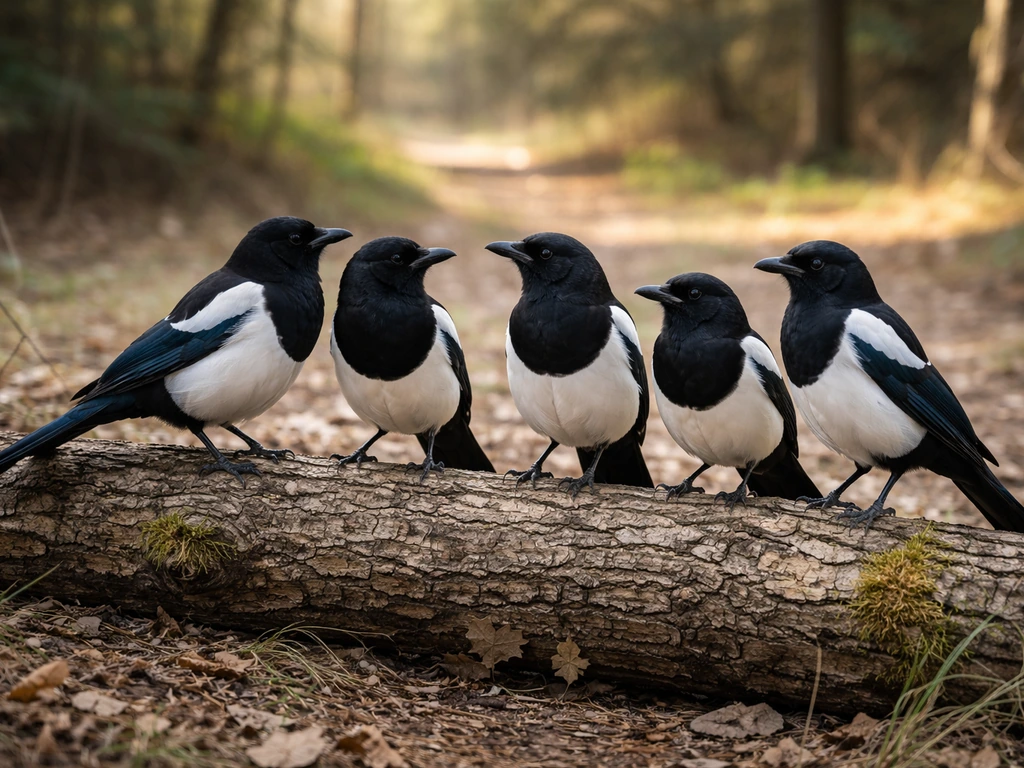
The bird you're looking for is the magpie. 'A conventicle of magpies' and 'a tribe of magpies' both appear in popular collective-noun lists as alternative group terms for magpies, alongside the more widely known 'a tiding of magpies. A Wasatch Audubon newsletter PDF also lists collective-noun options for magpies, including “charm,” “gulp,” “mischief,” “tittering,” and “tribe.” “a tribe of magpies”. ' That said, neither 'conventicle' nor 'tribe' is a dictionary-attested standard the way 'flock' or 'murder' are. They come from the terms-of-venery tradition, where compiled bird-group names spread through reference lists rather than through formal lexicography. So the direct answer is magpies, but with a caveat about how reliable that mapping actually is.
A Bird Whose Collective Noun Is Conventicle or Tribe

What you're really asking: collective nouns and how they work for birds
A blank" rel="noopener noreferrer">collective noun is a single word that refers to a group of things treated as one unit. The plural of “bird” is “birds.
” what is the plural of bird. For animals, the most interesting subset is called 'terms of venery' or 'nouns of assembly,' which are group names that are species-specific. Think 'a murder of crows,' 'a parliament of owls,' or 'a circus of kea. For example, one well-known collective noun for birds is “a parliament of owls.
”. A parliament of owls is a classic example of a bird collective noun used in the terms of venery tradition. ' These terms have a long folkloric tradition rooted in medieval hunting culture, and they tend to be charming and evocative rather than clinically precise.
The tricky part is that these terms of venery have never been fully standardized. Compilers have been gathering, inventing, and passing along bird group terms for centuries, and different books, websites, and databases often disagree on which term belongs to which bird. When you search for 'a bird whose collective noun is a conventicle or tribe,' you're working in exactly this grey zone: terms that appear on lists but aren't always pinned firmly to one species across every source.
The quick answer: conventicle and tribe as magpie group names
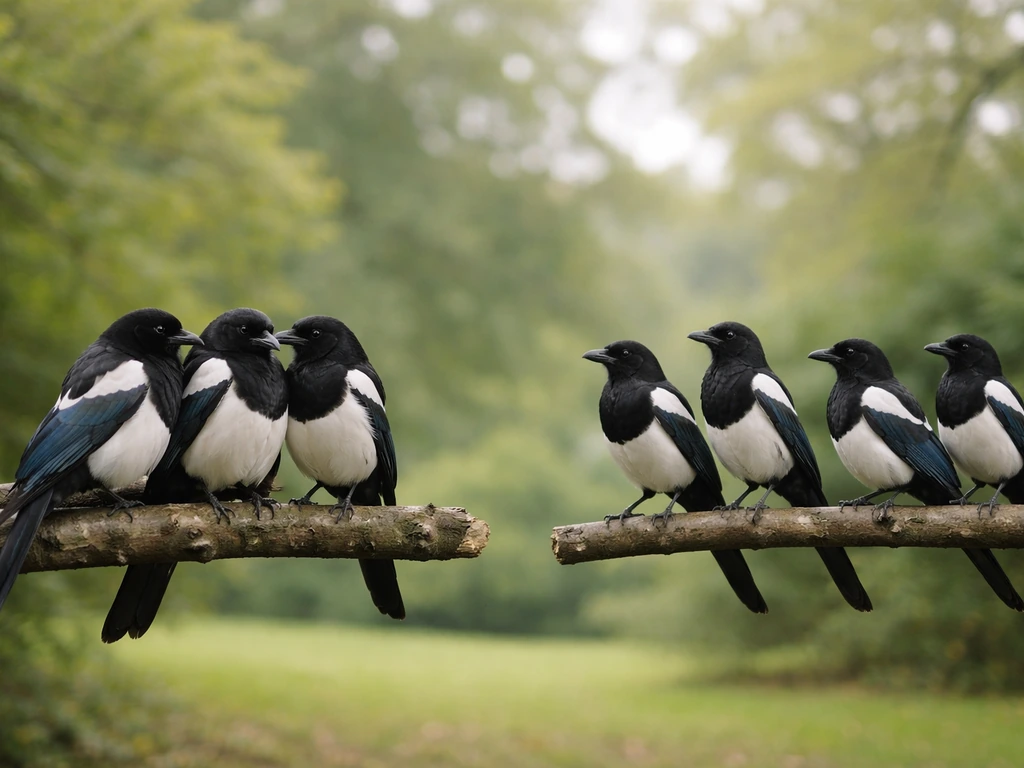
Multiple collective-noun resources list 'a conventicle of magpies' as one of several group terms for magpies. The word conventicle historically refers to a secret or clandestine assembly (specifically a dissenting religious gathering), and it's been applied to magpies in a playful, metaphorical way. Magpies are famously noisy, conspiratorial-seeming birds, which makes a word meaning 'secret meeting' feel like a fitting, if tongue-in-cheek, label.
'A tribe of magpies' also shows up in some lists, though 'tribe' travels more broadly across animal-group compilations. At least one educational collective-noun resource also maps 'a tribe' to sparrows, which shows how loosely these terms can circulate. For magpies specifically, 'tiding' (or 'tidings') is the most commonly cited group term. Conventicle and tribe are real alternatives you'll find listed, but they're secondary options, not the headline term.
How to verify a collective noun: dictionaries vs. bird lists vs. puzzle sites
This is where it pays to know your sources, because they behave very differently when it comes to bird collective nouns.
| Source type | What it gives you | Reliability for bird group terms |
|---|---|---|
| General dictionaries (Merriam-Webster, Oxford, Cambridge) | Core word definitions; standard language meanings | Low for specialist group terms. 'Conventicle' is defined as a religious assembly, not a bird-group word. |
| Collective-noun lists and databases (Grammar Monster, EngDic, Vigay.com) | Compiled bird group terms, often including rare or folkloric options | Medium. Widely cited but not always cross-verified against primary sources. |
| Wikipedia species articles | Sometimes mentions collective nouns in passing (e.g., 'a murder of crows') | Varies. Good for established terms; less consistent for minor variants. |
| Word puzzle and trivia sites | Broad lists intended for crosswords, quizzes, and word games | Low as a language authority, but useful for solving specific clues. |
| Specialist ornithology references | Scientific naming and taxonomy, not usually terms of venery | Not relevant for collective-noun queries. |
The practical takeaway: if you're solving a crossword or word puzzle and the clue points to 'conventicle or tribe' as a collective noun, the answer is almost certainly magpie. But if you want to cite this in writing and need it to hold up to scrutiny, know that general dictionaries won't back you up on the bird-group sense. The term lives in the terms-of-venery tradition, not in mainstream lexicography.
Spelling and pronunciation: how to say and write 'conventicle' correctly

Conventicle is one of those words that looks harder than it is. Here's how to break it down:
- Spelling: c-o-n-v-e-n-t-i-c-l-e. Five syllables. The root is the Latin 'convenire,' meaning 'to assemble' or 'to come together,' which is also the root of 'convention' and 'convene.'
- IPA pronunciation: /kənˈvɛn.tɪ.kəl/
- Practical phonetic guide: kun-VEN-ti-kul. Stress falls on the second syllable (VEN).
- Common mistake: confusing it with 'conventional' or mashing the ending into '-tical.' The correct ending is '-ticle,' not '-tical' or '-tical.'
- Another easy mix-up: 'conventicle' vs. 'conventicle.' There's only one correct spelling. No double letters, no alternate endings.
'Tribe' needs no pronunciation guide (/traɪb/, rhymes with 'scribe'), but it's worth knowing that in biology, 'tribe' is also a formal taxonomic rank sitting between family and genus. That's a completely separate use from the collective-noun sense, and it's why some sources treat 'tribe' as a scientific term rather than a fun group name.
When and how to use these terms in real life
Birdwatching and casual conversation
In everyday birdwatching, almost nobody says 'a conventicle of magpies.' You'd say 'a group of magpies' or 'a flock of magpies,' and everyone would understand you instantly. The terms of venery, including conventicle, are mostly reserved for moments when you want to impress, amuse, or play with language. Drop 'conventicle' into a conversation with a birder or a word nerd and you'll get a reaction.
Creative writing and nature writing
In prose, 'a conventicle of magpies' is genuinely evocative. The word carries connotations of secrecy, conspiracy, and dissent, which layers nicely onto a description of magpies chattering in a tree. If you're writing a nature essay, a poem, or fiction that involves magpies, this term earns its place. 'A tribe of magpies' works too, though it reads as slightly more generic. Use 'conventicle' when you want the word itself to do some work.
Word puzzles, quizzes, and trivia

This is probably the most common reason someone searches this phrase. If a clue or question asks 'what bird has the collective noun conventicle or tribe,' the answer your puzzle is looking for is magpie. If you're asking for what is the collective noun for bird, the commonly given answer is 'a conventicle of magpies' (or 'a tribe of magpies') what bird has the collective noun conventicle or tribe. That mapping appears consistently across collective-noun lists and puzzle-oriented word resources. Lock it in.
Other magpie group names (and related bird collective nouns worth knowing)
If you're building out your knowledge of bird collective nouns, here are the main group terms for magpies plus a selection of well-known bird group names that are worth having in your vocabulary.
Group names specifically for magpies
- A tiding (or tidings) of magpies: the most commonly cited and widely recognized term.
- A conventicle of magpies: appears across collective-noun lists; evocative of secret assemblies.
- A tribe of magpies: less magpie-specific but shows up in some compilations.
- A parliament of magpies: occasionally listed, though 'parliament' is more famously associated with owls.
- A mischief of magpies: a playful alternative sometimes cited in popular lists.
Well-known collective nouns for other birds
| Bird | Collective noun(s) | Notes |
|---|---|---|
| Crows | A murder | One of the most famous and well-documented terms of venery. |
| Owls | A parliament | Widely cited; connects to the idea of wisdom and deliberation. |
| Sparrows | A host or tribe | Shows how 'tribe' migrates across species in list-based sources. |
| Finches | A charm | A popular and widely recognized bird group term. |
| Kea | A circus or conspiracy | Documented in Wikipedia's species article; reflects the kea's reputation for mischief. |
| Any birds (general) | A flock | The universal, dictionary-standard term usable for any bird group. |
Knowing these alternatives matters because collective-noun questions in puzzles and trivia often use the group term as the clue rather than the bird name, so building a mental map in both directions (term to bird and bird to term) is genuinely useful. If you're exploring related territory, collective nouns for birds more broadly, or specific terms like 'charm' or 'parliament,' follow those threads and you'll find a whole ecosystem of terms-of-venery lore worth knowing.
Bottom line: what to do with this information
If you need a quick answer for a puzzle or a quiz, write 'magpie.' That's the bird most consistently linked to 'a conventicle' in collective-noun lists. If you're writing and want to use the term, go for it, 'a conventicle of magpies' is vivid and defensible in any creative or descriptive context. Just don't expect a standard dictionary to back up the bird-group sense; that's not where these terms live. They belong to the terms-of-venery tradition, which is part folklore, part wordplay, and entirely worth knowing.
FAQ
If a crossword clue says "a conventicle" or "a tribe" by itself, how should I respond?
In most puzzle contexts, those phrases are used as collective-noun starters that point to the magpie specifically (for example, “a conventicle of magpies”). If the clue does not name the bird, check crossings, because other terms-of-venery labels can exist for other species, and “conventicle” by itself can also mean a secret gathering in general English.
Is "conventicle" ever used for a different bird besides magpies?
Some collective-noun lists mix and match terms-of-venery across species, and “conventicle” appears mainly in magpie mappings in the sources people rely on for puzzles. If you are writing for publication, treat it as list-dependent, not universally standardized, and consider pairing it with a safer, mainstream option like “a flock of magpies.”
Which is safer for formal writing, "a conventicle of magpies" or "a flock of magpies"?
Use “a flock of magpies” when you need broad comprehension, since “flock” is dictionary-attested for many birds and avoids the terms-of-venery consistency problem. “A conventicle of magpies” is best when you specifically want the stylistic, playful register of terms-of-venery language.
Can "tribe" confuse people because it is also a biological classification rank?
Yes. Readers with a biology background may pause because “tribe” is a formal taxonomic rank (between family and genus). In contexts where clarity matters, consider “a group of magpies” or “a flock of magpies,” or explain the phrase is a collective noun.
Are “tidings” or “tiding” interchangeable with “conventicle” and “tribe” for magpies?
They can be treated as alternative collective-noun options for magpies in puzzle sources, but “tiding” (or “tidings”) is the more commonly cited headline-style term. If you are solving, try “magpie” as the answer, then use the exact wording to choose the intended collective noun.
How can I double-check the intended answer if the puzzle clue is vague or missing article text?
If the clue format is unclear (for example, “magpies, collective noun: conventicle or tribe”), focus on the bird name “magpie.” Then verify by letter pattern and crossings, because the terms-of-venery tradition has multiple variants and some collections disagree on which term belongs to which species.
What should I write if someone challenges me that “conventicle” is not a dictionary collective noun?
You can acknowledge the limitation directly: the magpie mapping comes from the terms-of-venery tradition rather than broad lexicographic standardization. If you need to be persuasive, frame it as a “terms-of-venery” collective noun used in word lists and puzzles, not a mainstream definition found in general dictionaries.
What Is the Collective Noun for Bird? (Flocks and More)
Learn the collective nouns for birds, whether bird is one, and when to use flocks and more with copyable examples.