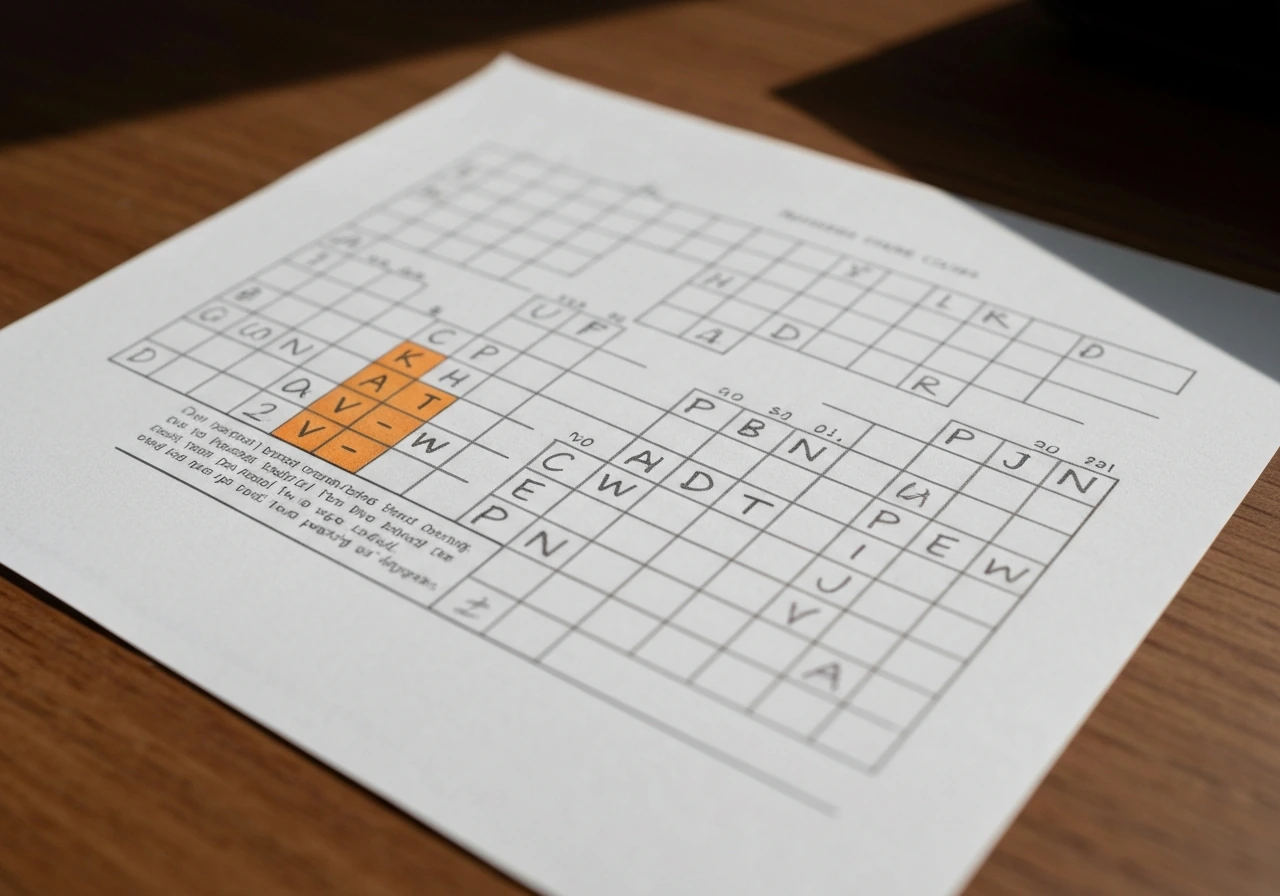
If you are staring at a crossword clue that reads 'prefix meaning bird or flight, 3 letters,' the answer you want is AVI. That is the Latin-rooted prefix from avis, meaning bird, and it is the go-to 3-letter answer confirmed across multiple NYT crossword clue databases. That is the Latin-rooted prefix from avis, meaning bird, and it is the same idea behind the prefix meaning bird or flight nyt clue answer. prefix meaning bird or flight nyt. But a few other 3-letter roots can come up depending on how the clue is worded, so it is worth knowing the full shortlist and how to tell them apart quickly.
Prefix Meaning Bird or Flight in 3 Letters: Quick Guide

James Ridgley
21 Apr 2026

Quick answer shortlist: 3-letter prefixes for bird or flight
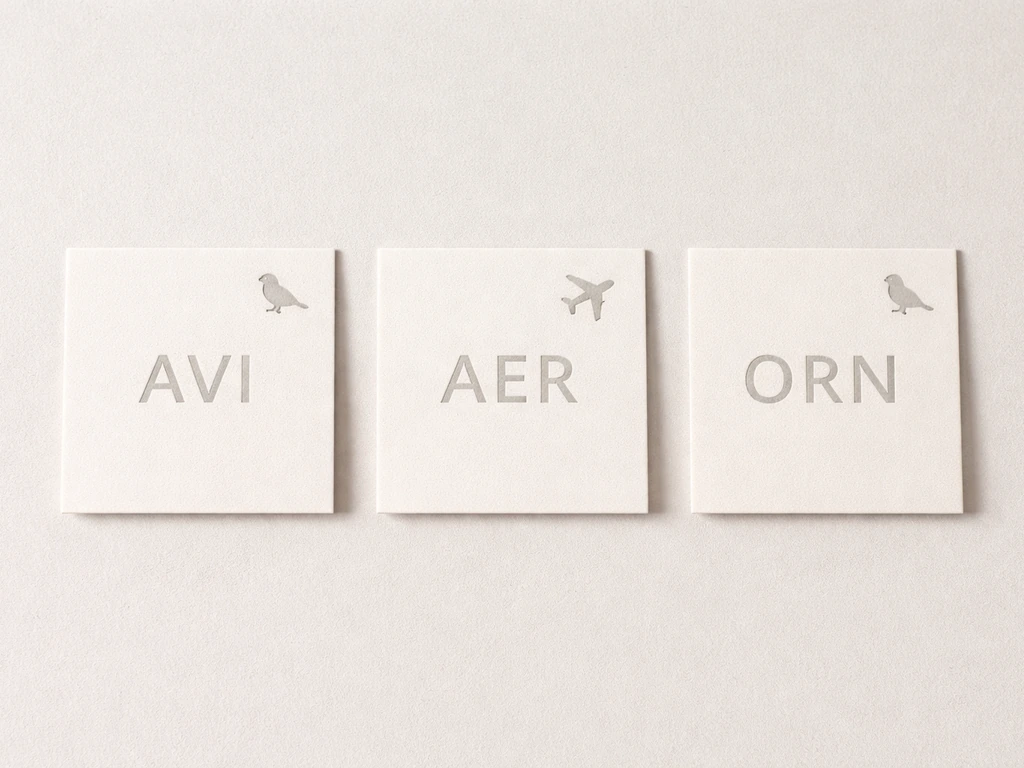
Here are the three candidates you will realistically encounter in a word puzzle or naming context. Each one is genuinely used as a combining form in English vocabulary, so knowing all three helps you match the right one to your specific clue or word.
| Prefix | Core meaning | Language root | Typical puzzle clue wording |
|---|---|---|---|
| AVI | Bird | Latin avis (bird) | "Prefix meaning bird or flight" / "Bird: Prefix" |
| AER | Air / atmosphere | Greek aēr (air) | "Prefix meaning air or flight" / "Aviation prefix" |
| ORN | Bird (short form of ornith-) | Greek ornis/ornithos (bird) | Rarely clued as 3 letters; usually ornith- or ornitho- |
AVI is the dominant correct answer for any clue that pairs 'bird' and 'flight' together in 3 letters. AER is your answer if the clue leans toward 'air' or 'atmosphere' rather than a living bird. ORN as a standalone 3-letter prefix is uncommon in puzzles but worth knowing for bird-naming contexts on this site.
Meaning and origin: what is behind each root
AVI: Latin for bird
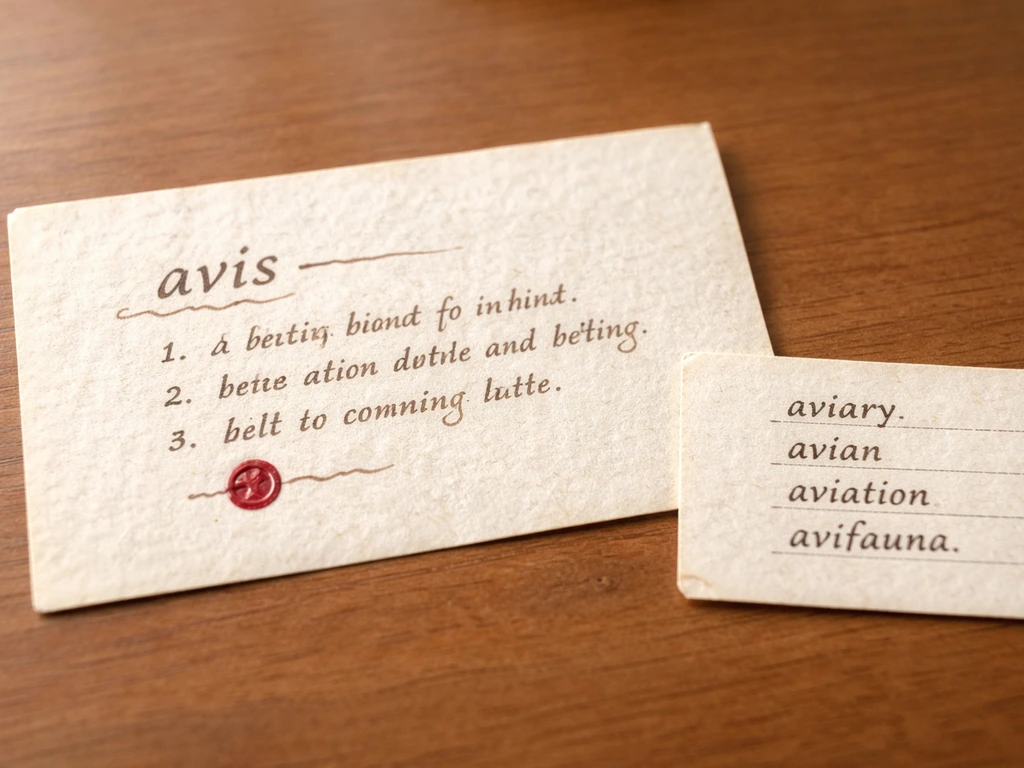
AVI comes from the Latin word avis, simply meaning 'a bird.' This root fed directly into English words like aviary (an enclosure for birds, from Latin aviarium), avian (relating to birds), and aviation (originally a metaphor built on bird flight). The connection between 'bird' and 'flight' in the prefix AVI is exactly why puzzle setters pair those two meanings in a single clue. Latin avis is also the source of the name Avis and shows up in ornithological taxonomy when species names are constructed using Latinized roots.
AER: Greek for air
AER comes from the Greek aēr (also spelled āḗr), meaning air. Merriam-Webster and Dictionary.com both document it as a combining form meaning 'air,' and Oxford Learner's Dictionaries gives the same Greek aēr origin for its longer sibling aero-. Words built on this root include aerogram, aerobic, and the broader aero- family covering aircraft and atmosphere. Britannica Dictionary also defines aero- as a combining form meaning “air.” aero- family covering aircraft and atmosphere.. AER is about air or the atmosphere, not specifically about birds as living creatures. It connects to flight only in the physical sense of moving through air.
ORNITH (and the short form ORN): Greek for bird

ORNITH- comes from Greek ornis, with the genitive form ornithos, meaning bird. Merriam-Webster lists ornith- as a combining form meaning 'bird(s),' and Etymonline describes ornitho- as a word-forming element meaning 'bird, birds' derived from that same Greek root. The full prefix is almost always written as ornith- or ornitho- in real usage, so a puzzle asking for exactly 3 letters is unlikely to use ORN alone. But in scientific bird naming, this is the dominant Greek-origin root you will see, appearing in ornithology, Ornithoptera (bird wing), Ornithorhynchus (bird snout, the platypus genus), and Ornithocheirus (bird hand, a pterosaur genus).
How to confirm the prefix for your specific word puzzle
The fastest confirmation method is to check your crossing letters first. If the puzzle has given you even one intersecting letter, use it to eliminate candidates immediately. AVI starts with A-V-I, AER starts with A-E-R, and ORN starts with O-R-N. They share no letters in common, so a single crossing letter at position 1, 2, or 3 will settle it.
After crossing letters, read the full clue carefully for emphasis. If the clue says 'bird or flight' or just 'bird: prefix,' the answer is AVI. If it says 'air or flight,' 'atmosphere,' or includes something like 'aerobics prefix,' the answer is AER. If the clue references science, biology, or ornithology specifically, and you need more than 3 letters, look at ornith-.
- Check crossing letters first: A-V-I vs. A-E-R vs. O-R-N are completely different letter sets.
- Read the clue for the word 'bird' specifically: AVI is the puzzle world's standard answer when 'bird' appears in the clue.
- Check the fill: AVI fits as a prefix in words like avian, aviary, aviation, avifauna, aviculture.
- Cross-reference with a puzzle database if still unsure: multiple crossword answer sites confirm AVI at 100% match rate for 'prefix meaning bird or flight.'
Bird and ornithology naming connections for these roots
If you are here not for a crossword but for bird naming or ornithological terminology, all three roots are genuinely active in the field, each in its own lane.
AVI- is the Latin-origin workhorse in English ornithology and everyday bird language. Avian influenza, avifauna (the bird life of a region), aviculture (the keeping and breeding of birds), and avid birdwatching all trace back here. When you see avi- at the front of a compound, it is almost always signaling 'relating to birds' in a Latin-derived scientific or descriptive context.
ORNITH- / ORNITHO- is the Greek-origin root that dominates formal taxonomic names and the scientific discipline itself: ornithology is the study of birds. The root shows up in genus names and fossil names across zoology. Ornithoptera is the genus of birdwing butterflies, named for their bird-like wingspan. Ornithorhynchus is the scientific name for the platypus, whose bill resembled a bird's beak to early taxonomists. If you are also looking for a quick definition like bill meaning bird, compare it with these related ornithology terms and naming roots. These names follow the Greek combining-form rule of using ornitho- before consonants and ornith- before vowels.
AER- / AERO- connects to bird naming less directly, but it appears in terms describing flight mechanics, aerodynamics of wings, and the physical environment birds live in. In compound scientific terms relating to bird flight studies, aero- is a useful element even if it does not mean 'bird' itself. You will also see it in older naturalist writing where aerial is used as an adjective for birds that spend most of their lives in the air, like swifts.
Spelling and pronunciation pitfalls to watch out for
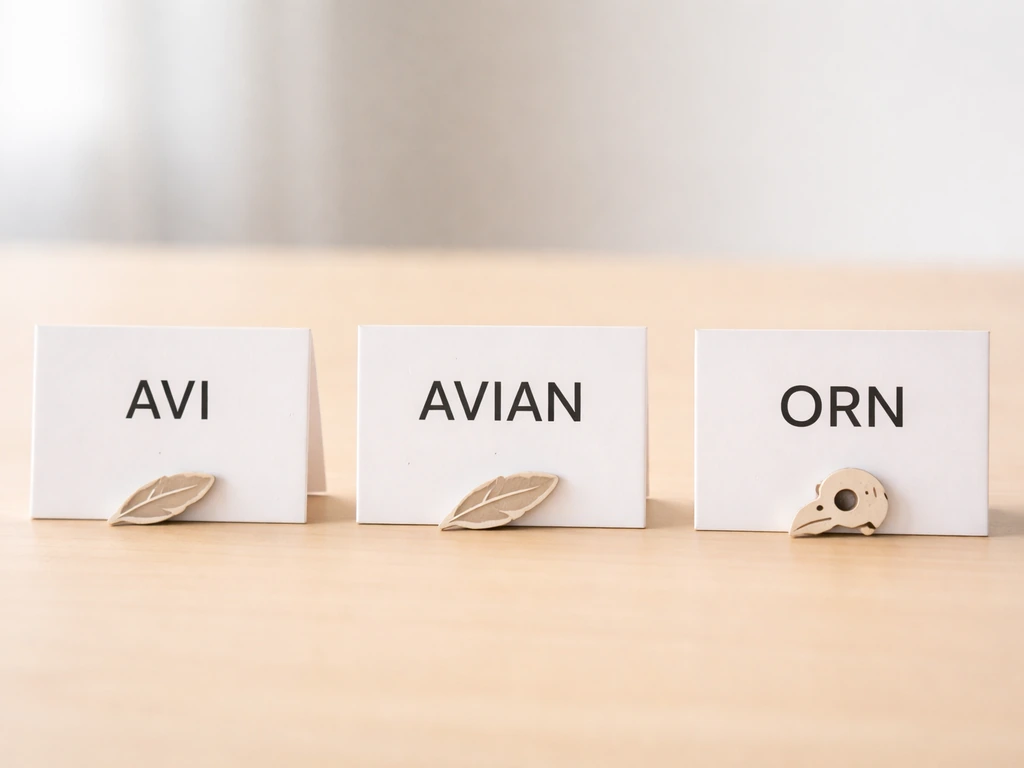
The most common mistake is confusing AVI with AVIAN or AVION and trying to fit a 5-letter prefix where only 3 letters belong. The prefix itself is just AVI (three letters: A, V, I). If a puzzle asks for 3 letters and you write AVIA or AVIAN in the prefix slot, you have overrun the grid.
Pronunciation is simple once you know the rule. AVI is pronounced 'AY-vee' (IPA: /ˈeɪ.vi/), rhyming with 'navy' without the N. AER is pronounced 'AIR' (IPA: /ɛr/), exactly like the English word 'air.' ORNITH is pronounced 'OR-nith' (IPA: /ˈɔːr.nɪθ/), with a soft 'th' at the end like in 'myth.'
- Do not confuse AVI (bird) with AVID (eager): AVID is an unrelated Latin word from avidus (greedy/eager).
- Do not confuse AER (air) with ARC or ARE: the spelling is A-E-R, not A-R-E or A-R-C.
- ORNITH ends with a 'th' sound, not a 't' sound: say 'or-NITH' not 'or-NIT.'
- In crossword grids, AVI is always written without a hyphen: just the three capital letters A-V-I.
- The longer form ORNITHO- is sometimes mistakenly shortened to ORNITO (missing the H): the H is always there in standard spelling.
One sneaky trap: the clue 'prefix meaning bird or flight' feels like it could point to two separate concepts and therefore two different answers. The term “limbless prey for a bird” is a playful way people describe the 4-letter target in crossword and riddle contexts limbless prey for a bird 4 letters. The clue “limbless prey for a bird” is often used in crossword and riddle contexts to point to that same 4-letter answer. It does not. The puzzle setter is relying on the double meaning of AVI, which covers both 'bird' (from Latin avis) and 'flight' (through aviation). Recognizing that single root covers both concepts is the key insight that makes the clue click. If you are looking for a common origami bird crossword answer, the clue often points back to the same AVI prefix idea.
Using these prefixes in bird-related names and terms
If you are building a bird-related name, coining a term for a pet, writing about ornithology, or just curious how these roots work in practice, here is a practical breakdown of how each prefix functions in real compound words.
| Prefix | Example word | What it means | Context it is used in |
|---|---|---|---|
| AVI- | Avifauna | The bird life of a region | Scientific writing, ecology, field guides |
| AVI- | Aviculture | The keeping and breeding of birds | Pet ownership, bird breeding, hobby contexts |
| AVI- | Avian | Relating to birds | Everyday English, veterinary, ornithology |
| AVI- | Aviation | Flight / aircraft (metaphor from bird flight) | Transport, engineering, crossword clues |
| ORNITH- | Ornithology | The scientific study of birds | Academic, research, formal naming |
| ORNITH- | Ornithoptera | Birdwing (butterfly genus) | Taxonomy, entomology, natural history |
| AER- | Aerogram | An air-mail letter form | Postal, communication history |
| AERO- | Aerodynamics | Movement through air | Physics, flight science, bird-flight studies |
When constructing a new bird-related compound name, Latin AVI- is typically the better choice for English-language contexts because it blends naturally with English words and is immediately recognizable to non-specialists. Greek ORNITH- / ORNITHO- is the right choice for formal scientific or taxonomic names, following the conventions used in species classification. If you are naming a pet bird and want something that signals 'bird' clearly, AVI- gives you avian, aviator, and similar roots to play with. If you are interested in how bird names are formed in species nomenclature more broadly, the ornith- root is where most of the action is.
For anyone working through related clues, it is worth knowing that the 'bird or flight' phrasing is a classic double-definition trick used in NYT crossword clues. If you come across sibling clues like 'bird: prefix' in a different puzzle, those also resolve to AVI. The broader world of bird-related prefixes, crossword clue patterns, and Latin versus Greek roots in bird naming all connect to the same small set of roots covered here.
FAQ
If a clue says “bird or flight” but the crossings only confirm one meaning, should I still assume AVI?
Yes, it can still be AVI, because puzzle setters often use “bird” and “flight” as two angles on the same Latin root avis (bird) and its bird-flight descendants (like aviation). You do not need a separate “flight” root if the clue is written to feel like a single combined idea.
What if the clue mentions flight but also includes “air” or “atmosphere,” which should win?
Look at the letter count and the clue grammar. If the puzzle asks for exactly 3 letters and the clue mentions anything tied to air, atmosphere, aerodynamics, or aero-, the intended answer is AER. If the clue instead signals formal biology or taxonomy, it will be steering you toward ornith- or ornitho-, which usually cannot be reduced to ORN with confidence in a strict 3-letter slot.
How can I tell whether AER is correct beyond the clue text?
If you see AER as your best fit from crossings, double-check whether the remaining letters make sense in a real word. AER is commonly used in English as a combining form in aero- and related families, so answers that feel like “air-related technical words” are stronger than answers that look like “bird-only” terms.
What’s a fast elimination strategy when I only get one or two crossing letters?
When crossings are scarce, use letter-position logic. Since the three candidates have very different starting letters (AVI and AER both start with A, ORN starts with O), the first letter is often decisive. If you have two crossing letters, the pair usually eliminates all but one candidate even if you cannot see the full word.
What’s the most common mistake people make with this clue in crosswords?
Be careful with words like AVIAN, AVION, and AVIATE. Those are longer and they mean different things than the 3-letter prefix slot. If the grid clearly demands 3 letters, write AVI (not AVIA/AVIAN) and do not try to extend the form to make a longer-looking spelling.
Why is ORN a weaker choice for many crossword clues, even if it seems like it means “bird”?
In bird-related scientific writing, you may see ornith- or ornitho- depending on the following sound, but the “3-letter” crossword answer is typically about AVI or AER. ORN alone is rare in standard puzzle answers because the real scientific combining forms are usually longer.
Do these clue variations always follow the same answer logic?
For clue variations, treat them as aliases, not new concepts. “Bird: prefix” and “bird or flight, 3 letters” generally resolve to AVI. “Air,” “atmosphere,” or “aerobics prefix” tends to point to AER instead.
Which prefix should I use if I’m coining a new bird-related name and want it to be unmistakably “bird”?
If you are working on naming and want “bird” without ambiguity, AVI- is the safest English-language choice because it cleanly signals bird-related meaning in compounds people will recognize. If you want the strict scientific flavor, use ornith- or ornitho- instead, even though that will not be a 3-letter crossword-style prefix.
Should I decide based on whether the context is crosswords or real scientific terminology?
Use the clue’s domain to decide. Crossword answers are usually about the exact 3-letter prefix, so they prefer AVI or AER. In scientific terminology and taxonomy contexts, the “dominant” combining form for birds is ornith-, with orthographic variants (ornith- vs ornitho-) following the word that comes next.
Next Article
Prefix Meaning Bird Crossword Clue: Likely Prefixes
Solve the prefix meaning bird crossword clue with likely roots, pronunciation tips, and how to disambiguate bird vs flig