"Oh Say Can You Say" is a 1979 Dr. Seuss tongue-twister book, and if you're searching for "oh say can you say bird," you're probably trying to figure out the phrase's origin, use it for pronunciation practice, solve a word puzzle, or track down the actual name of a bird you have in mind. If you meant the translation of “bird” in other languages, that section has a quick breakdown for common languages. All of those are fair reasons to land here. Let's untangle all of them.
Oh Say Can You Say Bird Meaning and Bird Naming Guide

James Ridgley
2 May 2026
Where "Oh Say Can You Say" Actually Comes From
The phrase "Oh Say Can You Say" is the title of a children's book published in 1979 by Dr. Seuss (Theodor Geisel), released by Random House. It's a collection of tongue-twisters aimed at young readers, built around a framing device featuring a parrot named Hooey who reads through the impossible-to-say phrases and reacts with "phooey." That bird connection is genuinely relevant here: Seuss used a parrot specifically because parrots are associated with repeating and mimicking speech, which is the whole joke.
The title itself echoes the opening line of the U.S. national anthem ("Oh say can you see"), swapping in "say" for a punny twist on speech and language. It's become a shorthand phrase for tongue-twister challenges in general, so when people search "oh say can you say bird," they're often looking for pronunciation practice with the word "bird" specifically, a birdy word puzzle, or just curious about the phrase in a bird-naming context.
How the Phrase Gets Used Today
Teachers and speech therapists still use "Oh Say Can You Say" as a go-to resource for phonics and articulation practice. The phrase itself has become a kind of template: "Oh say can you say [tricky word]?" is used in classrooms, language-learning apps, puzzle books, and social media language games. In a bird context, this shows up most often in two ways:
- Pronunciation drills: using "bird," "birdie," and similar words to practice the notoriously tricky English /r/ + vowel combination
- Word games and crossword clues: "Oh say can you say _?" as a prompt where the answer is a bird-related word or species name
- Children's literacy activities: reading the Seuss book aloud and substituting bird names to make the tongue-twister longer and harder
- ESL and language learner contexts: the word "bird" is a classic test case for the British vs. American vowel difference
Pronunciation and Spelling: "Bird" and Related Words
"Bird" is one of those English words that trips up learners from almost every language background, and it also exposes the most noticeable difference between British and American English. Here's exactly how it breaks down:
| Word | UK IPA | US IPA | Phonetic Approximation |
|---|---|---|---|
| bird | /bɜːd/ | /bɝːd/ | "burd" (UK) / "byrd" with r-color (US) |
| birdie | /ˈbɜː.di/ | /ˈbɝː.di/ | "BUR-dee" (UK) / "BYRD-ee" (US) |
| birds | /bɜːdz/ | /bɝːdz/ | "burdz" (UK) / rhotically colored (US) |
The key difference is rhoticity: American English pronounces the /r/ after the vowel (that's the "r-colored" or rhotic vowel, shown as /ɝː/ in IPA), while British English drops it, giving a long, open mid-central vowel (/ɜː/). If you're practicing the word "bird" for an accent, speech therapy, or language learning, that /r/ presence or absence is the whole ballgame. The spelling is always b-i-r-d regardless of accent, which is one less thing to worry about.
Common spelling mistakes to watch for: "brid" (a transposition), "byrd" (an archaic/surname spelling), and "bird's" versus "birds'" (possessive confusion when writing about more than one bird). When you're writing bird names specifically, capitalization rules add another layer, covered just below.
Bird Naming Basics: Common Names vs. Scientific Names
If the Seuss phrase led you here because you're actually trying to refer to a specific bird correctly, there's a straightforward system to know. Birds are named two ways: vernacular (common) English names and scientific (Latin binomial) names. Both systems are standardized, and using them together removes ambiguity.
Common (Vernacular) English Names
The American Ornithological Society (formerly AOU) has clear guidelines on this. When you're writing about a recognized species by its English name, capitalize it: American Robin, not american robin. Barn Owl, not barn owl. This matters more than it sounds: capitalizing the name signals that you mean the specific species with that name, not just any owl that lives in a barn. When you write "gray flycatcher" in lowercase, it could mean any grayish flycatcher; when you write "Gray Flycatcher," you mean Empidonax wrightii, the distinct species with that exact name.
Scientific Names
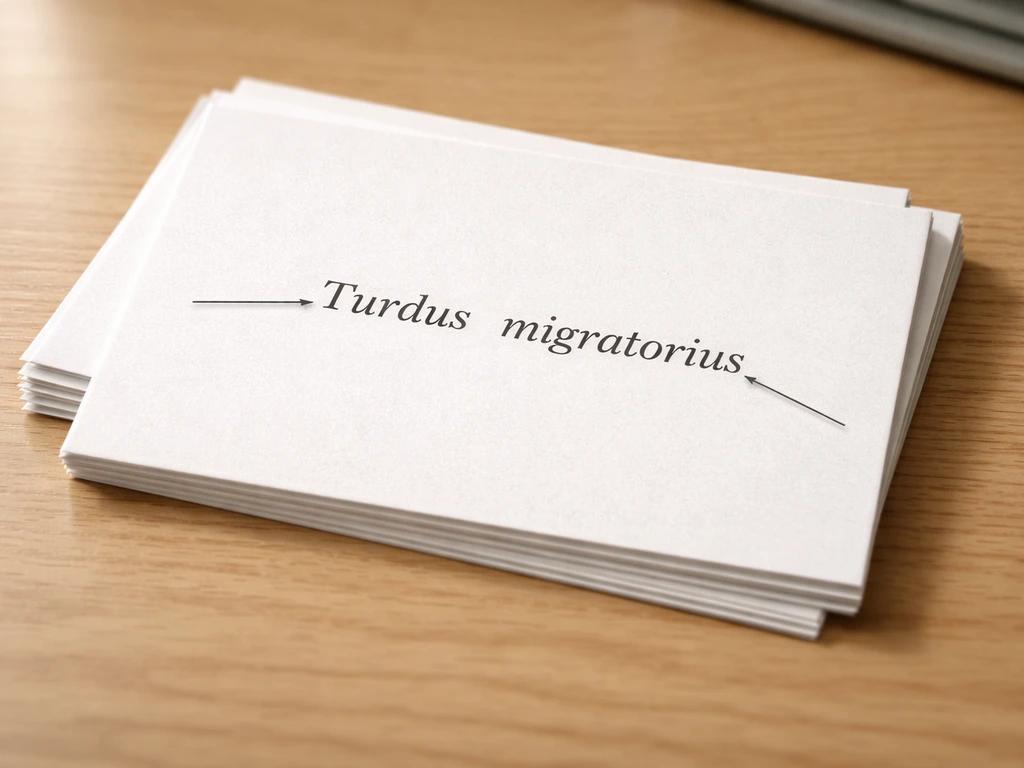
Scientific names follow binomial nomenclature: genus first (capitalized), then species epithet (lowercase), both in italics. So the American Robin is Turdus migratorius. The genus tells you the group; the species epithet tells you the specific kind. According to Cornell Lab's Birds of the World, the capital letter on the genus corresponds to a recognized taxonomic grouping, and the combination should always be read together. Never capitalize the species epithet, and never italicize the common name.
| Name Type | Example | Capitalization | Italics? |
|---|---|---|---|
| Common (English) name | American Robin | Both words capitalized | No |
| Generic (genus only) | Turdus | Capitalized | Yes |
| Scientific (binomial) | Turdus migratorius | Genus capitalized, epithet lowercase | Yes |
| Informal/descriptive | a small brown bird | No caps | No |
How "Bird" Translates Across Languages
The word "bird" itself has a fascinating history and maps differently across language families. If you're coming from the site's broader coverage of how to say bird in other languages, here's the short version of the linguistic picture, with bird etymology built in. If you want the quickest answers, our guide also breaks down how to say bird in multiple languages step by step.
The Old English word for bird was "bridd" (originally meaning a young bird or chick), and "fowl" (from Old English "fugol") was the standard term for adult birds. Over centuries, "bird" expanded to cover all birds, while "fowl" narrowed to mean domesticated or game birds. The /r/ in "bird" is actually a relic of that Old English "bridd" root, shifted by a linguistic process called metathesis (letters swapping positions).
Across languages, the word for bird varies widely because it comes from completely different roots. A few examples from the most widely searched languages:
| Language | Word for Bird | Pronunciation Guide | Root/Notes |
|---|---|---|---|
| French | oiseau | wah-ZOH | From Latin 'avis' via Old French |
| Spanish | pájaro / ave | PAH-hah-roh / AH-veh | 'Ave' is formal/poetic; 'pájaro' is everyday |
| German | Vogel | FOH-gel | Same Germanic root as English 'fowl' |
| Russian | птица (ptitsa) | PTEE-tsah | Slavic root, distinct from Germanic/Romance |
| Japanese | 鳥 (tori) | TOH-ree | Also means chicken in food contexts |
| Mandarin | 鸟 (niǎo) | nyow (falling-rising tone) | Pictographic character, ancient root |
| Italian | uccello | oo-CHEL-loh | From Latin 'avicellus,' diminutive of 'avis' |
Notice that the Latin root "avis" (bird) shows up in several Romance languages and is also the source of English words like "avian," "aviary," and "aviation" (the metaphor of flight). The Germanic branch, where English sits, went a different direction with "bridd/bird" and "fugol/fowl." That's why bird naming in English looks so different from bird naming in French or Italian even though the science behind both is Latin-based.
If you're exploring how to say bird in Russian specifically, or comparing how to say bird across multiple languages at once, the quick mapping above is a useful starting point, but each language has its own nuances in context and usage worth looking at individually.
Context Check: What Are You Actually Looking For?
People arrive at "oh say can you say bird" for very different reasons. Here's a quick diagnostic to point you toward the right next step:
- You want to practice pronouncing 'bird': Focus on the IPA and phonetic guides above. The UK /bɜːd/ vs. US /bɝːd/ distinction is your key target. Try saying 'her,' 'word,' 'heard,' and 'bird' in sequence; they all share the same vowel sound and are great for drilling the pattern.
- You're solving a puzzle or crossword clue: If the clue is phrased as 'Oh say can you say _' and the answer relates to a bird, think about tongue-twister-friendly bird names (Woodpecker, Mockingbird, Whip-poor-will) or simple phonics answers like 'birdie.' Check whether the clue is asking for the Seuss book title itself.
- You're trying to name a specific bird correctly: Use the capitalization rules above for the English common name, and look up the binomial in a resource like Cornell's Birds of the World or the AOS checklist to get the scientific name right.
- You heard or saw a bird and want to identify it: 'Oh say can you say bird' won't help directly here. Go to a field guide or an app like Merlin (Cornell Lab) where you can filter by region, size, color, and sound to ID the species, then come back here for the naming conventions.
- You're teaching a child or language learner: The Dr. Seuss book itself is genuinely useful. Pair it with a short list of bird names that have tricky pronunciation (like 'wren,' 'ptarmigan,' 'pheasant,' or 'toucan') and you have a ready-made phonics lesson with a bird theme.
The bottom line: "Oh say can you say bird" is rooted in a specific Dr. Seuss tradition of playful language and tongue-twister challenge, and the parrot in that book is a sly nod to birds as natural language mimics. Whether you landed here for the wordplay, the pronunciation, or the actual business of naming a bird correctly, you now have the tools to move forward with confidence.
FAQ
How can I use “Oh say can you say bird” to practice pronunciation effectively?
Use the frame literally as a template, “Oh say can you say [word]?”, and pick a target word that creates the pronunciation difficulty you want to practice (for example, minimal pairs like “bird” versus “bard”). For best articulation practice, say it slowly first, then increase speed while keeping the vowel sounds consistent, since the tongue-twister benefit depends on accuracy before speed.
Do I capitalize “bird” when I write a bird species name?
If you are writing a specific species name in English, capitalize the common name exactly as standard usage does (for example, American Robin, Barn Owl). Do not capitalize “bird” or other generic words inside the name if they are part of the common-name phrase, keep the capitalization tied to the established species name.
What is the correct way to write “bird’s” versus “birds’”?
Punctuation matters: use an apostrophe for possessive singular (a bird’s wing) and no apostrophe for plural possessive that ends in s (birds’ wings). If you are unsure, rewrite the sentence to avoid possessive forms, for example, “the wings of the birds.”
What are the exact formatting rules for scientific bird names (genus, species, italics)?
For scientific names, capitalize the genus, lowercase the species epithet, and italicize both together. Also, avoid capitalizing the species epithet even when it is derived from a person or place, it stays lowercase by convention.
Why can two sources disagree about a bird’s “common name”?
Common names do not always map cleanly to one scientific species across regions, for example, the same common name can be used differently in different places. If you need precision, rely on the scientific (binomial) name once you know the bird’s habitat and identifying features.
Are translations of “bird” always one-to-one across languages?
If you are translating or learning “bird” in another language, check whether the language has different words for wild versus domestic birds, or for adult versus young birds. The English word “bird” is broader, so a direct word-for-word translation may be too general or too narrow.
Is “Oh say can you say” connected to the national anthem text exactly, or just loosely?
The phrase is best treated as an English expression, not a literal anthem quote in bird-related contexts. If your goal is to sound natural in English, keep the playful form “Oh say can you say [word]?” rather than trying to match the exact original anthem wording beyond the “Oh say can you see” echo.
What should I do if I only know a rough bird label like “sparrow”?
If the bird you mean might be an ambiguous group (for example, “hawk,” “sparrow,” or “flycatcher”), don’t guess the scientific name from the common name alone. Start with a short list of likely species for your region, then confirm using distinctive traits (size, markings, bill shape, calls) before you finalize capitalization and Latin names.
Should I always use common names or scientific names when identifying a bird?
When you want the “bird naming” answer quickly, use this decision rule: if you need general conversation, use the common name, if you need unambiguous identification, use the scientific name. If you publish, academic, or log sightings, scientific names help prevent confusion caused by regional common-name differences.
Next Article
How to Say Bird: Pronunciation, Spelling, and Naming by Language
How to say and spell bird with pronunciation tips, IPA, and common phrases across languages and birdwatching contexts.