
In most cases, the bird called 'kabar' in English is the Common Myna (also written Common Mynah), scientific name Acridotheres tristis. This is confirmed by multiple Indian regional bird lists, environmental impact assessment documents, and the Rajasthan district gazetteer, all of which explicitly map the local vernacular name 'blank" rel="noopener noreferrer">Kabar' to this single species. If you're in South Asia and you're looking at a boldly patterned, brown-bodied bird with a jet-black head and a bright yellow bill and eye patch, the English name you want is Common Myna.
What Is Kabar Bird Called in English? Find the Name

James Ridgley
5 May 2026
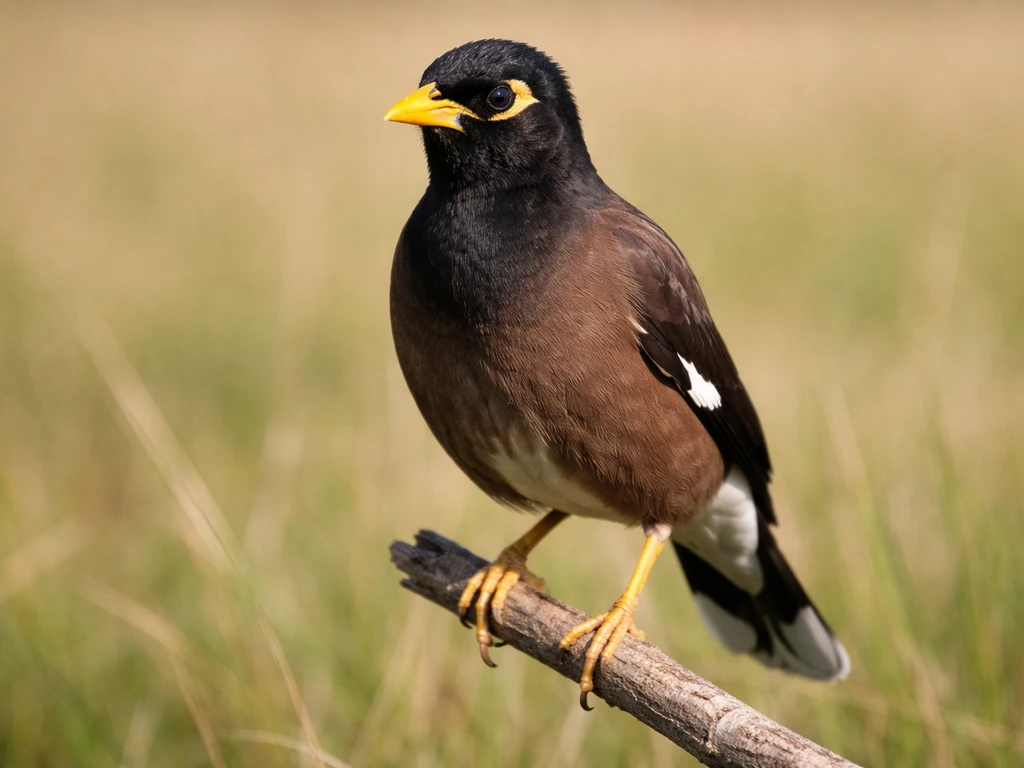
What 'Kabar' actually refers to: local name, regional label, or spelling variant?
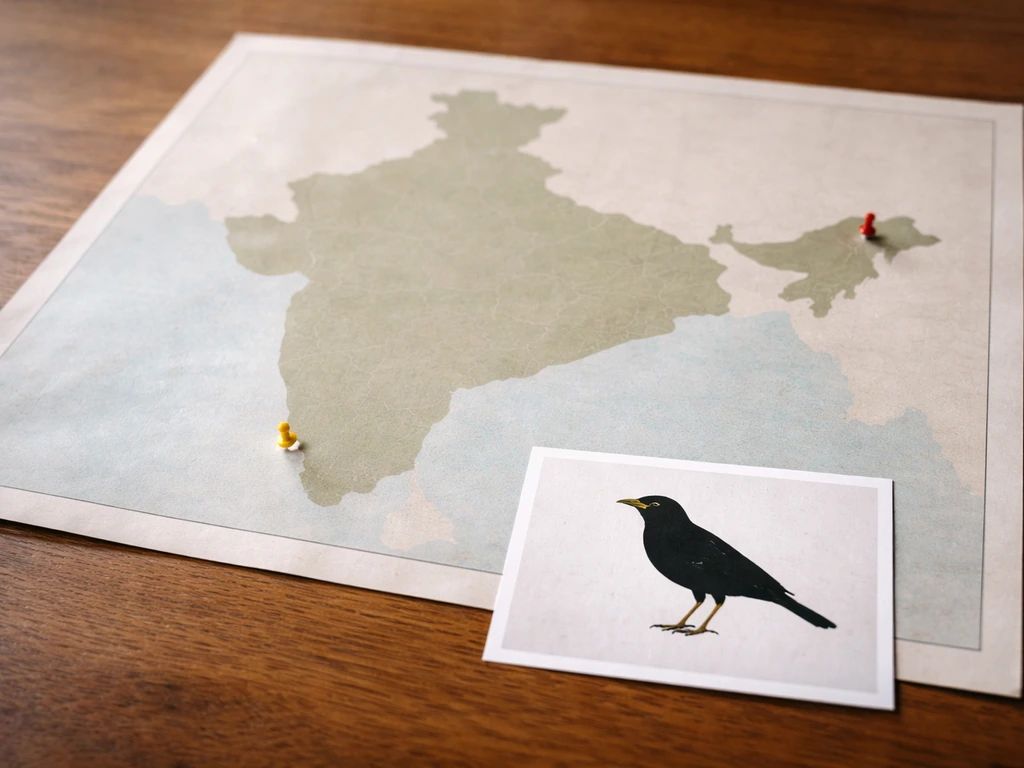
'Kabar' is a vernacular common name used in parts of India, not a scientific or internationally standardized label. It functions much like the way 'koyal' refers to the Asian Koel in Hindi, or how 'ghar' is used locally for certain common birds tied to human settlement. In Gujarati bird lists specifically, 'Kabar' is mapped directly to Acridotheres tristis (Common Myna). The Rajasthan District Gazetteer for Hanumangarh uses the same mapping. It is not a misspelling of an English word and it is not a transliteration of a scientific term. It's simply what people in those communities call the bird.
One important nuance: 'kabar' is not locked to a single species across every community. Some biodiversity case-study documents and regional ornithology papers attach 'kabar' or compound forms like 'Ghoda kabar' to Bank Myna (Acridotheres ginginianus) instead. This tells you that 'kabar' likely works as a broad label for the myna group (genus Acridotheres) in some regions, rather than pinpointing one exact bird. The strong majority of sources, though, point to Common Myna.
The English bird names most people mean when they say 'kabar'
There are two main candidates, and it matters which one you land on because they are different birds with different looks and ranges.
| Local name / variant | English name | Scientific name | Most likely region of use |
|---|---|---|---|
| Kabar | Common Myna (Indian Myna) | Acridotheres tristis | Gujarat, Rajasthan, and broadly across South Asia |
| Ghoda kabar / Kabar variant | Bank Myna | Acridotheres ginginianus | Northern India, riverine/agricultural areas |
Common Myna is the default answer for most readers, and it's what web searches for 'kabar bird' consistently return. Bank Myna is the alternative if you're in a northern Indian state and the bird you're looking at lives near riverbanks or open farmland. When you hear 'kabar' without any qualifier, treat Common Myna as your working assumption until the physical description tells you otherwise.
How to confirm which species you're actually looking at
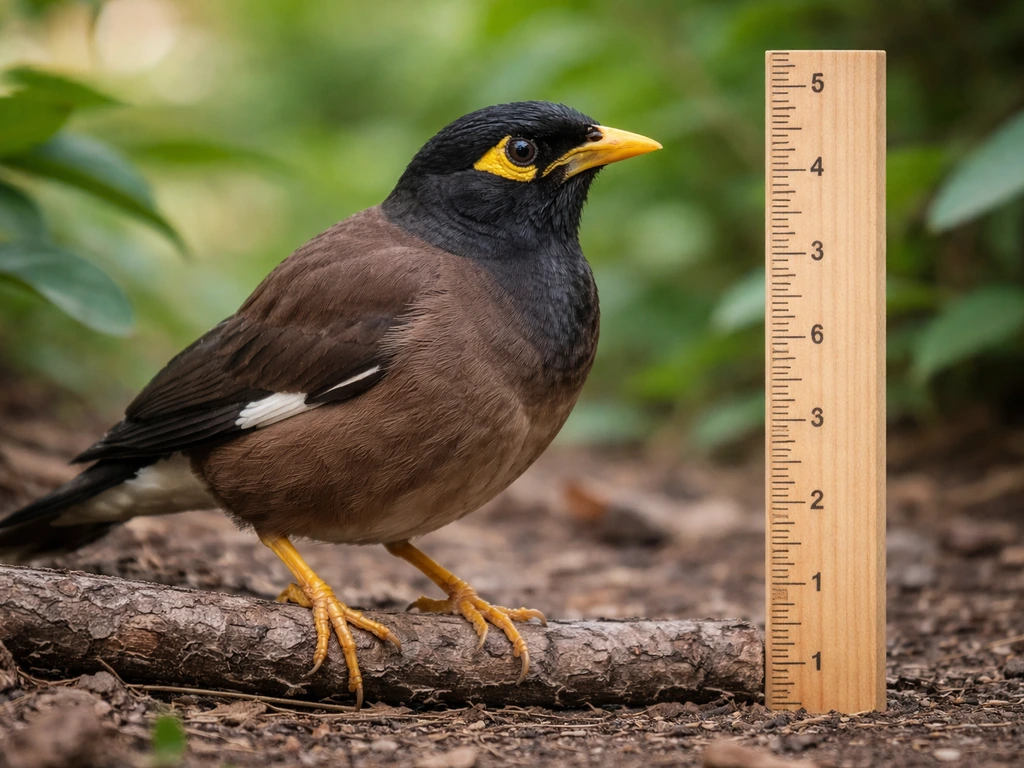
Location and appearance together are the fastest way to lock in the correct English name. Here's what to check:
- Size: Common Myna measures roughly 23 to 27 cm from bill to tail, about the size of a starling. Bank Myna is slightly smaller and slimmer.
- Head and bill: Common Myna has a solid black hood covering the head and upper breast, a bright yellow-orange bill, and a patch of bare yellow skin around the eye. Bank Myna has a black head too, but the bill is orange-red with a bluish base and the bare skin around the eye is orange-red, not yellow.
- Body color: Common Myna is warm brown on the back and wings. Bank Myna is paler and more greyish-brown.
- Wing patch: Both species flash a bold white wing patch in flight, but Common Myna's is more prominent and instantly recognizable.
- Habitat: Common Myna thrives in urban gardens, towns, agricultural fields, and anywhere near people. Bank Myna strongly prefers open ground near riverbeds, sandy banks, and cultivated fields away from dense urban areas.
- Call: Common Myna produces a loud, harsh 'chake-chake' alarm call and a variety of gurgling, chattering sounds. If the bird you're watching is noisy and bold in a city or village, that reinforces Common Myna.
If you're outside South Asia entirely and the local population of 'kabar'-like birds was introduced, it is almost certainly Common Myna. Acridotheres tristis has been introduced and established in Australia, South Africa, parts of the Middle East, and many Pacific islands. Bank Myna has not spread in the same way.
English naming by region: why the translations don't always agree
The bird called 'Common Myna' in most English-language contexts goes by 'Indian Myna' or 'Indian Mynah' in Australia and parts of southern Africa, where it was introduced and has become invasive. The Audubon Field Guide and Cornell Lab's All About Birds both use 'Common Myna' as the preferred English name for Acridotheres tristis, and that's the name you'll find in most formal birding checklists and field guides globally.
The spelling 'myna' versus 'mynah' is also a source of confusion. Both are accepted in English, but 'myna' is increasingly the preferred spelling in scientific and birding contexts, while 'mynah' appears more often in older texts, pet trade literature, and casual writing. Neither spelling is wrong, but if you're searching a field guide database, 'Common Myna' will get you to the right page faster.
If you've come across this same naming puzzle with other regional bird terms, you may find the same pattern at play with names like 'koyal' (which maps to the Asian Koel in English) or 'garuda' (a mythological bird name with its own translation challenges). If you are also wondering about similar vernacular names like what is the koyal bird called in english, the same approach of matching the local name to an accepted English label will help you confirm the right species. If you're also wondering about the mythological garuda bird, you may be looking for what it is called in English what is garuda bird called in english. Regional vernacular names almost always require a location check before you can confidently match them to a single English species name.
How to spell and say 'Common Myna' (and 'kabar') correctly
Spelling
- Preferred English spelling: Common Myna
- Accepted variant: Common Mynah
- Also seen in context: Indian Myna, Indian Mynah (especially in Australia)
- Scientific name: Acridotheres tristis
Pronunciation
'Myna' is pronounced MY-nuh (rhymes with 'China'). IPA: /ˈmaɪ.nə/. The stress falls on the first syllable. It does not rhyme with 'arena' or 'hyena,' which is a common slip when people see the word for the first time.
'Kabar' in the regional context is typically pronounced KAH-bar, with a short open 'a' in the first syllable and stress on the first syllable as well. IPA approximation: /ˈkɑː.bər/. You may also hear 'KAB-ar' with a slightly clipped first vowel depending on the dialect.
Where 'kabar' comes from as a bird name
The precise linguistic origin of 'kabar' as a name for the myna is not conclusively documented in any major etymological source. What the evidence does show is that it functions as a regional common name within Gujarati and Rajasthani communities, applied consistently to Acridotheres tristis. It is not derived from any formal ornithological naming system, and it is not a transliteration of the Latin scientific name.
One reasonable interpretation is that 'kabar' (or related forms like 'kabaru') may refer to the bird's pied or boldly marked appearance, since 'kabar' in some South Asian linguistic contexts can carry associations with contrast or variegation. The black-and-brown patterning of the Common Myna with its bright yellow facial patch would fit that kind of descriptive naming. That said, this remains an educated inference rather than a confirmed etymology, and it's worth being honest about that gap. Regional vernacular bird names in India often have folk or agricultural origins that were never formally recorded.
Your next steps to get the right English name today
- Note your location: which country, and if in India, which state or region. This alone narrows the candidate species significantly.
- Look at the bird's bill and eye patch color: yellow means Common Myna, orange-red with a bluish base means Bank Myna.
- Check the habitat: urban or village setting points strongly to Common Myna; sandy riverbanks or open farmland shifts the odds toward Bank Myna.
- Search 'Common Myna Acridotheres tristis' in Cornell Lab's All About Birds or the Audubon Field Guide to compare your observation against the official description and photos.
- If you're outside South Asia and trying to identify an introduced bird, search 'Indian Myna' alongside your country name, since that's the English label used in Australia and several African and Pacific countries.
- If you're working on a crossword, translation task, or bird puzzle: 'Common Myna' is the answer in most standard English-language contexts for the term 'kabar.'
Most people searching 'kabar bird' are looking for exactly one answer, and in the vast majority of cases that answer is Common Myna. To understand it clearly, also note the chise name meaning bird context around the word as used for this bird. The steps above will help you confirm it with confidence rather than just guessing, and they'll also help if you ever run into the same ambiguity with other regional bird names in the same family.
FAQ
How can I be sure it is Common Myna and not Bank Myna when someone says “kabar”?
If the bird has a bright yellow bill, a dark face with a distinct eye patch, and a mostly brown body, the English name is overwhelmingly Common Myna (Acridotheres tristis). If those marks are missing and the bird looks more uniform or has a different bill and facial pattern, “kabar” could be referring to Bank Myna (Acridotheres ginginianus) in that community.
What is the best English name or spelling to use when searching online databases?
In English, you can safely search both spellings, but for field guides and bird databases use “Common Myna” (myna spelling). “Indian Mynah” is commonly used in parts of Australia and southern Africa, where Common Myna is introduced.
Does “kabar” always refer to the same species across all regions in India?
Because “kabar” is a regional vernacular label, the meaning can change by locality and habitat. The practical rule is to confirm the species using both location and key appearance, especially whether the bird is in riverbank/open farmland areas where Bank Myna may be more likely.
If I’m seeing this bird outside South Asia, which “kabar” species is most likely?
If you are outside South Asia and you are seeing a “myna” that matches the Common Myna look, the odds are very high it is Common Myna because it has been introduced broadly (including Australia, South Africa, and many islands). Bank Myna does not have the same widespread introduction pattern.
Can I identify “kabar” using the bird’s call only?
Myna species can sound similar, but calls alone are not reliable for distinguishing Common Myna from Bank Myna. Use call as a clue, then confirm with face and bill coloration (especially the yellow bill and facial patch for Common Myna) and the bird’s local habitat.
What should I write as the English name in a report if I only have a “kabar” local label from one source?
If you want an English name for writing or reporting, use Common Myna unless you have strong evidence otherwise. If your sources mention “kabar” plus a qualifier like “ghoda,” treat it as a warning that the local term may be pointing to Bank Myna rather than Common Myna.
How do I pronounce “myna” and “kabar” correctly?
Pronounce “Common Myna” as “MY-nuh” (stress on the first syllable). When discussing “kabar,” most listeners in India would say KAH-bar with stress up front, and dialects may slightly change the first vowel, but that variation does not usually change the intended bird.
What is the most reliable way to avoid confusion if local names vary?
Look up the bird by scientific name after you identify which myna fits the description. “Common Myna” corresponds to Acridotheres tristis, while Bank Myna corresponds to Acridotheres ginginianus, and using the scientific name prevents confusion when local names vary.
Next Article
Chise Name Meaning Bird: Origin, Pronunciation, and Check
Chise name meaning bird: likely origin, pronunciation, spelling variants, and how to verify bird-related roots and symbo