
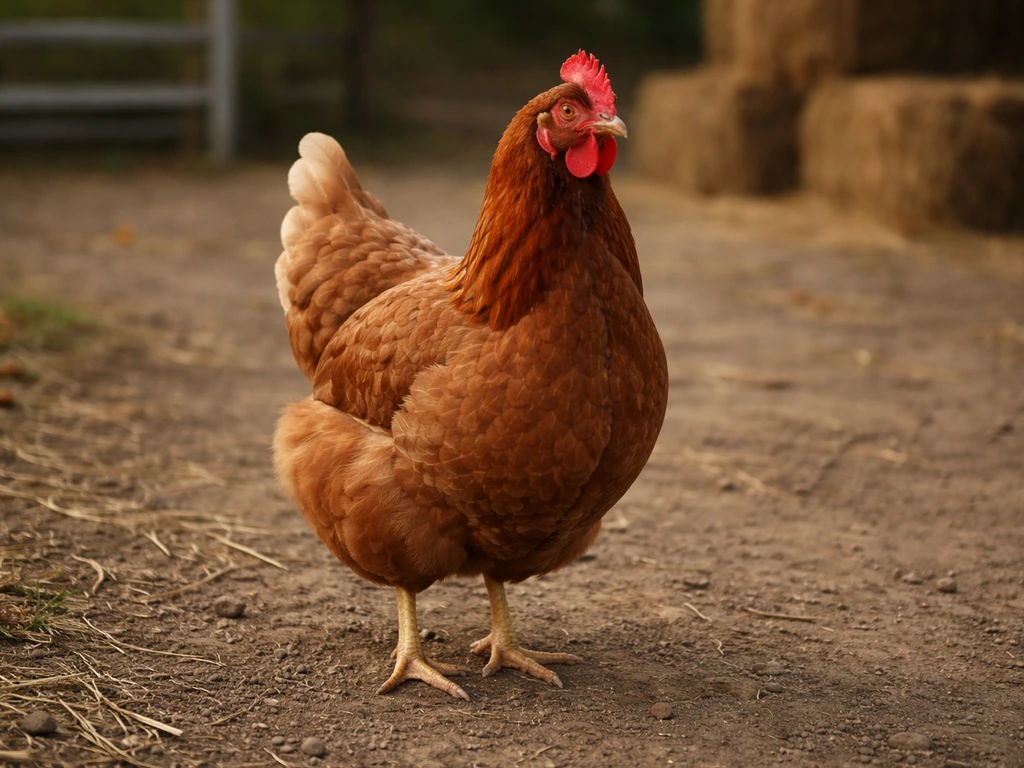
If your grid has 3 letters, the answer is almost certainly HEN. That single word dominates every major crossword clue database for "farmyard bird" and is the default go-to for crossword setters worldwide. If you have more letters to fill, GOOSE (5 letters) is the next strongest candidate, with DUCK (4 letters) also appearing when the clue is phrased as "any farmyard bird." Everything else in the barnyard, turkey, rooster, cock, shows up occasionally but far less often.
Common Farmyard Bird Crossword Clue: Solver Guide

James Ridgley
19 May 2026

What this clue is actually asking
"Common farmyard bird" is a straight-definition clue, not a cryptic one. That matters because it changes how you read it. In a cryptic crossword, a clue is split into a definition part and a wordplay part, and indicator words tell you which is which. But when there's no obvious indicator word (no anagram signal, no hidden-word marker, nothing like "sounds like" or "mixed up"), the entire phrase is working as a plain definition. You're just looking for a word that means "a bird commonly found on a farm." The word "common" here is a qualifier reinforcing familiarity, not a hidden instruction. Treat the whole clue as a dictionary definition and match it to your grid length.
One quick parsing check: is the clue singular or plural? "Common farmyard bird" is singular, so your answer should be singular too unless the clue reads "common farmyard birds" or "farmyard birds." Crossword grids respect grammatical number, and a setter writing a singular clue expects a singular answer. Keep that in mind before you lock in HENS or GEESE when the clue doesn't call for a plural.
The farmyard birds crossword setters love
Not every farmyard animal with feathers makes it into crossword wordlists. Setters gravitate toward short, unambiguous common nouns that solvers will recognize instantly. Here's the practical shortlist, ranked by how often they appear in "farmyard bird" clue databases:
- HEN (3 letters): The single most frequent answer for this clue type. It's the female chicken, instantly recognizable, unambiguously a farmyard bird, and perfectly concise for a crossword grid.
- GOOSE (5 letters): The second strongest candidate. Geese are classic farmyard birds with a memorable presence, and the word fits a clean 5-letter slot.
- DUCK (4 letters): A solid 4-letter option. The Guardian's Quick Crossword has used "any farmyard bird (4)" as a clue, and DUCK is the natural fit for that length.
- COCK (4 letters): Less common in modern puzzles but historically used, especially in British crosswords. It refers to a male chicken.
- TURKEY (6 letters): Appears occasionally in longer slots but is much rarer than HEN or GOOSE for this specific clue phrasing.
Matching candidates to your letter count

The fastest way to narrow down your answer is to count the grid squares. Here's a quick-reference map of farmyard bird answers by letter length:
| Letter Count | Answer | Notes |
|---|---|---|
| 3 | HEN | Default answer; most common in clue databases; female chicken |
| 4 | DUCK | Strong candidate for 4-letter slots; waterfowl common on farms |
| 4 | COCK | Older/British usage for male chicken; less frequent in modern grids |
| 5 | GOOSE | Second most common answer; singular form (not GEESE) |
| 6 | TURKEY | Rare for this clue; appears in longer grids occasionally |
| 7 | ROOSTER | Very rare for this exact clue; US term for male chicken |
If your grid has 3 letters, stop here: enter HEN and confirm with crossing letters. If you have 4 letters, DUCK is your best bet with COCK as a backup, especially if a crossing letter suggests C in the first position. For 5 letters, GOOSE is the move. Beyond 6 letters, you're in rare territory for this specific clue phrasing, and you'll want to rely heavily on crossing letters rather than probability alone.
Spelling, capitalization, and the singular vs plural trap
Crossword answers are almost always entered in capital letters with no spaces or punctuation, so capitalization itself isn't usually the issue. But spelling and number (singular vs plural) absolutely matter. Here are the forms you need to know:
- HEN (singular) / HENS (plural): Simple and regular. No spelling surprises.
- GOOSE (singular) / GEESE (plural): This is an irregular plural. If your clue is singular and your grid has 5 squares, the answer is GOOSE, not GEESE. GEESE is 5 letters too, so count carefully and let crossing letters decide.
- DUCK (singular) / DUCKS (plural): Regular plural, no issues.
- TURKEY (singular) / TURKEYS (plural): Regular plural. Note it's TURKEYS, not TURKIES.
- ROOSTER (singular) / ROOSTERS (plural): Regular plural. Britannica explicitly labels ROOSTER as also called COCK, so the two are interchangeable in meaning but not in crossword grid length.
The GOOSE/GEESE distinction is the one most likely to trip you up because both are 5 letters and both could theoretically fit a 5-square grid. Always check your clue: singular clue wording means GOOSE, any clue using "birds" (plural) opens the door to GEESE.
Pronunciation and naming variants worth knowing
If you're deciding between two candidates and one sounds more like a "natural" word choice, it helps to know how these words are actually said and what regional variants exist. HEN is pronounced /hɛn/ in both British and American English, a single clean syllable with no regional variation to worry about. GOOSE rhymes with "loose" and is stable across dialects. DUCK is /dʌk/, again consistent everywhere.
The naming variants are where things get interesting from a bird-language perspective. ROOSTER is the dominant North American term for a male chicken, while COCK is the traditional British term for the same bird. Crossword setters in the UK may favor COCK over ROOSTER because it's shorter and more traditional in British English. If you're solving a British newspaper puzzle (The Guardian, The Times, The Telegraph), COCK is a real possibility for a 4-letter slot. American puzzle solvers will more naturally reach for ROOSTER, but at 7 letters it's rarely the answer for a clue this short.
GANDER (the male goose) is another term that occasionally surfaces in crosswords related to farmyard birds, though it's much less common as an answer to a "farmyard bird" clue specifically. As a related aside, some solvers also look up cloaca meaning bird to better understand bird anatomy terms that sometimes appear in puzzle discussions. GANDER (6 letters) could appear if the clue hints at a male bird, but for the plain "farmyard bird" phrasing, GOOSE is a stronger fit. Common marine bird crossword clues are a different category, but the same idea of matching the clue wording to a likely answer still applies.
Using crossing letters to confirm your answer

Once you have a probable answer, crossing letters are your verification tool. If you are looking for the common small brown bird crossword clue answer, focus on the letter count and any crossing letters farmyard bird. Here's how to apply them systematically for each main candidate:
- For HEN (3 letters): Look for H in position 1, E in position 2, N in position 3. If a crossing answer gives you anything other than those letters in those squares, HEN is wrong and you need to revisit.
- For DUCK (4 letters): D in position 1, U in position 2, C in position 3, K in position 4. A crossing letter of D or U in the first two spots strongly supports DUCK.
- For COCK (4 letters): C in position 1, O in position 2, C in position 3, K in position 4. If your first crossing letter is clearly a C, COCK stays on the table alongside DUCK.
- For GOOSE (5 letters): G in position 1, O in position 2, O in position 3, S in position 4, E in position 5. Two O's in the middle are distinctive; if a crossing gives you anything other than O in position 2 or 3, rule GOOSE out immediately.
- For TURKEY (6 letters): T in position 1, U in position 2, R in position 3, K in position 4, E in position 5, Y in position 6. The K in position 4 is a useful distinguishing letter.
A practical habit: solve at least one or two of the crossing answers first before committing to your farmyard bird. Even a single confirmed crossing letter can eliminate two or three candidates instantly. If you've confirmed that position 1 is definitely G, for example, you can drop HEN, DUCK, COCK, and TURKEY from consideration in one move.
What to do when you're still not sure
If crossing letters aren't giving you enough to commit, here are the most reliable next steps for verifying a farmyard bird crossword answer:
- Check a crossword clue database: Sites that track recurring clues and their accepted answers are your fastest resource. Search the exact clue phrase "farmyard bird" and filter by your letter count. HEN appears as the top result across multiple databases for 3-letter entries.
- Use a bird nomenclature reference: Resources like the IOC World Bird List (worldbirdnames.org) and eBird's taxonomy framework list accepted common names for domestic and wild birds. If you're unsure whether a colloquial term like "cock" or "rooster" is the standard name used in databases, these sources clarify it quickly.
- Try a word pattern search: If you have some crossing letters already, a word pattern search (entering known letters with wildcards for unknowns) will filter your options fast. For example, E with 3 letters and a confirmed E in the middle still gives HEN as your obvious farmyard bird.
- Compare with similar clue types: Clues for "common city bird," "common marine bird," and "common aquatic bird" follow the same straight-definition format and can give you a feel for how setters phrase these clues and what answer lengths to expect. The logic is identical.
- Read the full puzzle theme: Sometimes a puzzle's theme locks in a particular bird family or era of vocabulary. A puzzle themed around rural life or traditional British farming might favor COCK over DUCK; a general American newspaper puzzle strongly favors HEN.
The bottom line strategy is this: count your letters first, pencil in HEN for 3, DUCK for 4, or GOOSE for 5, then immediately test those letters against any crossing answers you've already solved. If you are looking up a common aquatic bird crossword clue, the same approach of using word length and crossings still helps you confirm the right answer farmyard bird. In most cases, you'll have your confirmation within one or two crossings. If something doesn't fit, run through the table above, check the spelling carefully (especially GOOSE vs GEESE), and verify with a clue database or bird-name reference before you ink it in. If you're still stuck, compare your letters to a common city bird crossword clue to see which bird-name answers match best farmyard bird.
FAQ
If the clue says “birds” instead of “bird,” does the answer change?
Yes. If the clue is written as “common farmyard birds” (plural), the most common 5-letter shift is GEESE (not GOOSE). If it is “common farmyard bird” (singular), HEN, DUCK, or GOOSE remain the main options depending on grid length.
How should I handle “any farmyard bird” style clues with different grid lengths?
Check the grid length against the clue wording. For example, “any farmyard bird” often points to DUCK (4) or GOOSE (5), but if the slot is 3 squares, HEN is still the best fit even when “any” is used.
Are longer, less common candidates like TURKEY ever the right answer for this clue?
Treat unusual answers like TURKEY as low-probability unless crossings force it. If your slot is 4 or 5 squares, crossings will quickly rule out turkey-like options, because the common high-frequency answers (HEN, DUCK, GOOSE) usually match far more often.
Can answers like “chicken” ever fit this clue?
In standard crossword grids, you usually cannot use spaces, hyphens, or apostrophes, so “chicken” will not fit as a multi-word entry. If a solver feels tempted by “chicken,” rely on letter count first, then crossings, because setters for this specific clue typically choose shorter single-word farm-bird nouns.
What’s the fastest way to recover when my first guess (like HEN or GOOSE) is contradicted by crossings?
If a cross letter conflicts with your penciled choice, do not keep both. For instance, if you pencil GOOSE in a 5-letter slot but a crossing forces an early letter like H or C, HEN and DUCK become irrelevant and you should test the remaining 5-letter farm-bird options that match the crossings.
Could “cock” or “rooster” be the correct answer depending on region?
Yes, but only if your crossings make it viable. “Cock” (4) and “rooster” (7) are dialect-linked terms for the same concept, so the clue still reads as a straight definition, but the grid length determines which term can physically fit.
How can I use just one confirmed crossing letter to choose between similar options?
Be careful with letter placement, not just total letters. For example, GOOSE and COCK are different word patterns, so even a single confirmed letter position (like the first letter) can eliminate the wrong candidate immediately.
What should I double-check if crossings still leave me torn between GOOSE and GEESE?
If crossings are too ambiguous, the best tie-breaker is “most likely by length plus grammar,” then verify spelling. In particular, re-check GOOSE vs GEESE, because both are 5 letters and one crossing letter can still leave both plausible if it is an overlapping letter like E.
Do puzzle themes ever change the expected farmyard bird answer for this clue?
Sometimes the clue appears in themed puzzles where the editor favors a particular farmyard set. Even then, letter count and crossings usually override theme, but you can still look for consistency with other nearby animal answers (for example, if many entries are poultry terms, HEN/DUCK/COCK become more likely).
If spelling looks almost right but crossings don’t, how do I avoid wasting time on variants?
If the crossing letters force a nonmatching spelling for the candidate you expect, stop and verify the exact word form. Crossword submissions typically use standard dictionary spellings, so variations or archaic spellings are unlikely, and the safe move is to use the crossings to identify the exact standard form.
Citations
In many standard (non-cryptic) newspaper crosswords, a simple adjective-style clue like “common farmyard bird” most often works as a direct definition, with the full clue pointing to the answer rather than containing wordplay.
https://en.wikipedia.org/wiki/Cryptic_crossword
Cryptic-style clues typically split into a “definition” and “wordplay,” and the definition works “like a normal crossword clue”; when there’s no obvious wordplay indicator, solvers treat most of the clue as definition.
https://www.baphl.org/19/pdfs/0-REF%20SHEETS%20WELCOME%20LETTER-RIGHT.pdf
Specific crossword clue-tracking databases show that “Farmyard bird” is commonly answered as HEN (3 letters), indicating strong recurrence of the shortest, most typical domestic-female-chicken term.
https://crosswordtracker.com/clue/farmyard-bird/
Crossword clue databases for “Farmyard bird” also report HEN as a common/primary solution, consistent across multiple solvers’ clue pages.
https://www.crosswordsolver.com/clue/FARMYARD-BIRD
Puzzle databases indicate the clue stem “farmyard bird” has a short list of accepted answers; for example, at least one tracker reports that the longest commonly listed solution for “Farmyard bird” is GOOSE (5 letters) while HEN is shortest (3 letters).
https://www.the-crossword-solver.com/word/farmyard%2Bbird
Crossword clue databases dedicated to “farmyard bird” likewise highlight HEN as the leading answer (and often treat it as the default 3-letter entry).
https://www.crossword-dictionary.com/clue/barnyard-bird
Common crossword-usable forms for domestic fowl include HEN (female chicken) and GOOSE; solvers commonly map “farmyard bird” to short singular bird nouns rather than longer scientific terms.
https://www.the-crossword-solver.com/word/farmyard%2Bbird
For farmyard context, crossword lists strongly favor the simplest “gendered” chicken noun HEN (3) over broader poultry terms; the clue phrasing “farmyard bird” aligns to domestic-livestock familiarity.
https://www.crossword-dictionary.com/clue/barnyard-bird
Spelling and plural orthography: “geese” is explicitly identified as the plural of “goose” by major dictionaries.
https://www.merriam-webster.com/dictionary/geese
Spelling and plural orthography: “hen” plural is “hens.”
https://www.britannica.com/dictionary/hen
Spelling and plural orthography: “rooster” plural is “roosters,” and Britannica explicitly notes “called also cock.”
https://www.britannica.com/dictionary/roosters
Spelling and plural orthography: “duck” plural is “ducks.”
https://www.dictionary.com/browse/duck
Spelling/plural: “turkeys” is the plural form of “turkey.”
https://www.merriam-webster.com/dictionary/turkey
Pronunciation guidance (US-style IPA): Collins lists “hen” pronunciation as /hɛn/ (British) and /hɛ n/ (American-style transcription shown by Collins).
https://www.collinsdictionary.com/dictionary/english-pronunciations/hen
Pronunciation guidance: Cambridge provides a pronunciation entry for “hen,” useful when teaching solvers how the word sounds even if they don’t need IPA.
https://dictionary.cambridge.org/us/pronunciation/english/hen
“Rooster” is a British/UK-encompassing term and is also “called also cock” per Britannica; crossword setters may use either term depending on theme/wordlist tolerance.
https://www.britannica.com/dictionary/roosters
Solver heuristic for cryptic crosswords: cryptic clues usually have an explicit split between definition and wordplay, and indicator words tell you how to parse; in straight-definition clues, you use the clue text as definition and rely on crossings to confirm.
https://dailycryptic.co/tools/indicators
For cryptic clue solving, a commonly taught method is to recognize the definition/wordplay split first, then use the constructed wordplay to get the candidate answer; crossings become confirmation rather than the primary mechanism.
https://arxiv.org/abs/2506.04824
Verification sources for accepted spelling: official/semiofficial bird taxonomy projects provide standardized names (useful when the solver is deciding whether a term like “gander” vs “goose” or other names are the standard “common name”).
https://www.worldbirdnames.org/new/bow/
eBird maintains a taxonomy framework and explicitly distinguishes accepted/recognized taxa; this helps solvers reconcile colloquial variants vs standardized naming used in databases.
https://support.ebird.org/en/support/solutions/articles/48000837816-the-ebird-taxonomy
Crossword clue length evidence (example): the Guardian’s “Quick crossword” includes an “Any farmyard bird (4)” entry, demonstrating that farmyard-bird answers can appear in 4-letter slots depending on the specific crossword’s answer list.
https://www.theguardian.com/crosswords/quick/10553
Next Article
Common Aquatic Bird Crossword Clue Answers and Tips
Get likely answers and solve tips for the crossword clue common aquatic bird, with spelling, variants, and crossing-lett
