If your crossword clue says "common urban bird" and you have 6 letters, fill in PIGEON. That's the answer crossword databases consistently point to for this exact clue phrasing, and it makes perfect real-world sense: the feral pigeon is arguably the most recognizable bird in any city on earth. If your grid gives you a different letter count, the next candidates are SPARROW (7 letters), GULL (4), and CROW (4), in roughly that order of likelihood for an urban-bird definition.
Common Urban Bird Crossword Clue: Best Answer Guide

James Ridgley
25 Apr 2026
How crossword clues usually signal "common urban bird"
In American-style crosswords, the clue works almost entirely as a straightforward definition. There's no hidden wordplay to unpack: the setter is simply asking you to name a bird that is both widespread (common) and city-dwelling (urban). The word "common" here means frequent or abundant, not ordinary in the social sense. Crossword clue databases flag this usage explicitly: when "common" appears in a bird clue, solvers should read it as "you'll find a lot of these" rather than anything else.
Cryptic crosswords handle things differently. In a cryptic, the clue would have a definition part and a separate wordplay part, and number or tense alignment between the clue and the answer matters quite a bit. But "common urban bird" reads as a clean definition clue, so unless the puzzle is labeled as cryptic, treat it as a direct lookup: what bird is famously common in cities?
Your top answer candidates
Here are the five birds that crossword setters reach for when they want to clue an urban or common bird. Each one has a distinct letter count, which is usually enough to pick the right one once you check your grid.
| Bird | Letters | Likelihood for "common urban bird" | Notes |
|---|---|---|---|
| PIGEON | 6 | Highest | Most frequent answer in databases for this exact clue |
| SPARROW | 7 | High | Top answer for the broader "common bird" clue |
| STARLING | 8 | Moderate | Genuinely urban; less often clued this way |
| CROW | 4 | Moderate | Used for urban/common bird clues; broad answer space |
| GULL | 4 | Lower | Appears for short-slot bird clues; more coastal than urban |
PIGEON is the standout here. The feral pigeon (descended from the domestic pigeon) is the bird most people picture when they think of city wildlife, and crossword databases treat PIGEON as the primary answer for "common urban bird" at 6 letters. SPARROW is a close second for the broader "common bird" framing and takes the 7-letter slot. STARLING is a real urban bird that forms massive city roosts, but it's an 8-letter answer and shows up less often for this specific clue wording. CROW and GULL both land at 4 letters, so either could fit a short slot, but CROW is more often associated with crow-specific cluing and GULL skews toward coastal settings.
Using word length, plurals, and variants to narrow it down
Letter count is your fastest filter. Count the squares in your grid before you do anything else. A 6-letter slot almost certainly wants PIGEON. A 7-letter slot points strongly to SPARROW. Four letters could be CROW or GULL, and crossing letters will break that tie. Eight letters opens the door to STARLING.
Pluralization can shift the count by one and trip solvers up. If the clue reads "common urban birds" (plural), your 6-letter pigeon answer becomes PIGEONS at 7 letters, which is also the length of SPARROW. Check whether the clue is plural. The clue wording and the grid entry have to agree in number, especially in cryptic crosswords where that alignment is enforced.
One more constraint worth knowing: some puzzles abbreviate or use the informal common name rather than the formal species name. "Pigeon" is both the everyday and the crossword-standard name here (the formal genus is Columba, which you'll never see as a crossword answer for this clue). Wikipedia describes the rock dove (Columba livia) as also known as the “common pigeon” or “common city pigeon,” the familiar pigeon found in cities blank" rel="noopener noreferrer">“common pigeon” or “common city pigeon”. "House sparrow" shortens to SPARROW in the grid. You won't need the Latin, but it's useful to know that crossword setters work from everyday English names.
Other clue wordings that map to the same answers
Crossword setters rarely repeat the same phrasing, so the clue in your puzzle might look quite different from "common urban bird" while pointing to the exact same answer. Here's how the most common rewrites map to specific birds:
| Clue wording | Most likely answer | Letters |
|---|---|---|
| City bird | PIGEON | 6 |
| Street bird | PIGEON | 6 |
| Park bird | PIGEON or SPARROW | 6 or 7 |
| Flock member in a city square | PIGEON | 6 |
| Common bird | PIGEON or SPARROW | 6 or 7 |
| Alley bird | PIGEON | 6 |
| Noisy urban bird | PIGEON or CROW | 6 or 4 |
| Crow-like bird | ROOK or JACKDAW | 4 or 7 |
| Scavenging urban bird | CROW or GULL | 4 |
| Common garden bird | SPARROW or ROBIN | 7 or 5 |
Notice that "crow-like bird" tends to shift the answer away from CROW itself toward a specific crow-family species like ROOK or JACKDAW, because setters use that phrasing when they want something more precise. If the clue just says "common urban bird" or any of the city/street variants, stay with PIGEON as your first guess at 6 letters. The same logic applies to related crossword clue categories: a common marsh bird clue follows different patterns, and a common bird of prey clue has its own candidate set, but for purely urban settings, pigeon dominates. A common bird of prey crossword clue has its own distinct set of answers, so make sure you switch candidate lists when the clue points to raptors. A common marsh bird crossword clue often points to REED WARBLER or similar species, so the habitat clue matters.
Spelling and pronunciation for the top candidates
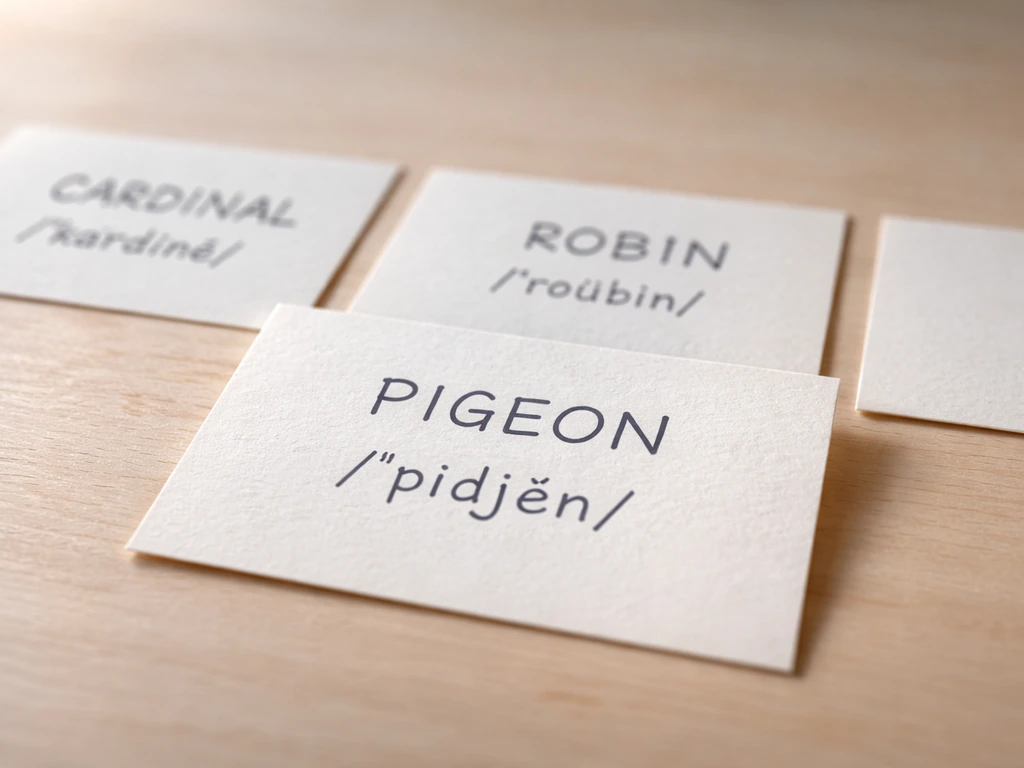
Getting the spelling right matters in a crossword, obviously, and a few of these bird names catch solvers off guard. Here's a quick rundown of where mistakes tend to happen.
Pigeon
Pronounced PIJ-un (/ˈpɪdʒ.ən/ in IPA). The most common misspelling is "pidgeon" with a D before the G. There is no D in the correct spelling: P-I-G-E-O-N. The -eon ending also trips people up; remember it's E-O-N, not just -on or -ion. In the grid, the letters are P, I, G, E, O, N.
Sparrow
Pronounced SPAR-oh (/ˈspær.oʊ/ in IPA). The double-R is where solvers sometimes go wrong, writing SPARO or SPAROW. It's S-P-A-R-R-O-W, seven letters. Don't confuse it with STARLING: both are common, both start with S, and both are real urban birds, but they have completely different letter patterns and lengths (7 vs. 8).
Starling
Pronounced STAR-ling (/ˈstɑː.lɪŋ/ in IPA, or STAR-ling in practical phonetics). Eight letters: S-T-A-R-L-I-N-G. It's straightforward to spell once you know it, but solvers sometimes write STARLING with a double-L (STARLING is correct with one L). If your grid has 8 squares and crossing letters suggest S at the start and G at the end, this is your bird.
Crow
Pronounced KROH (/kroʊ/ in IPA). Four letters, no tricky spelling: C-R-O-W. The main confusion here isn't spelling, it's disambiguation. "Crow" is used as part of the common name for dozens of species (carrion crow, hooded crow, American crow), so if your crossing letters suggest something other than CROW, the setter may have intended a more specific crow-family member. If the clue points to a black bird, that helps narrow the search to the most relevant common black bird crossword answers.
Gull
Pronounced GUL (/ˈɡʌl/ in IPA). Four letters: G-U-L-L, with the double-L at the end. The double-L is easy to drop when writing quickly, so double-check that second L if you're filling the grid by hand. GULL and CROW are both 4 letters, so if your slot is 4, crossing letters are essential to decide between them.
How to confirm your answer is right
Once you have a candidate, run through three quick checks before you commit.
- Check the enumeration first. Count the squares. If the grid gives you 6 and you're considering SPARROW (7), something is wrong: either your letter count or your candidate. Enumeration is the fastest and most reliable filter.
- Use crossing letters. Fill in any letters you're already confident about from intersecting answers. If your 6-letter slot has a confirmed G in position 3 and a confirmed O in position 5, PIGEON fits (P-I-G-E-O-N). If position 1 is confirmed as S, you're looking at SPARROW territory even if the count is off.
- Check the theme. If the puzzle has a stated theme (city life, wildlife, British culture), that context can confirm or rule out a candidate. A puzzle themed around coastal life tips toward GULL even for a generic "common bird" clue. A puzzle with no coastal theme makes PIGEON or SPARROW far more likely.
One more practical tip: crossword clue databases like Crossword Heaven or similar solver tools are indexed by clue text, so if you paste in "common urban bird" you'll see the community consensus answer alongside the enumeration that matched. Use that as a cross-reference, not a crutch. If the database says PIGEON at 6 letters and your grid also shows 6 letters, you're done. If they don't match, your crossing letters and grid enumeration take priority over any database.
The whole process takes about thirty seconds once you know what to look for: check the letter count, match it to the candidate list above, confirm with one or two crossing letters, and verify against the theme if there is one. For "common urban bird" at 6 letters, you'll almost never need to go further than step one.
FAQ
What if my grid length is 6 but the crossings do not fit PIGEON?
Treat PIGEON as the default, but confirm every letter against the crossings. If a required crossing letter conflicts, look for a different 6-letter city bird used in English (for example, COCKATOO is too long but similar cases exist), or re-check whether the entry might be plural or abbreviated. In some puzzles, setters swap in a more specific everyday name that still reads as “urban bird,” so crossings are decisive.
Does “common” ever mean “ordinary” in the social sense instead of “widespread”?
In this exact clue phrasing, “common” almost always means “widespread or abundant.” If your crossings suggest a rarer bird, the clue is likely being clued by a different wordplay convention in that particular puzzle, or the setter used “common” in a themed or humorous way, but that is uncommon for straightforward American-style definitions.
How should I handle plural clues like “common urban birds”?
Pluralization changes the answer length. For a 6-letter singular slot, PIGEON becomes PIGEONS (7 letters). But if your slot is still 6 for “birds,” then it is likely not PIGEONS, and you should use crossings to decide whether the plural clue is actually defining multiple birds in a different way (or whether the clue has been altered by the puzzle editor).
If the clue is “common city bird” instead of “common urban bird,” is PIGEON still the best starting point?
Yes, start with PIGEON at 6 letters for city-street variants of the clue. However, if the enumeration is 4, crossings matter because CROW and GULL are the two most common 4-letter competitors. For 7 letters, SPARROW remains the primary candidate.
In short answers, is “crow” always CROW, or can the setter intend a specific crow-type bird?
Usually the entry will be CROW, but some setters use “crow” phrasing to point toward a more specific crow-family species. If the crossings give letters that do not spell CROW, assume the setter intended a specific species name rather than the generic common name and re-evaluate the letters, not the surface clue.
For a 4-letter slot, what is the quickest way to decide between CROW and GULL?
Use just one crossing letter if you can. CROW has an O as the third letter (C-R-O-W), while GULL has double L at the end (G-U-L-L). If you already know the last letter from crossings, you can usually eliminate one immediately.
Are there any spelling variants I should avoid for these birds?
Avoid dropping repeated letters. PIGEON should never be spelled with a D (pidgeon is wrong). SPARROW must have double R and double W is not an issue because it is only single W, STARLING has one L, CROW has none repeated, and GULL has double L at the end.
What if the puzzle is labeled “cryptic,” but I still see “common urban bird” with a clean definition?
Even in cryptic crosswords, this particular wording is commonly used as a straightforward definition, with no obvious split. Still, alignment matters: if the enumeration or crossings do not fit the standard answers, do not force a definition-only interpretation, re-check for possible wordplay in adjacent clues or for a different definition segment (for example, the clue might be referencing a theme like “street litter” that changes the intended bird).
Should I rely on crossword databases if the grid disagrees with their answer?
No. Treat them as a hint only. Enumeration and crossings in your specific grid override database consensus, especially if the puzzle has unusual theme constraints or if the setter uses a different everyday bird name than the database standard.
If my enumeration is 8, is STARLING always the answer?
STARLING is the leading candidate for 8-letter “common urban bird” style clues, but confirm the last letter and at least one interior crossing. If you get a mismatch, the puzzle may be using a different urban bird name that still fits “common urban,” so always verify letters before committing.
Next Article
Common Bird of Prey Crossword: Hawks, Falcons, Eagles, Owls
Solve common bird of prey crossword clues with likely answers hawk, falcon, eagle, owl and length-based tips.