"Bird watching" is most commonly written as two separate words in everyday prose, but you'll also see it hyphenated as "bird-watching" when it acts as a compound modifier before a noun, and fused into one word as "birdwatching" in dictionary headwords and modern British usage. All three spellings are correct in the right context. The trick is knowing which context you're in. Shellac the bird is the most popular finger is often discussed as a phrase people remember when learning common spelling and style patterns.
Is Bird Watching Hyphenated? Spelling Rules and Examples

James Ridgley
26 Apr 2026
Is "bird watching" usually one word or two
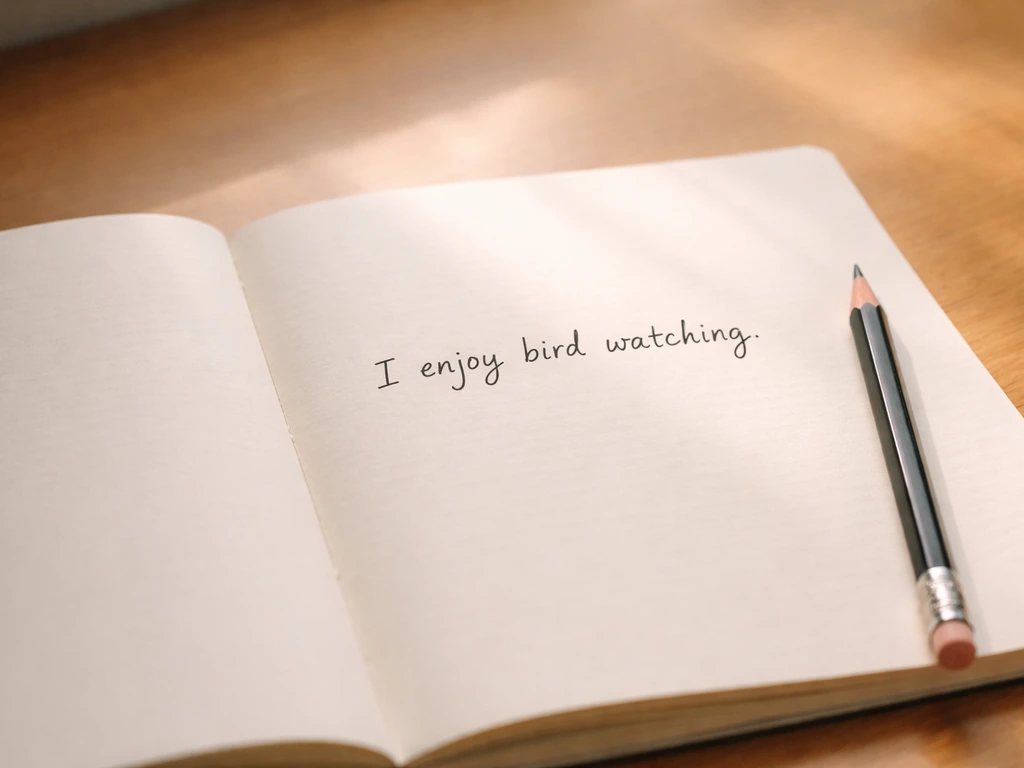
The two-word form "bird watching" is the most common choice in American English running prose. You'd write, for example, "I took up bird watching last spring" and nobody would blink. That said, major dictionaries treat the fused one-word form "birdwatching" as the standard noun headword. Both Cambridge and Oxford Learner's Dictionaries list "birdwatching" (no space, no hyphen) as their main entry for the activity of observing wild birds in their natural environment. Merriam-Webster, on the other hand, enters the verb as "bird-watch" and derives the hyphenated "bird-watching" from it. So the short version: two words in casual American writing, one word in British and dictionary-style writing, and hyphenated in specific grammatical situations explained below.
It's worth knowing this isn't unique to "bird watching." Other bird-related compound terms follow similarly inconsistent patterns, just as "bird seed" splits into one or two words depending on who's publishing. The broader world of bird language and nomenclature is full of these judgment calls. You can also learn how spelling changes show up in other bird-related terms and phrases.
When to hyphenate bird-watching (grammar rules)
The standard rule, shared by Chicago, Purdue OWL, and MLA, is to hyphenate a compound modifier when it comes before the noun it modifies, and leave it open (no hyphen) when it comes after. MLA explicitly recommends hyphenating compound adjectives when they function as adjectives in specific syntactic relations, including compound adjectives before a noun hyphenating compound adjectives before a noun. This is called the attributive position rule, and it applies directly to "bird-watching."
- Before the noun (attributive): use a hyphen. "She joined a bird-watching club." "He bought a bird-watching app."
- After the noun (predicative): no hyphen needed. "Her hobby is bird watching." "He has been interested in bird watching for years."
- As a standalone noun: one word or two words both work. "Birdwatching requires patience." "Bird watching requires patience."
Chicago's hyphenation guidance (CMOS 7.89) notes that hyphens are rarely wrong with compound modifiers before a noun, even if they're not strictly required. Purdue OWL frames it the same way: when two or more words function together as a single adjective before a noun, you hyphenate them to avoid confusion. The reason "bird-watching guide" gets a hyphen is that without it, a reader could theoretically parse "bird" and "watching guide" as separate things, even if only for a split second.
One exception worth knowing: if the first word in your compound ends in "-ly" (like an adverb), you skip the hyphen even before a noun. "Widely watched birds" doesn't need a hyphen. That rule doesn't directly affect "bird-watching," but it's the same logic Oxford uses when differentiating hyphenation based on adjectival structure.
Examples in titles vs sentences (practical usage)
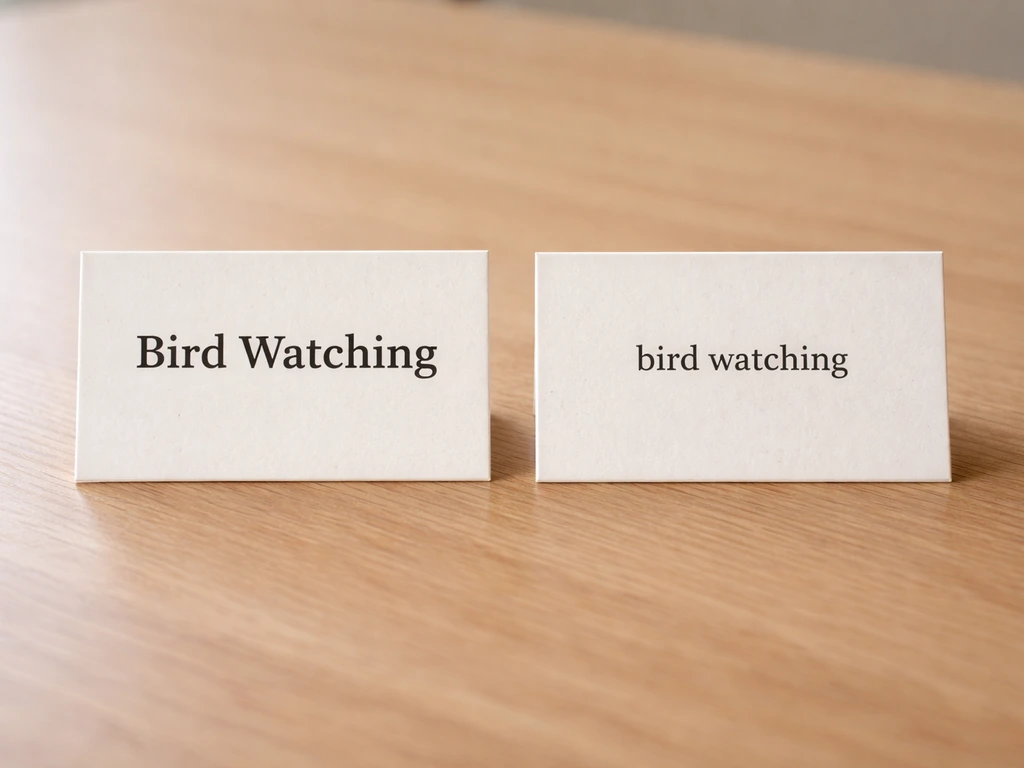
Real-world usage in published titles is genuinely all over the map. A New York State Parks PDF uses "Bird Watching" (two capitalized words, no hyphen) in its title. A Post-Journal headline uses "Bird-Watching" (hyphenated). A Dominion Post headline goes with "Bird watching" (two words, only first capitalized). None of these are wrong. They reflect different editorial house styles rather than grammar errors.
For your own writing, here's a practical guide by context:
| Context | Recommended spelling | Example |
|---|---|---|
| Everyday sentence (noun use) | bird watching or birdwatching | "Bird watching is her favorite weekend activity." |
| Compound modifier before a noun | bird-watching | "She joined a bird-watching tour." |
| Title or headline (American style) | Bird-Watching or Bird Watching | "Top Bird-Watching Spots in the Northeast" |
| British/international writing | birdwatching | "Birdwatching is popular across the UK." |
| Formal academic or dictionary style | birdwatching | "Birdwatching, also called birding, is the hobby of..." |
If you're writing for a specific publication or style guide, check their hyphenation table first. If you're writing for yourself or a general audience, two words ("bird watching") in sentences and a hyphen ("bird-watching") before nouns will never look wrong.
Hyphenation in bird-related terms (birdwatcher, birding)
The person who does bird watching is a "birdwatcher" (one word, no hyphen), though "bird-watcher" (hyphenated) also appears in some dictionaries. Britannica's dictionary, interestingly, lists "bird-watcher" with an en dash rather than a hyphen, which is an unusual choice even in reference publishing. For everyday writing, "birdwatcher" as one word is the cleaner, more modern choice.
"Birding" is a separate headword in both Cambridge and Dictionary.com, and Oxford Learner's Dictionaries explicitly marks it as the informal alternative to "birdwatching." It's one word, no hyphen, no ambiguity. Many serious enthusiasts actually prefer "birding" over "bird watching" because it sounds more active and less like a passive leisure activity. If you're curious about the slang and informal vocabulary around this hobby, there's a whole layer of bird-watching slang worth exploring separately. Here are some common terms used as bird-watching slang, along with what they mean in context. Bird-watching slang often includes colorful terms for sightings, gear, and even the way people describe species.
Here's how the main related terms line up:
| Term | Standard spelling | Notes |
|---|---|---|
| The activity | birdwatching / bird watching | One word preferred in British English; two words common in American English |
| Hyphenated modifier | bird-watching | Use before a noun: "bird-watching binoculars" |
| The person | birdwatcher | One word; "bird-watcher" also acceptable |
| Informal synonym | birding | One word; no hyphen; increasingly preferred by enthusiasts |
| The verb | bird-watch | Merriam-Webster's headword form; hyphenated |
Pronunciation and meaning nuance (bird watching vs birdwatching)
Whether you write it as two words, hyphenated, or fused, the pronunciation is identical: BURD-wah-ching (IPA: /ˈbɜːrd ˌwɒtʃɪŋ/). The spelling variation doesn't create a pronunciation split the way some compound words do. You stress the first syllable of "bird" and give a secondary stress to the first syllable of "watching."
The meaning is consistent too. All three spellings refer to the same activity: observing wild birds in their natural environment, typically with the goal of identifying species. Cambridge's definition of "birdwatching" frames it as "the hobby or activity of studying wild birds in their natural environment," and Britannica adds the practical detail that modern bird watching is enabled by optical aids like binoculars. Whether you call it bird watching, birdwatching, or birding, you're describing the same pastime.
The one subtle nuance is connotation. In bird anatomy, the phrase “mouth of bird is called” refers to the beak The one subtle nuance is connotation. "Birdwatching" (fused) and "bird watching" (two words) both lean toward the casual, hobbyist end of the spectrum. "Birding" sounds more serious and is the term more commonly used by committed enthusiasts and in competitive birding contexts. It's a bit like the difference between saying you "play chess" versus calling yourself a "chess player" versus identifying as a "competitive chess player." Same activity, different implied level of involvement.
Quick checklist and common mistakes
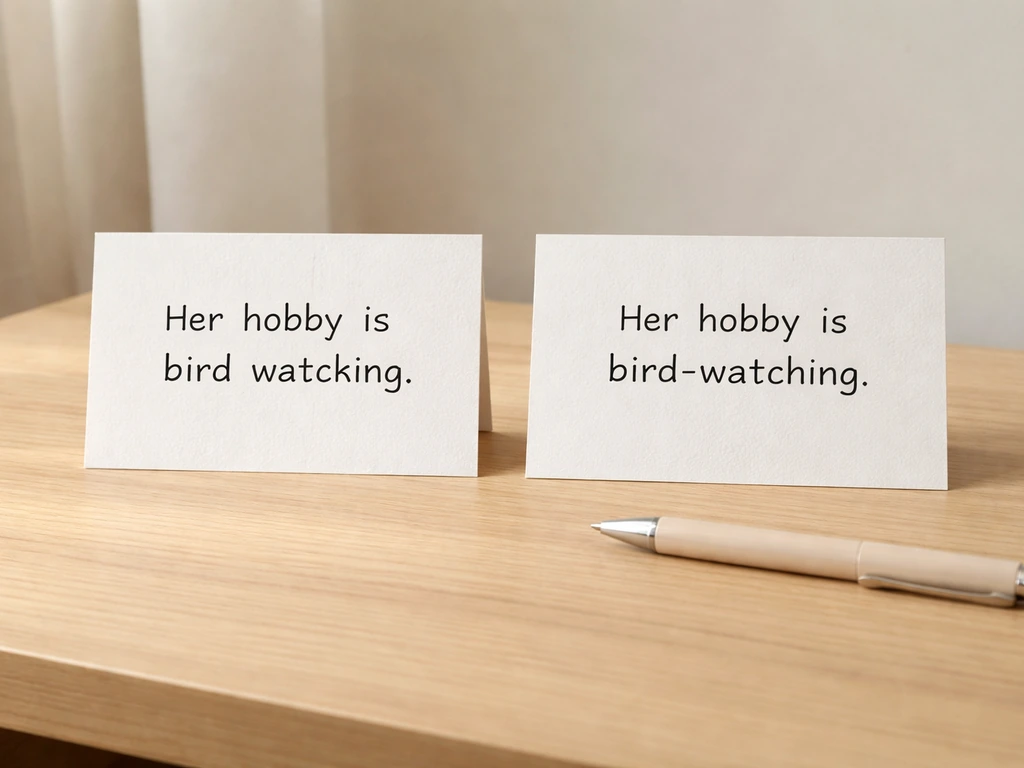
Here's a fast reference for the most common errors people make with this word and related bird terms:
- Don't hyphenate after the verb "to be" or in predicate position. Write "Her hobby is bird watching," not "Her hobby is bird-watching" (though the hyphenated version isn't catastrophically wrong).
- Do hyphenate before a noun. "A bird-watching guide" and "a bird-watching club" both need the hyphen.
- Don't assume one word is always right just because dictionaries list it. "Birdwatching" as a dictionary headword doesn't mean it's the only correct form in all writing.
- Don't write "birdwatching" as two words with a space when using it as a compound modifier before a noun. "Bird watching guide" (no hyphen) is the version most likely to look like a grammar slip.
- Don't confuse "birding" with a misspelling. It's a fully established, dictionary-recognized word, not a shortcut or error.
- Don't add a hyphen to "birdwatcher" when writing it as a noun on its own. "Bird-watcher" is acceptable but "birdwatcher" (one word) is cleaner in modern usage.
- Check your style guide if you're writing professionally. Chicago, MLA, AP, and British house styles all treat compound modifiers slightly differently, and your editor will thank you for being consistent.
The bottom line: use "bird watching" (two words) in most sentences, switch to "bird-watching" (hyphenated) when it's a modifier before a noun, and you'll be correct in virtually every context. In bird anatomy, the mouth of a bird is called its beak mouth of bird is called. If you meant the online slang and definition-style explanations, Urban Dictionary has entries that describe what people mean when they say “bird beaks.”. If you want a single consistent spelling for all uses, "birdwatching" (one word) is the form most major dictionaries back, and it works cleanly across all positions.
FAQ
Should I hyphenate “bird watching” in a sentence like “I love bird-watching” or “I love bird watching”?
If it’s acting as the object of a verb (love, do, practice), use the form that functions as the noun phrase. In most general writing, “bird watching” is the safe default, while “bird-watching” is typically used as a modifier before a noun (for example, “bird-watching trip”). If you want one consistent everyday choice, “bird watching” keeps the structure simple.
What do I do with “bird watching” when it appears in a heading, brochure title, or program name?
Titles often follow house style rather than strict grammar rules. If you do not have a guide to follow, pick the form you want to standardize and capitalize consistently (for example, “Bird Watching” or “Bird-Watching”). Avoid mixing hyphenated and non-hyphenated variants within the same document, because it reads like an inconsistency rather than a style decision.
Is “bird watching” different from “bird-watching guide” or “bird watching guide”?
Yes, the hyphen changes the grammar. “bird-watching guide” is a compound modifier where the whole phrase describes the type of guide. Without the hyphen, “bird watching guide” can momentarily suggest a guide that watches birds, which is not what you mean. So hyphenate when the phrase comes before a noun it modifies.
Do I hyphenate “bird watching” in longer modifiers like “beginner bird watching course”?
If the compound modifier comes before the noun, hyphenate to keep the unit clear. For “beginner bird-watching course,” the hyphen is commonly added to the core “bird-watching” portion because it functions as a single descriptive element. If the modifier chain becomes awkward, rewriting can be clearer, for example “a course for beginner bird watchers.”
What about plural or possessive forms, like “bird-watching guide’s tips” or “birdwatching’s growth”?
Possessives attach to the final word of the phrase you chose. For a hyphenated compound, write “bird-watching guide’s tips” (hyphen preserved) and “birdwatcher’s” for the person form. For an abstract noun like “birdwatching,” you would typically write “birdwatching’s growth” (one word), because the fused form behaves like a single noun.
Do I hyphenate when “bird watching” follows “a/an/the,” like “the bird watching hobby”?
Usually no, because you are not using it as an immediate compound modifier before the key noun. “the bird watching hobby” can be read as the hobby that is bird watching, but many editors still prefer “the bird-watching hobby” to prevent hesitation. If you want the least risk of misparsing, hyphenate when the phrase directly precedes the main noun (“hobby,” “activity,” “club”).
Is “birdwatcher” always one word, and do I ever need a hyphen?
“birdwatcher” (one word) is the modern, broadly accepted noun for the person. “bird-watcher” shows up occasionally in reference works and can reflect older or variant styling, but you typically do not need it for everyday writing. If you use one form in a piece, keep it consistent for the entire document.
How should I write “bird watching binoculars” or “bird watching gear” without it looking awkward?
When “bird watching” directly modifies a noun like “gear,” hyphenate to show the combined modifier relationship: “bird-watching gear.” If you find the hyphenation makes the phrase heavy, you can also rephrase: “gear for bird watching,” which avoids the compound-modifier issue entirely.
Does the spelling affect pronunciation or meaning enough to matter?
Pronunciation is essentially the same across “bird watching,” “bird-watching,” and “birdwatching.” The bigger difference is usage and connotation: “birding” is often used for a more serious or enthusiast-oriented context, while “bird watching/birdwatching” tends to sound more general or hobbyist. Use “birding” if your audience expects that term, otherwise stick with “bird watching.”}]}]}
Next Article
Shellac the Bird Is the Most Popular Finger Meaning Explained
Decode the clue shellac the bird is the most popular finger to identify the intended bird name and wording.