The combining form 'ornith-' means bird, full stop. It comes from Ancient Greek and shows up in a handful of important English words that you will encounter in bird science, word puzzles, and everyday bird talk. If you have been trying to build a list of words containing 'ornith,' or you just want to know what the root means and how to spell and say these words correctly, this guide covers all of it.
Words with Ornith Meaning Bird: List, Pronunciation, Uses

James Ridgley
20 Apr 2026
What 'ornith-' means and where it comes from

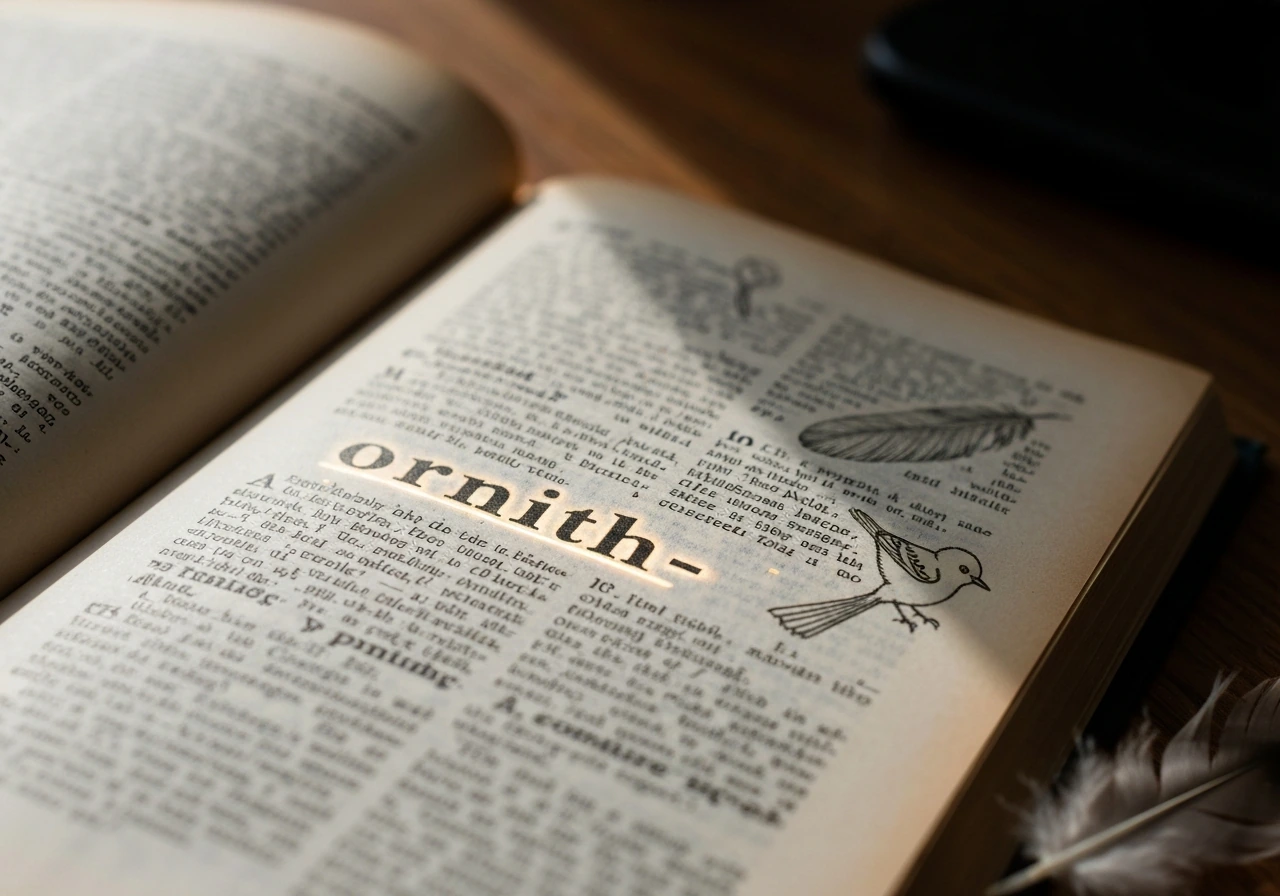
Merriam-Webster defines ornith- as a combining form meaning 'bird.' Its variant form is ornitho-, and both are used depending on what suffix follows them. The root traces back to Ancient Greek: the stem ὄρνιθ- (ornith-) comes from the noun ὄρνις (órnis), the Greek word for a bird. When the ancient Romans adopted Greek learning, they carried this root into New Latin scientific vocabulary, which is why modern scientific and academic English is full of ornitho- constructions.
One important nuance worth knowing: according to Wikipedia's list of commonly used taxonomic affixes, ornith- and ornitho- are specifically used for things with birdlike characteristics, not just as a generic label for 'bird.' That distinction matters when you are reading scientific names or trying to decode new vocabulary on your own. It is not a loose synonym for 'avian' in all contexts, which I will come back to later.
The ornith- words you will actually run into
There are not hundreds of everyday English words built on this root, which is actually good news: the list is manageable, and knowing these core words covers the vast majority of what you will encounter in field guides, crossword puzzles, and ornithology texts.
| Word | Pronunciation (practical) | What it means |
|---|---|---|
| ornithology | or-nih-THOL-uh-jee | The scientific study of birds |
| ornithological | or-nih-thuh-LOJ-ih-kul | Relating to ornithology or bird science |
| ornithologist | or-nih-THOL-uh-jist | A person who studies birds scientifically |
| ornithophily | or-nih-THOF-ih-lee | Pollination of flowering plants by birds |
| ornithophilous | or-nih-THOF-ih-lus | Pollinated by birds; bird-loving (adjective form) |
| ornithomancy | or-NITH-oh-man-see | Divination or fortune-telling by observing birds |
Ornithology is by far the most common word in the set, and its formation is textbook clean: New Latin ornithologia, built from ornith- plus -logia (from Greek logos, meaning discourse or study). Merriam-Webster confirms this etymology directly. Ornithologist and ornithological are simply the agent noun and adjective spun off from that base. Ornithophily and ornithophilous are more specialized: Wikipedia defines ornithophily as bird pollination, referring to the role birds like hummingbirds and sunbirds play in transferring pollen between flowers. Ornithomancy is the oldest and most obscure of the bunch, meaning divination by watching how birds fly and behave, and it has an entry in Merriam-Webster.
How to find more ornith- words for puzzles and word lists

If you are building a word list for a crossword, Scrabble, or a writing project, the most reliable approach is to search by substring rather than guessing at words. Tools like Wordfind.com let you search for words that contain 'ornith' as a string, pulling up everything in their database in one go. Merriam-Webster's Scrabble word finder confirms that ORNITHOLOGICAL is a valid playable word, and ScrabbleWordFinder.org has a dedicated dictionary-check workflow for ornithology-related words. Those two sites together give you both validity checking and new-word discovery.
For a more systematic approach, think about the combining form itself. The pattern is ornitho- plus a suffix. Common suffix families that attach to ornitho- include -logy (study of), -logist (person who studies), -logical (adjective of study), -phily (attraction or pollination), -philous (adjective of that), and -mancy (divination). If you see a new word starting with ornitho- in a scientific paper or crossword clue, you can usually decode it by isolating the suffix and working out its Greek or Latin meaning. That skill transfers to dozens of related scientific roots too.
- Search Wordfind.com using the 'contains' filter with the string 'ornith' to get a complete current list
- Use Merriam-Webster's word finder to verify whether a specific ornith- word is dictionary-valid
- Isolate the suffix after ornitho- and look up its Greek or Latin root to decode unfamiliar terms
- Check Scrabble dictionaries (TWL or SOWPODS) when the goal is puzzle play, not just general vocabulary
Spelling and pronunciation: the gotchas to watch for
The spelling trips people up in a few consistent ways. First, the root is ornith- (ending in 'th'), not ornath-, orneth-, or orinth-. The 'th' is the key cluster, and it reflects the Greek theta (θ) directly. Second, when the combining form connects to a vowel-initial suffix, you use the fuller form ornitho- rather than ornith-. So it is ornithology (ornitho- + logy) not ornith-logy. The 'o' in ornitho- is a connecting vowel that smooths out the pronunciation.
Pronunciation is where most people stumble, especially on ornithology and ornithological. Both Cambridge and Collins provide official pronunciation pages for ornithology, and Merriam-Webster has a full guide for reading its pronunciation symbols. For practical purposes: ornithology is stressed on the third syllable, or-nih-THOL-uh-jee. Ornithological shifts the stress: or-nih-thuh-LOJ-ih-kul. The stress moves because of the -ical ending, which is a common pattern in English (think geological, biological). If you are using IPA, Oxford Learner's Dictionaries includes IPA transcriptions for ornithologist and explains exactly how to read their symbols, which Cambridge also does for its own system.
One more spelling note: ornithophilous has five syllables and is easy to run together when typing. Break it into chunks: or-ni-tho-phi-lous. The 'phi' in the middle comes from Greek philos (loving), and this same philos root appears in plenty of other biology words, so once you see it, it starts to look familiar.
Using ornith- words in bird naming and bird conversation

For birdwatchers, knowing these words pays off in reading field guides, joining birding clubs, and understanding scientific literature. When a paper describes ornithophilous plants, for instance, it is telling you those plants depend on birds for pollination, which is directly relevant to understanding habitat. When a museum exhibit is labeled ornithological, it signals a collection or display centered on bird science, not just pretty bird pictures.
Pet owners sometimes want to use ornith- roots in creative names for birds. Ornitho as a standalone nickname has been used for parrots, and compound names like Orni or Thea (from ornith-) work as shortened pet names with a nod to the Greek root. These are personal choices, but if the goal is a name that signals 'bird' etymologically, the ornith- family is the most direct route in the Greek tradition.
In everyday bird talk, the word you will use most often from this family is ornithologist, usually to describe someone who watches or studies birds professionally or seriously. For pronunciation guidance specifically for ornithologist, Cambridge’s pronunciation page provides an English pronunciation reference Cambridge’s pronunciation page provides English pronunciation guidance for ornithologist. It is worth knowing that 'ornithologist' and 'birder' or 'birdwatcher' are not synonyms: an ornithologist has formal scientific training and typically publishes research, while a birder is anyone who watches birds as a hobby. The language matters in birding communities, and using ornithologist correctly shows you understand the distinction.
Quick etymology: how ornith- threads through bird terminology
The ornitho- root entered English scientific vocabulary primarily through New Latin, the standardized scholarly Latin used by European scientists from the 16th century onward. The 1911 Encyclopædia Britannica traces ornithologia to Greek ὀρνιθ- plus -λογία (logia), meaning discourse or study. This New Latin formation was then absorbed into English as ornithology, following the same borrowing path as geology, biology, and zoology.
In taxonomic names and scientific species nomenclature, ornith- and ornitho- signal that a creature or plant has characteristics associated with birds. The International Ornithologists' Union maintains resources on how scientific bird names are pronounced, which is useful when you encounter genus and species names that use the root in less familiar combinations. The Oxford Academic community has also pointed to the value of specialized ornithology dictionaries for tracking down the full range of ornith- terminology, precisely because the root generates so many technical compound words that standard dictionaries do not always include.
It is worth drawing a clear line between ornith- words and avian words, since both are common in bird language and sometimes confused. A related term you might see in puzzles is bird that is a synonym for nuts, which highlights how “bird” can show up as slang or a homophone depending on context. Avian comes from Latin avis (bird), and words like aviary, avifauna, and aviculture all use that Latin root. Ornith- is the Greek-origin parallel.
In modern English, avian tends to appear in more general or clinical contexts (avian flu, avian anatomy), while ornith- tends to appear in academic or scientific contexts (ornithology, ornithophily). Neither is more correct for bird-talk in general: they have different registers and origins. This site covers the broader landscape of bird naming and language, so understanding both roots helps you navigate everything from crossword clues to scientific papers.
Best tools for keeping your ornith- word list growing
If you want to go beyond the core six words covered here, a few specific tools make the process efficient. For general dictionary verification, Merriam-Webster is the most reliable for American English and has direct entries for ornith-, ornithology, ornithological, ornithologist, ornithophilous, and ornithomancy. For pronunciation, use Cambridge or Oxford Learner's Dictionaries if you want IPA alongside audio, or Merriam-Webster if you prefer their own pronunciation symbol system (they provide a downloadable guide explaining exactly how to read it).
- Merriam-Webster: best for checking whether an ornith- word is dictionary-valid and for etymology notes
- Wordfind.com: best for generating a complete substring list of all words containing 'ornith'
- Oxford Learner's Dictionaries: best for IPA pronunciation with audio, especially for ornithologist
- Cambridge Dictionary: best for British English pronunciation and IPA cross-reference
- Wiktionary: useful for etymology deep-dives, especially the Greek-to-English borrowing path
- Scrabble word finders (Merriam-Webster or ScrabbleWordFinder.org): best for puzzle-validity checking
One practical search tip: when using any of these tools, try both 'ornith' and 'ornitho' as your search strings. Some words hyphenate the combining form in older texts (ornitho-logy in 19th-century books), while modern usage drops the hyphen entirely. Searching both variants catches everything.
And if you are interested in the broader world of bird language beyond just this root, questions about whether bird functions grammatically as a noun, what homophones exist for bird-related words, or how bird synonyms work in puzzles all touch on related corners of bird language that are worth exploring alongside etymology. If you are wondering about the specific pronunciation-based meanings, see our guide on what a bird homophone is homophones.
If you are also looking up bird homophones meaning, you will find that these same language puzzles often connect to how people interpret “bird” in different contexts. If you are also wondering whether “bird” itself is a noun, that comes down to how it functions in a sentence is bird a noun.
FAQ
Are “ornith-” and “ornitho-” always interchangeable in spelling?
No. Use ornitho- when the next piece starts with a vowel, such as ornithology, ornithologist, and ornithological. Use ornith- with consonant-initial suffixes, and avoid forms like “ornith-logy” that swap the connecting vowel.
What if I see “ornitho-” with a hyphen in an older text or a crossword clue?
Hyphens are optional in modern writing. Older editions may show ornitho-logy or ornith-o- spelling patterns, but most contemporary dictionaries list the closed form (for example, ornithology). For crossword or Scrabble lookups, search both ornitho and ornith, and also try the exact expected closed spelling.
Do ornith- words always refer specifically to “birds,” or can they mean “birdlike”?
In scientific and technical usage, ornith- and ornitho- are typically used for birdlike characteristics, not just a generic synonym for bird. When reading taxonomy or species descriptions, treat the root as a cue that the word may describe traits that resemble birds.
How should I pronounce ornithology if I do not use IPA?
A practical stress guide is or-nih-THOL-uh-jee for ornithology. If you are unsure, focus on landing the THOL syllable strongly, since the stress pattern is the key difference people notice between ornithology and ornithological.
Is ornithological pronounced like a longer version of ornithology?
It is longer, but the stress shifts. Use or-nih-thuh-LOJ-ih-kul, with the LOJ part emphasized because of the -ical ending. Pronouncing it like ornithology with extra syllables often sounds off to native ears.
What is the most common spelling mistake when typing “ornith-” words?
Confusing the key “th” cluster. Common typos are ornath-, orneth-, or orinth-. If you type “ornith” and then apply the known suffix rules, you will usually correct the spelling quickly.
How do I decide which combining form to use when decoding a new word that starts with “ornitho-” ?
Treat ornitho- as the base marker, then isolate the suffix to get the meaning. For example, -logy implies study, -mancy implies divination, and -phily implies attraction or pollination. This avoids guessing the whole definition at once.
Are ornithology and birding the same thing?
Not exactly. Ornithology is a scientific discipline, and an ornithologist typically has formal training and may publish research. Birding or birdwatching is usually a hobby or community activity, even though both involve observing birds.
Can I use “ornithologist” or “birder” interchangeably in conversation?
Be careful. “Birder” often means anyone who watches birds regularly, while “ornithologist” implies professional or academic study. In birding communities, using “ornithologist” casually can overstate someone’s role.
Is “ornithophilous” always about pollination, and does it refer only to plants?
In practice, ornithophily and ornithophilous are used in biology contexts for bird-mediated pollination, most commonly referring to plants and flowers. If you see the term applied to another organism, check the surrounding sentence, because usage can become specialized.
How can I find words with ornith- faster in a crossword or word game?
Use substring searches for “ornith” and also for “ornitho,” then verify the exact form in a game dictionary. Also watch for closed forms versus hyphenated forms, since some clue sources may reflect older spellings.
When reading scientific names, does “ornith-” affect how I pronounce the genus or species?
It can help you anticipate pronunciation of the internal root, but species names also follow specific Latinized pronunciation rules. When unsure, use a pronunciation resource geared to ornithology terminology, then apply the general stress and letter-sound patterns consistently.
Next Article
What Is a Bird Homophone? Check Bird Word Sounds
Learn what a bird homophone means, whether bird has any, and how to check sounds and near-homophones.