Pronounce it like this: BURD-uv-PRAY. The full phonetic spelling is /ˌbɜːd əv ˈpreɪ/, and the stress lands firmly on "prey" at the end. Oxford Learner’s Dictionaries lists "bird of prey" as /ˌbɜːd əv ˈpreɪ/ with stress on PREY, and it also shows an alternate form /ˌbɜːrd əv ˈpreɪ/ blank" rel="noopener noreferrer">bird of prey as /ˌbɜːd əv ˈpreɪ/ with stress on PREY. "Bird" gets a secondary stress, and "of" quietly disappears into a quick "uv" sound. That's it. If you can say the word "pray" (as in a prayer), you can say "bird of prey" correctly right now.
How to Pronounce Bird of Prey: Stress, Syllables, Tips

James Ridgley
16 May 2026
The standard pronunciation, broken down
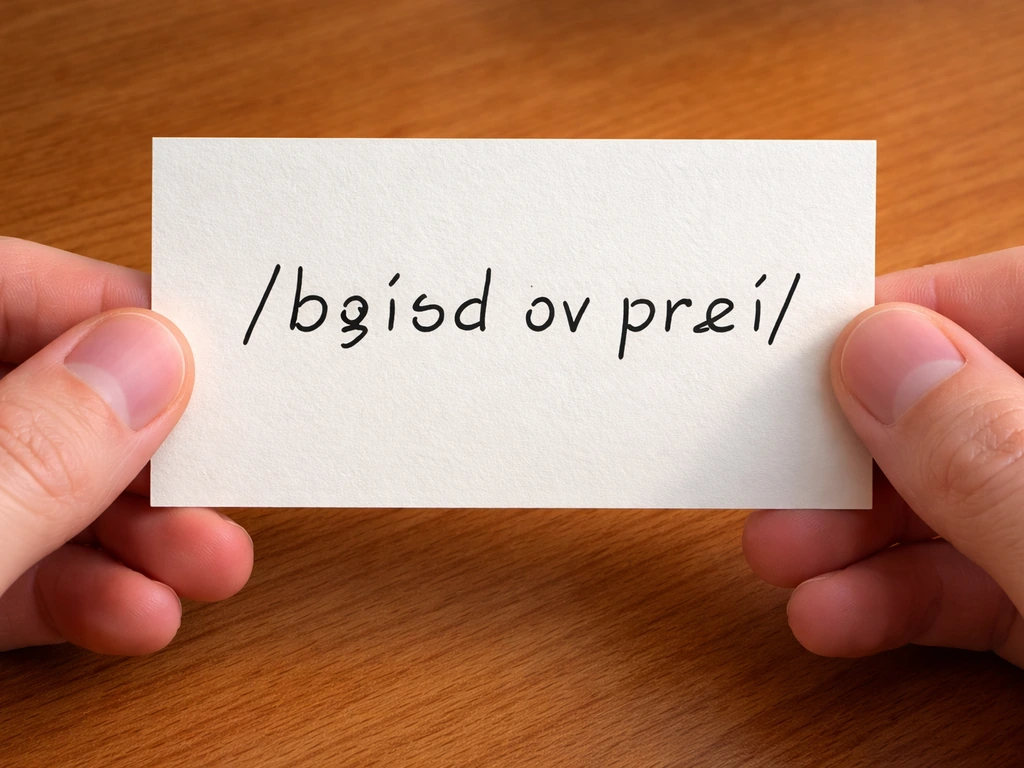
Both Cambridge Dictionary and Oxford Learner's Dictionaries agree on the phonetic transcription: /ˌbɜːd əv ˈpreɪ/. That might look intimidating if you're not used to IPA, so here's what each part actually sounds like in plain English:
| Word | IPA | Sounds like |
|---|---|---|
| bird | /bɜːd/ | "burd" (rhymes with "heard" and "word") |
| of | /əv/ | "uv" (very quick, unstressed) |
| prey | /preɪ/ | "pray" (rhymes with "day" and "say") |
The only real difference between British and American English here is a slight vowel quality in "bird." British English uses /bɜːd/ (a long, rounded vowel), while American English uses /bɜːrd/ with a noticeable r-color. In practice, both land in the same place to most ears. Neither version changes the stress or the sound of "prey."
Syllable breakdown and where the stress goes
"Bird of prey" contains three syllable-bearing units: BIRD (1 syllable), of (essentially a connector), and PREY (1 syllable). For example, the word “bird” alone has its own syllable count and stress pattern, which you can check in the same way how many syllables in bird. When you say the full phrase, it follows this rhythm: light stress on BIRD, very weak on "of," and the strongest stress on PREY. Think of it like a sentence that builds to a landing: burd-uv-PRAY.
The word "of" is what linguists call a function word, and in connected speech it almost always reduces to a schwa-plus-v sound: /əv/. Cambridge Dictionary lists “of” with a weak form /əv/ (and sometimes /ə/), which matches this connected-speech reduction in everyday phrases like “bird of prey.” schwa-plus-v sound: /əv/. You're not supposed to say "bird OF prey" with a punchy "OF" in the middle. That sounds unnatural and stilted. The "of" just glides between the two content words without drawing attention to itself.
Common mispronunciations and quick fixes

Most mistakes with this phrase come down to one of three habits. Here's what to watch for and how to correct each one:
- Saying "prey" wrong: This is the big one. "Prey" is pronounced exactly like "pray" (/preɪ/). It rhymes with "day," "say," and "way." Some people instinctively reach for a short-e sound ("preh") because the spelling looks like it might rhyme with "fret." It doesn't. The vowel is the long FACE diphthong /eɪ/, the same one in "day."
- Over-stressing "of": If you're saying "bird OF prey" with a full, clear "of," it sounds like you're reading aloud rather than speaking naturally. Let it reduce to "uv." The phrase should flow as one smooth unit.
- Putting stress in the wrong place: The primary stress belongs on "prey," not "bird." If you stress "bird" heavily and let "prey" go flat, the phrase sounds off to native speakers. Think of it as setting up for the punch: burd-uv-PRAY.
Saying "birds of prey" and the hyphenated form
The plural is "birds of prey" (no apostrophe, just add an s to bird). Oxford Learner's Dictionaries lists this explicitly. In the plural, you'll naturally give a bit more weight to "BIRDS" since it's now carrying the plural marker, but "prey" stays stressed too: BURDZ-uv-PRAY. Cambridge Dictionary treats "birds of prey" as its own plural noun phrase rather than a hyphenated compound, which is the standard approach in modern English.
You'll also see "bird-of-prey" written with hyphens when it's used as a compound modifier before a noun, like "a bird-of-prey documentary" or "bird-of-prey behavior." The hyphenated version doesn't change the pronunciation at all. Say it exactly the same way: burd-uv-PRAY. The hyphens are just a spelling convention that holds the phrase together as a single modifier.
Quick practice: drills and sample sentences

The fastest way to lock in a pronunciation is to say it out loud a few times in context. Run through these drills slowly first, then at a natural speaking pace:
- Say "pray" by itself five times: pray, pray, pray, pray, pray.
- Now say "bird" by itself: burd, burd, burd.
- Connect them with a quick "uv": burd-uv-pray. Say it five times without pausing between the words.
- Say the plural: burdz-uv-pray. Notice that only the very first sound changes.
- Now drop it into a sentence at full speed.
Here are a few sentences to practice with. Read each one aloud at a comfortable pace, keeping the stress on "prey" each time:
- "The eagle is the most iconic bird of prey in North America."
- "She could identify any bird of prey just by its silhouette."
- "There are more than 500 species of birds of prey worldwide."
- "Owls are often overlooked as birds of prey because they hunt at night."
Self-check: are you saying it right?
Run through this quick checklist after your practice run:
- "Prey" rhymes with "day" and sounds identical to "pray" — not "preh" or "pree"
- "Of" is soft and fast, not punchy or drawn out
- The strongest stress lands on "prey," not "bird"
- The whole phrase flows as three connected beats: BURD-uv-PRAY
- In the plural, "birds" gets a bit of extra weight but "prey" stays stressed
How to verify the pronunciation yourself
If you want to hear it before you say it, the most reliable tools are Cambridge Dictionary and Oxford Learner's Dictionaries. Both have audio playback buttons right next to the phonetic transcription for "bird of prey." Cambridge will play both a British and American English version. Click both and compare. You'll hear the "uv" reduction in "of" in natural speech, which is often surprising for people who expected a cleaner vowel there.
Forvo is another strong option because it hosts real recordings from native speakers in different regions, so you get a sense of how the phrase actually sounds in casual conversation rather than in a controlled dictionary recording. Search for "bird of prey" and also for "prey" on its own to isolate and confirm that /eɪ/ vowel. If you're doing a quick check without opening multiple tabs, just type "how to pronounce bird of prey" directly into Google and it will display an interactive pronunciation widget at the top of the results. If what you need is spelling for bird sounds, use the phonetic cues above and match them to the letters you intend to write how to pronounce bird of prey.
Raptor vs. bird of prey: related terms worth knowing
Once you're comfortable saying "bird of prey," it's worth knowing that "raptor" is widely used as a synonym and comes up constantly in bird watching and ornithology. Britannica notes that the two terms are often used interchangeably, though "raptor" is more technical and compact. Pronounce it RAP-tor (/ˈræptər/), with clear stress on the first syllable. That's a very different stress pattern from "bird of prey," where the stress lands at the end.
The key distinction is that "raptor" is a single word with a clean two-syllable structure, while "bird of prey" is a three-unit noun phrase with a stress pattern that builds toward "prey." Knowing both terms and how to say them correctly is genuinely useful in birding contexts, since you'll hear both used in field guides, documentaries, and conversations at a bird blind. If you're also working on related bird-name pronunciations, the approaches used here for syllable stress and vowel sounds apply directly to other tricky bird names like ibis, vireo, dove, and quail, where getting the stressed vowel right is usually the whole battle. If you also need how to pronounce ibis bird, the same focus on the stressed vowel will help you get it right.
FAQ
Should I pronounce the “of” as a full “of” (like “uhv”) or can it be reduced?
No. In careful speech you will hear something like “burd-uv-PRAY,” but in fast, natural conversation the connector sound can become even shorter, sometimes closer to “burd’ n” or “burd-əv-PRAY” depending on accent. The key is that “prey” remains the strongest stress and the “of” does not get equal weight.
How does the pronunciation change when it’s plural, “birds of prey”?
Use “birds of prey” when there is more than one type or instance of raptor hunting wildlife. For example, “birds of prey nest in the cliffs.” Keep stress on “prey,” and just add a bit more prominence to “birds” (BIRDZ-uv-PRAY). Don’t use an apostrophe because it is not showing possession.
Does spelling it as “bird-of-prey” change how I pronounce it?
If you are using it as a hyphenated adjective before a noun, the pronunciation stays the same. “A bird-of-prey documentary” and “bird-of-prey behavior” are both said “burd-uv-PRAY,” because the hyphens only change spelling, not where the stress lands.
What’s the most common pronunciation mistake people make with this phrase?
Avoid saying “bird OF prey” with a strong, separate “OF” sound. The phrase sounds most natural when “of” behaves like a glide between “bird” and “prey,” essentially a weak schwa-like connector. If you find you are emphasizing it, try whispering the “of” portion while keeping “prey” clear and loud.
Can I use “raptor” instead of “bird of prey,” and are the pronunciations interchangeable?
It’s fine to use either as long as you keep the stress patterns straight. “Raptor” is RAP-tor with primary stress on “RAP.” “Bird of prey” builds to “PRAY” at the end, so even if the meaning is similar, listeners will hear a different rhythm if you swap them without adjusting stress.
If I speak American English, do I have to change the way I say “bird of prey”?
In IPA, the “bird” vowel differs slightly between British and American English, but the stress and the ending vowel in “prey” stay the same. If you are a speaker who doesn’t use r-coloring, you can aim for the British-style “bird” sound, still say the ending “prey” the same way, and you will be understood.
What should I do if my “prey” vowel sounds off, like “prey” vs “prey” (short vowel)?
Yes. In “bird of prey” the stress is phrase-final on “prey,” so “prey” should sound like the word “pray” (with an /eɪ/ vowel). If you accidentally say “prey” like “prey” with a short vowel or make the stress fall earlier, the phrase may sound unfamiliar or like a different rhythm entirely.
Next Article
How to Pronounce Dove Bird: IPA, Steps, and Common Mistakes
Learn how to pronounce dove bird correctly with IPA, step-by-step syllables, common mistakes, and dove species names