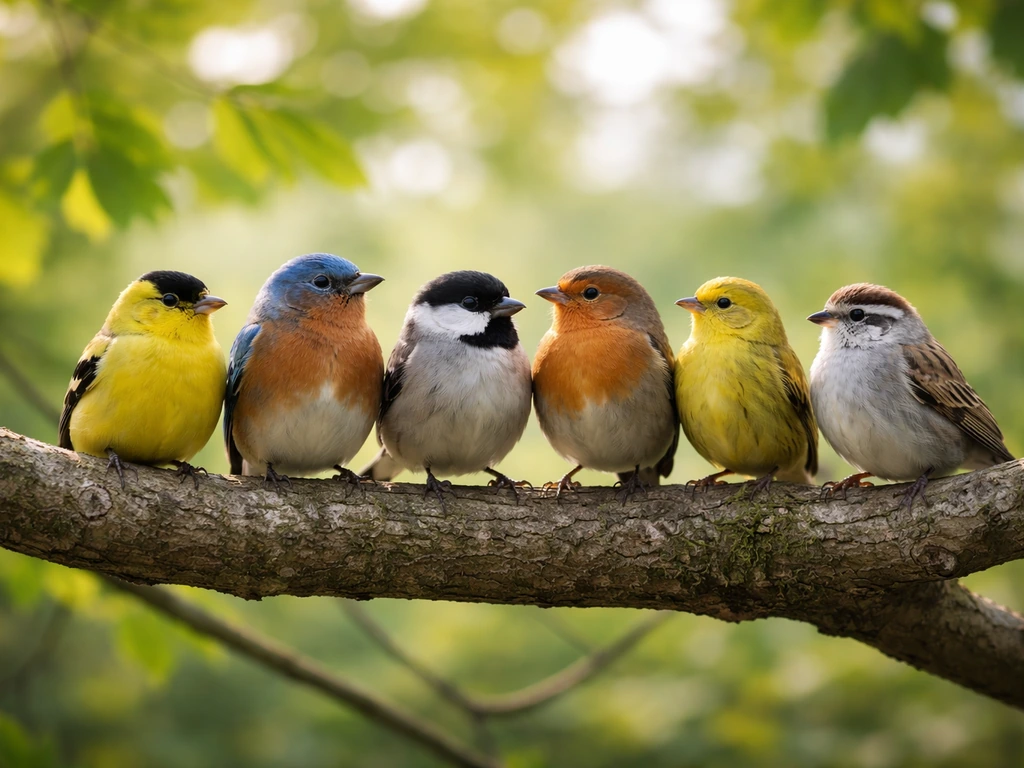
A "charm" is the collective noun for finches, most famously goldfinches. So if you searched "charm collective noun for which bird," the answer is finches. You might also see it written as "a charm of goldfinches" or "a charm of finches" depending on whether you're being general or species-specific. It is not the standard word for birds in general, but it is one of the most well-known poetic collective nouns in English birding language.
Charm Collective Noun for Which Bird: Correct Terms

James Ridgley
14 May 2026
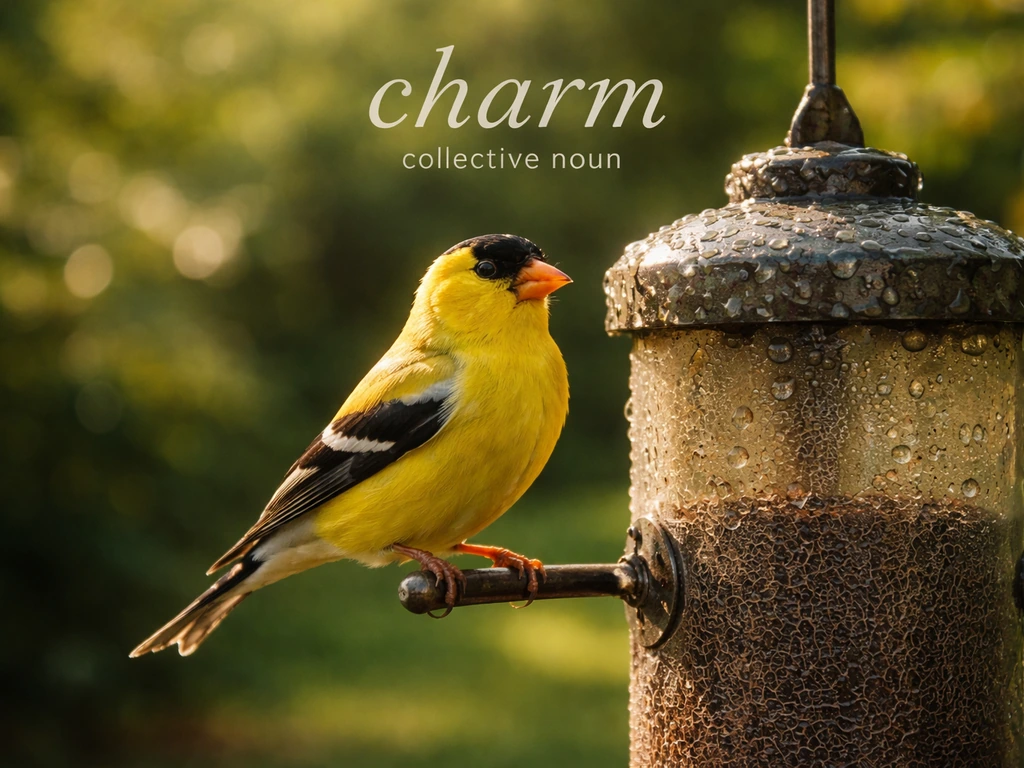
Which bird is a "charm"? The quick answer
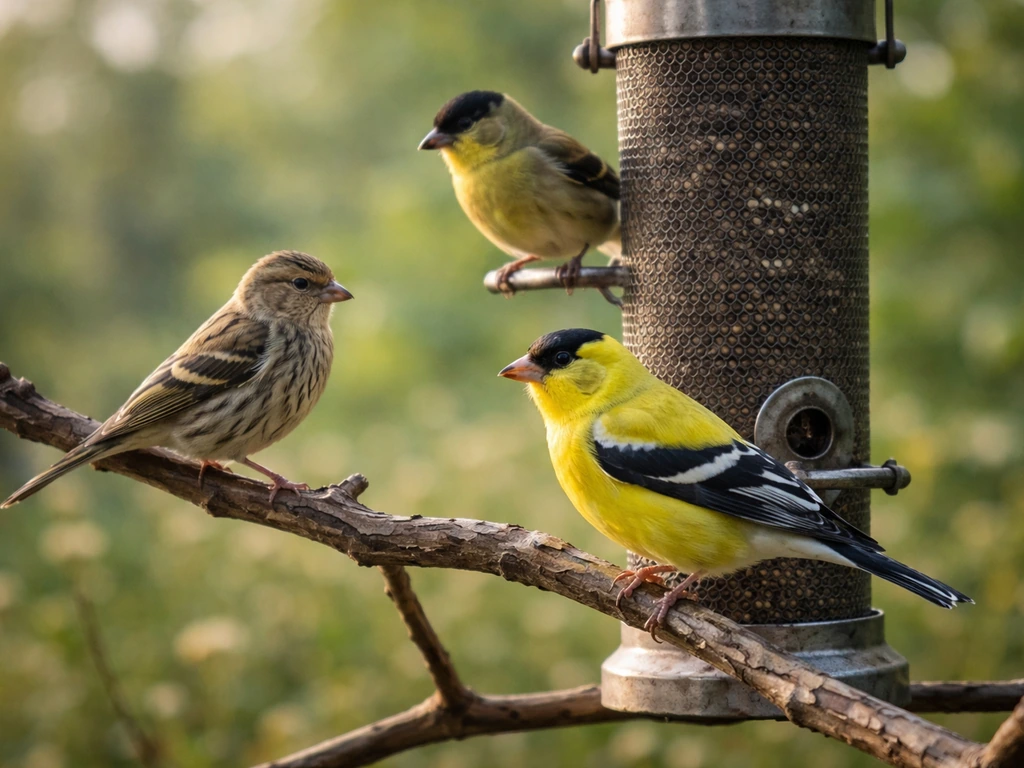
The collective noun "charm" belongs to finches, and goldfinches in particular. Merriam-Webster actually cites "a charm of goldfinches" as a textbook example of how specific collective nouns get applied to particular birds. The word is what linguists and ornithologists call a "term of venery" which is a special group noun from the medieval hunting tradition. It is not used for birds in general, and you will not find it in everyday casual conversation about a mixed flock you spotted in the garden. When someone says "a charm," they specifically mean finches.
Common collective nouns for birds and when to use each
Birds have both a generic catch-all collective noun and dozens of species-specific ones. The word "flock" is the standard, universally understood collective noun for birds of any kind. It works in every context: conversation, field notes, writing, and puzzles. Beyond that, specific bird groups have their own dedicated terms, many of them colorful and memorable. Here is a practical breakdown of the most commonly used ones:
| Collective Noun | Bird(s) It Applies To | Best Context to Use It |
|---|---|---|
| Flock | Any birds (general) | Everyday speech, field notes, writing |
| Charm | Finches, especially goldfinches | Poetry, puzzles, formal writing, bird trivia |
| Murmuration | Starlings | Describing aerial group displays |
| Parliament | Owls | Formal writing, word puzzles, trivia |
| Murder | Crows | Informal writing, trivia, popular culture |
| Conventicle / Tribe | Starlings (also used) | Historical or poetic usage |
| Covey | Quail, partridges, grouse | Hunting contexts, field guides |
| Colony | Gulls, penguins, herons | Scientific writing, birdwatching notes |
| Skein | Geese (in flight) | Field notes, descriptive writing |
| Gaggle | Geese (on the ground) | Casual speech, everyday writing |
Notice that "parliament" belongs to owls, the same way "charm" belongs to finches. Both are terms of venery with medieval roots. If you are working on a word puzzle or crossword and the clue references a collective noun for owls, that is a different article entirely, but the pattern is the same: one poetic word, one specific bird group.
Example phrases by bird type
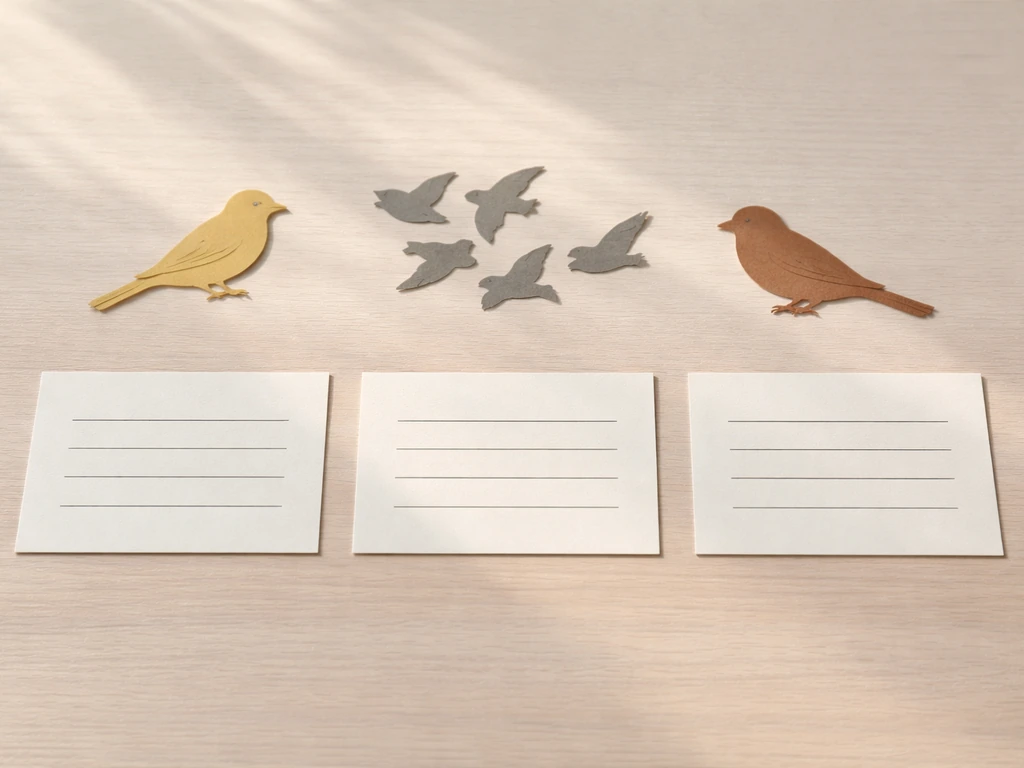
Seeing these collective nouns in real sentences makes them stick much better than a list ever does. Below are practical example phrases you can borrow directly for writing, birdwatching notes, or just impressing someone at a quiz night.
- "A charm of goldfinches settled on the thistle feeder this morning." (specific, poetic, correct)
- "We spotted a charm of finches along the hedgerow." (broader but still accurate)
- "A flock of birds passed overhead, but I couldn't identify the species." (generic, always safe)
- "The murmuration of starlings over the estuary lasted nearly twenty minutes." (species-specific, descriptive)
- "A parliament of owls was roosting in the barn rafters." (formal, poetic)
- "We flushed a covey of quail from the brush." (hunting/fieldwork context)
- "A skein of geese crossed the sky in a perfect V formation." (flight-specific)
- "A gaggle of geese was blocking the path to the pond." (on the ground, casual)
The key takeaway here is that "charm" sounds natural and correct when you pair it with finches or goldfinches. Swap it in for any other bird and it will read as a mistake. If you are unsure of the specific bird you mean, "flock" is always the safe, correct choice.
Regional differences, spelling, and common mix-ups
"Charm" is spelled identically in British and American English, and there is no regional variation in meaning when it comes to this collective noun. However, there are a few places where confusion creeps in. Some older British texts use "charme" as an archaic spelling drawn from Middle English, but you will never need that form in modern writing. The word you want is simply "charm."
The bigger source of confusion is that people sometimes misremember which bird a charm belongs to, or assume it is a general bird term. It is not. A related mix-up: some collective noun lists online are inconsistent or flat-out wrong. The most reliable sources are Merriam-Webster for American usage and the Oxford English Dictionary for British usage. Both confirm that "charm" applies to finches.
Another common stumble: people searching for the collective noun for starlings sometimes land on "conventicle" or "tribe," which are valid but archaic alternatives. The word most people recognize for starlings in flight is "murmuration." Starlings also have a sibling connection to this topic since their collective nouns share the same medieval venery tradition as "charm." If you are curious about which birds have particularly unusual collective nouns, starlings are worth exploring alongside finches.
How to pronounce "charm" and use it naturally in a sentence

"Charm" is pronounced exactly as it looks: CHAHRM (IPA: /tʃɑːrm/). One syllable, rhymes with "farm" and "arm." There is no tricky stress or silent letter. The plural is "charms" if you are referring to multiple groups of finches: "Two charms of goldfinches were competing for the same feeder." In formal writing, "a charm of goldfinches" is the conventional form, lowercase, with the indefinite article.
When you use it in spoken conversation, say it with the same confidence you would say "a flock of birds." It sounds poetic but not pretentious, and most birdwatchers will recognise it immediately. In a crossword or word puzzle context, the clue will usually read something like "Group of goldfinches" or "Goldfinch gathering" and the answer will be CHARM.
Where "charm" actually came from
The word "charm" as a collective noun for finches comes from the Old English word "cirm" or "cyrm," which meant a noise or din, particularly the kind of chattering, chirping sound that a group of finches makes. The connection is entirely about sound: a large group of finches together produces a constant, musical, somewhat chaotic mix of calls, and the Old English word for that racket became the collective noun. Over time, "cirm" evolved through Middle English into the modern "charm."
This is part of the broader tradition of "terms of venery" that flourished in medieval England. The most famous collection of these terms appears in "The Book of Saint Albans" (1486), a hunting manual that listed poetic group names for animals, birds, and even people. Many of the bird collective nouns we still use today, including "parliament" for owls and "murder" for crows, trace directly to that tradition. Parliament is the collective noun for owls. "Charm" fits neatly into that same family: a word chosen to capture something vivid and sensory about the animal it describes, in this case the musical noise of finches gathered together.
It is worth noting that "charm" also carries the modern meaning of a spell or enchantment, and some writers lean into that double meaning when describing a group of goldfinches. The two meanings are actually related at their root: the Latin "carmen" meant a song or incantation, which fed into both the sense of a magical charm and the noisy, musical chirping of birds. So the word has a genuinely rich etymological history that makes it one of the more satisfying collective nouns to use.
A quick decision guide: which collective noun do you actually need?
If you are still unsure which term fits your situation, run through this short checklist:
- Are you referring to finches or goldfinches specifically? Use "charm."
- Are you referring to any unidentified or mixed group of birds? Use "flock."
- Are you describing starlings in flight doing aerial displays? Use "murmuration."
- Are you talking about owls? Use "parliament."
- Are you writing about crows? Use "murder."
- Are you working on a crossword or word puzzle? Match the bird in the clue to the correct term using the table above.
- Are you unsure and just need something that always works? "Flock" is universally correct and understood.
Collective nouns for birds are one of those wonderfully specific corners of the English language where knowing the right word genuinely impresses people. "Charm" is one of the best ones to have in your vocabulary, not just because it is correct, but because it tells you something true about the birds themselves: a group of finches really is a charming, noisy, musical thing to witness.
FAQ
Can I use “a charm” for any small birds, like sparrows or canaries?
No. A “charm” is specifically for finches, so “a charm of sparrows” or “a charm of canaries” would be treated as incorrect by most standard collective-noun references. If you mean another small passerine, use “flock” unless you know its exact species term.
What should I say if I see a mixed flock in my garden and I am not sure they are finches?
Use “a flock of birds” for mixed-flock sightings, especially when you cannot confidently identify the species. “Charm” is best reserved for when you know you are looking at finches (often goldfinches, but the term is for finches generally).
How do I structure the sentence when I need more than one group, like “two charms”?
In modern usage, “charm” is treated as a collective noun that usually takes “of” plus the bird: “a charm of goldfinches.” If you need multiple groups, you can say “Two charms of goldfinches,” and the plural is “charms.”
In a crossword or word puzzle, when would “charm” be the wrong choice even if the clue mentions birds?
If your clue or text is asking for a generic bird group term, “charm” will likely be rejected. For crosswords, use “CHARM” only when the clue points to goldfinches or finches. When the clue is general (for birds in flight, for example), “FLOCK” is the safer answer.
Are there common wording mistakes, like “charmed” or using the wrong preposition?
“Charmed” or “enchantment” is not what you want in this context. The collective noun is “charm,” and the phrase pattern is “a charm of finches.” If you write “a charmed of finches” or “a charm for finches,” it will read as a grammar or word-selection error.
Why do some online lists disagree, and how can I verify the meaning for finches?
Expect variations in what some people remember, but the standard modern bird meaning is finches. Some lists also mention archaic or related venery terms for other birds, so double-check that the bird named in your sentence is actually the finch family.
Can I lean on the “magic charm” meaning when describing goldfinches?
Yes, it can be used in playful writing because it has the spell/enchantment meaning too. However, keep the bird portion clear, for example “a charm of goldfinches,” so readers do not think you mean literal magic rather than the collective noun.
How do I pronounce “charm” correctly when I say it as a collective noun?
Pronunciation is straightforward: “charm” sounds like one word, CHAHRM, and it rhymes with “farm” and “arm.” If you are reading it aloud for a quiz, there is no silent letter or tricky stress to memorize.
Should I use the archaic spelling “charme” or the modern spelling “charm”?
“Charm” and “charme” can appear in older writing, but the modern form for contemporary articles, field notes, and everyday use is “charm.” If you are trying to be correct for today’s English, use “charm” only.
What is the difference between a “charm” and a “murmuration”?
“Charm” is not the same thing as “murmuration,” which is the well-known collective noun associated with starlings. If your birds are starlings, use “murmuration,” and if they are finches, use “charm.”
Next Article
What Is the Plural of Bird? Birds and Usage Rules
Plural of bird is birds, with simple rules and sentence examples for birdwatching and general bird groups.