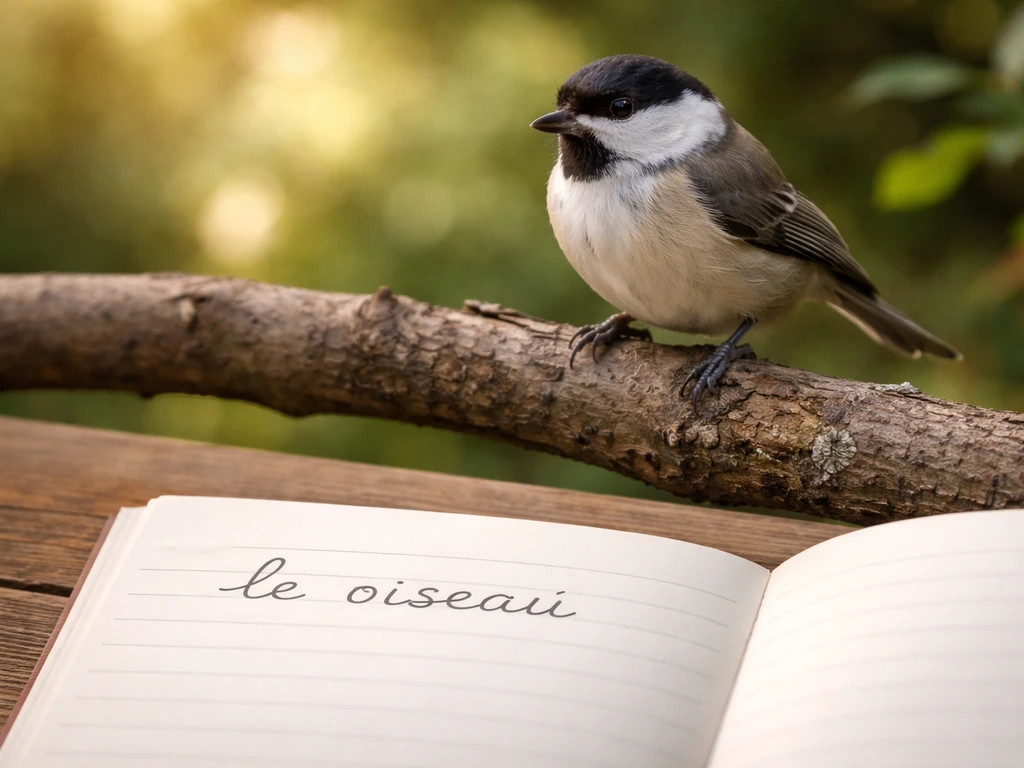
In Spanish, the most common word for bird is 'pájaro,' and it is masculine. If you are wondering about Duolingo’s bird mascot, you can treat it as a friendly character, but the idea of its gender varies by context bird is masculine. You say 'el pájaro' (the bird) and 'un pájaro' (a bird). Según la RAE, “un” se usa delante de “m.
Is Bird Masculine or Feminine in Spanish? Pájaros y aves

James Ridgley
3 Jun 2026
sing. ” y “una” delante de “f. sing. ” cuando empieza con “a-” o “ha-” tónicas [“un” se usa delante de “m.
sing. ” y “una” delante de “f. sing. ” con ciertos casos con “a-” o “ha-” tónicas](https://www.
rae. es/diccionario-estudiante/uno). In French, grammatical gender works differently, so you typically focus on the noun’s gender, not the Spanish one is bird feminine or masculine in French. The other main word, 'ave,' is feminine, so it takes 'la ave' or more correctly 'el ave' in the singular (because of a special rule for feminine nouns starting with a stressed 'a'), and 'unas aves' in the plural.
If you are just starting out, use 'pájaro' for everyday conversation and 'ave' when you want a more formal or scientific tone.
Which word should you actually use: pájaro or ave?
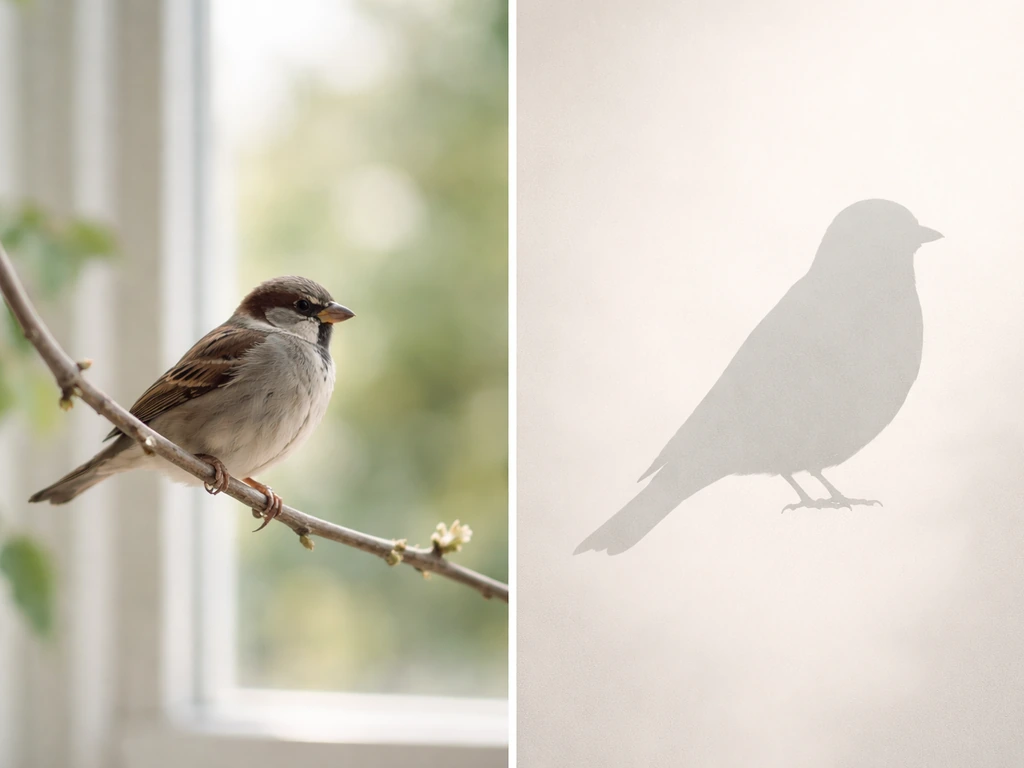
Both words translate as 'bird' in English, but they are not interchangeable in every situation. Choosing the right one is less about grammar and more about context and register.
'Pájaro' is the everyday word. You would use it the same way an English speaker casually says 'bird.' It often implies a small perching bird (what the RAE calls an 'ave pequeña'), and it shows up in figurative expressions, pet talk, and general conversation. It is also the word you will hear in most Latin American countries for a common garden bird.
'Ave' is broader and more formal. It refers to the entire biological class of birds, so you will see it in field guides, nature documentaries, zoology texts, and phrases like 'ave de paso' (migratory bird, or figuratively, someone who never stays long). It covers large birds as naturally as small ones. If you are talking about, say, an eagle or a flamingo in a scientific or descriptive context, 'ave' fits better than 'pájaro.'
| Word | Gender | Article (singular) | Best used for |
|---|---|---|---|
| pájaro | Masculine | el pájaro / un pájaro | Everyday chat, small birds, figurative use, pet talk |
| ave | Feminine (special article rule) | el ave / un ave (sing.), las aves / unas aves (pl.) | Formal, scientific, or descriptive contexts; all bird sizes |
How to get the articles and adjectives right
Spanish articles and adjectives must agree in gender and number with the noun. Since 'pájaro' is masculine singular, everything around it takes masculine forms. Since 'ave' is feminine, everything agrees in the feminine, with one tricky exception explained below.
The 'el ave' rule (and why it looks masculine but is not)
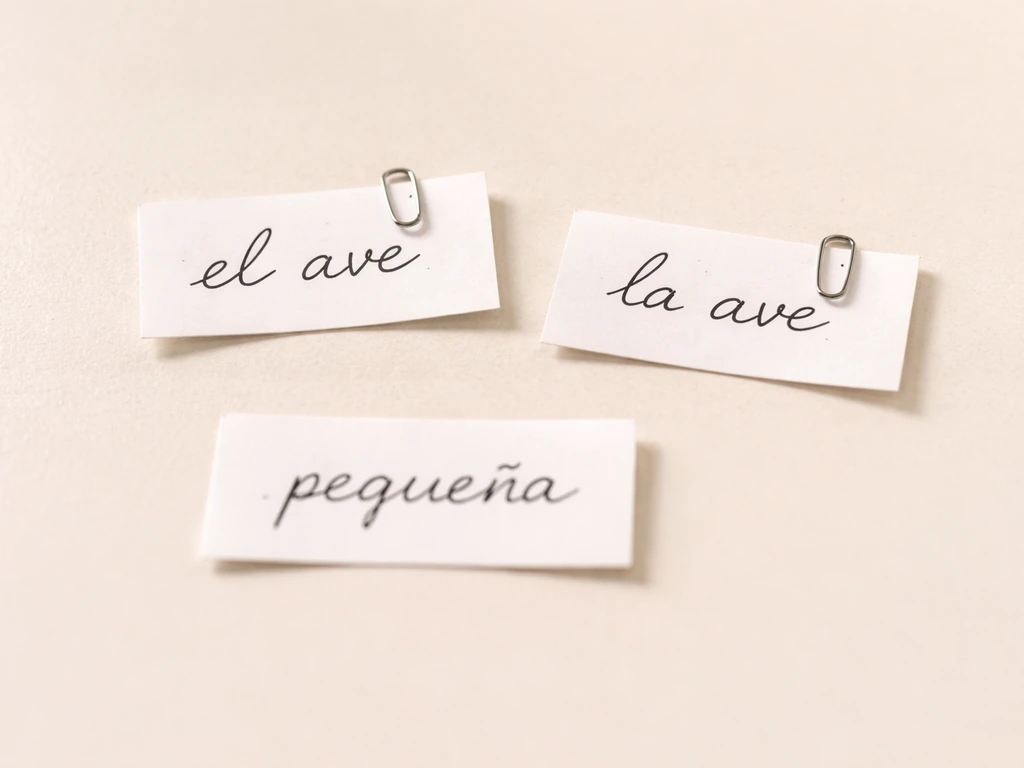
Here is the part that trips up even intermediate learners. 'Ave' is feminine, but in the singular it takes the article 'el' instead of 'la. En el DLE, la RAE marca “ibis” como “1. m.
” y lo define como “Ave zancuda…”, mostrando el uso del artículo masculino “el” para ese ave con género gramatical masculino [ibis se clasifica como “1. m. ” y es un “Ave zancuda” en el DLE](https://dle. rae.
es/ibis). ' This happens because 'ave' begins with a stressed 'a' sound (the stress falls on the first syllable: AH-veh). Spanish has a phonetic rule that swaps 'la' for 'el' before any feminine singular noun starting with a stressed 'a' or 'ha,' purely to avoid the awkward clashing of two 'a' sounds running together. So you say 'el ave,' not 'la ave.
' In the plural this rule does not apply, so it is 'las aves. ' Any adjective you add still takes the feminine form: 'el ave pequeña,' not 'el ave pequeño. '
Adjective agreement at a glance
- un pájaro pequeño (a small bird, masculine singular)
- unos pájaros pequeños (some small birds, masculine plural)
- el ave pequeña (the small bird, feminine singular with special article)
- las aves pequeñas (the small birds, feminine plural)
Example phrases you can copy right now
These sentences go from simple to more natural-sounding Spanish. They cover the scenarios where learners most often need to get the gender right: describing a bird, giving it an adjective, asking about it, and using it in a phrase.
- El pájaro canta. (The bird is singing.) — basic masculine singular.
- Vi un pájaro azul en el jardín. (I saw a blue bird in the garden.) — adjective 'azul' is invariable, but 'un' is masculine.
- Tengo un pájaro como mascota. (I have a bird as a pet.) — useful for pet owners.
- El ave migra cada año. (The bird migrates every year.) — feminine noun, special singular article.
- Las aves del parque son hermosas. (The birds in the park are beautiful.) — plural feminine, standard 'las.'
- ¡Qué pájaro tan bonito! (What a beautiful bird!) — 'bonito' matches masculine 'pájaro.'
- El ibis es un ave zancuda. (The ibis is a wading bird.) — 'ibis' is masculine (el ibis), but 'ave' here is feminine.
- Es un pájaro de mal agüero. (It is a bird of ill omen.) — common figurative phrase with 'pájaro.'
- El ave de paso no dura en el nido. (A migratory bird does not linger in the nest.) — idiomatic use of 'ave.'
Common mistakes and how to dodge them
Most errors come from three sources: carrying over English habits, forgetting the 'el ave' rule, and mixing up article gender when a specific bird species has a different grammatical gender than you expect.
- Saying 'la pájaro': 'pájaro' is masculine, so this is always wrong. It is 'el pájaro,' full stop.
- Saying 'la ave': Phonetically awkward and grammatically incorrect in the singular. Use 'el ave' for singular, 'las aves' for plural.
- Adding a masculine adjective to 'ave': Because you see 'el' in front of 'ave,' it can feel masculine. Remember: 'el ave pequeña,' not 'el ave pequeño.'
- Treating all bird species names as masculine: Many specific bird names are feminine. 'La grulla' (the crane) and 'la golondrina' (the swallow) are feminine regardless of the bird's sex. Check each species name individually.
- Confusing biological sex with grammatical gender: 'El pavo' is a tom turkey, 'la pava' is a hen turkey. But grammatical gender in Spanish is a property of the word, not always the creature's sex.
- Pronouncing 'pájaro' on the wrong syllable: The stress falls on the first syllable: PÁ-ja-ro (esdrújula pattern). Stressing the second syllable ('pa-JA-ro') sounds unnatural and can cause confusion.
A quick cheat-sheet and your next steps
Here is a fast-reference table for the most common bird nouns in Spanish, showing the gender and correct article for each. Use this when you are writing or speaking and need a quick check.
| Spanish word | English | Gender | Correct article |
|---|---|---|---|
| pájaro | bird (general/small) | Masculine | el / un |
| ave | bird (formal/all types) | Feminine | el (sing.) / las (pl.) |
| grulla | crane | Feminine | la / una |
| golondrina | swallow | Feminine | la / una |
| ibis | ibis | Masculine | el / un |
| gorrión | sparrow | Masculine | el / un |
| pavo / pava | turkey (male/female) | Masc. / Fem. | el pavo / la pava |
For pronunciation: 'pájaro' is PÁ-ja-ro (three syllables, stress on the first, written accent marks tell you that). 'Ave' is AH-veh (two syllables, stress on the first). Neither word is difficult once you know where the stress lands.
Your practical rule of thumb
- Default to 'pájaro' (masculine) for everyday bird talk, pet references, and casual conversation.
- Switch to 'ave' (feminine) for formal writing, scientific descriptions, field guides, or when you mean birds as a category.
- When a specific species has its own Spanish name (grulla, golondrina, ibis), look up that word's gender separately since it will not always match the generic 'pájaro/ave' pattern.
- If you are learning Spanish with an app like Duolingo, note that the Duolingo owl mascot has its own separate gender discussion in Spanish fan circles, which is a fun rabbit hole if you are curious about bird gender in a different context.
The core takeaway is straightforward: 'pájaro' is masculine (el/un pájaro), 'ave' is feminine but uses 'el' in the singular (el ave, las aves), and adjectives follow the gender of whichever word you pick. If you are wondering what bird Duolingo refers to, it is generally the owl used as the app’s mascot ave is feminine. Get those two patterns down and you will handle nearly every bird conversation in Spanish without stumbling.
FAQ
If both “pájaro” and “ave” mean “bird,” how do I know which gender to use?
In Spanish, the gender mainly follows the noun you choose. “Pájaro” is masculine, so you say “un pájaro” and “el pájaro”. “Ave” is feminine, so it normally takes feminine agreement, but in the singular you say “el ave” (not “la ave”) and “el ave pequeña”, while in plural it becomes “las aves”.
Should I say “un pájaro” or “un ave” when I do not mean a specific species?
For describing “a bird” in general, “un pájaro” sounds like an individual bird, while “un ave” (or more naturally “un ave” in scientific style) points to the broader biological category. If you are speaking conversationally, “un pájaro” is the safer default.
What happens with word order, for example adjective-first expressions with “ave”?
When the noun comes after the adjective, the agreement still follows the noun. So you would say “pequeña ave” only if you keep it as “una/esa ave”, but the correct article form in the singular is still “el ave pequeña”. In practice, it is easiest to learn the fixed noun phrases “el ave” and “las aves”.
Do articles and adjectives change if I am talking about a male or female bird?
You should not guess from English or from the actual sex of the animal. If you refer to a female bird, Spanish typically uses natural gender only for the animal or species name, but the grammatical gender of the noun still governs articles and adjectives: “el ave” stays “el” even if you are describing a female bird.
Is it ever correct to say “la ave” in Spanish?
Be careful with a common mistake: using “la ave” is almost always wrong in standard Spanish. The correct forms are “el ave” in singular and “las aves” in plural. Only the singular triggers the switch from “la” to “el”.
How does the “el ave” rule work in questions and negatives?
In negative or question sentences, the same rule applies. For example, “¿ves el ave?” and “no veo el ave” use “el” because it is singular and feminine. The plural version would be “¿ves las aves?” and “no veo las aves”.
Do determiners like “mi,” “esta,” or “esa” interact with the “el ave” pronunciation rule?
If you use a possessive or determiner, agreement and the “el” swap still follow the noun. You keep masculine forms only with “pájaro” (for example “mi pájaro”), and you keep feminine agreement with “ave” but use “el” in singular: “mi ave” does not exist as “la” or “el” here, it is “mi ave” with the possessive replacing the article, while “esta ave” uses “esta” and still pairs with the singular noun form pattern.
How do I correctly form plural phrases like “many birds”?
For plural, “ave” is regular and you say “las aves”. The “el” form disappears. So “many birds” is “muchas aves” (or “muchos” only if you switched the noun to “pájaros”).
Do proper names or titles after “ave” change the article choice?
If you write “ave” followed by a name or title, the grammatical rule still applies. You would say “el ave Fénix” (example) because it is the singular form of “ave”. The same pattern holds with adjectives you add afterward: “el ave migratoria”.
If “ave” uses “el,” do pronouns like “la” or “esa” create confusion later?
The article choice also affects pronouns later. If you start with “el ave,” later references like “esa” or “la” can become tricky because “ave” is grammatically feminine even though the article is “el.” Many speakers avoid clashing pronouns by restructuring the sentence, for example repeating the noun or using “esa especie” instead.
Next Article
Is bird masculine or feminine in French? Gender rules
Answer: oiseau is masculine in French, use le with un oiseau; bird species terms may differ by name and gender.