The generic word for 'bird' varies enormously across languages, and knowing the right one depends on what you actually need it for. If you are a birdwatcher trying to identify a species, a pet owner picking a name, or a word puzzle solver filling in a grid, the answer you want is different in each case. For the everyday concept of 'bird,' here are the most useful translations with pronunciation right up front: Spanish pájaro (PAH-hah-roh), French oiseau (wah-ZOH), German Vogel (FOH-gel), Italian uccello (oo-CHEL-loh), Portuguese pássaro (PAH-sah-roo), Russian птица (PTEE-tsah), Japanese 鳥 tori (toh-ree), Mandarin 鸟 niǎo (nyow, falling-rising tone), Arabic طائر tā'ir (TAH-ir), and Dutch vogel (FOH-khel).
How to Say Bird in Other Languages: Pronunciations & Tips

James Ridgley
27 May 2026
Common word vs. species name: which one do you actually need?
Before diving into translations, it is worth separating two very different things: the generic word for 'bird' (a category label, like saying 'animal') and the name of a specific bird species. These are not interchangeable, and mixing them up leads to real confusion depending on your goal.
The generic word is what you use when you want to say something like 'I saw a bird in the garden' or fill in a crossword clue that reads 'feathered creature (4).' It is a broad category word, not a species name. In contrast, species names are usually either standardized English common names (like 'European Robin') or scientific Latin binomials (like Erithacus rubecula). When you are birdwatching or looking up a bird in a field guide, you almost always want the species name, not the generic category word, because 'bird' does not help you identify anything specific.
For pet naming, it depends on what effect you want. Using the foreign word for 'bird' (like calling your parrot Vogel or Oiseau) gives a quirky, affectionate feel. Using a species-specific name or a name derived from the bird's characteristics (its color, call, or behavior in another language) tends to produce more distinctive, personal pet names. For word puzzles, you almost always want the generic translation, since clues like 'bird in French' are asking for oiseau, not merle (blackbird) or hirondelle (swallow).
How to say 'bird' in major languages

Below is a ready-to-use reference table covering the most widely spoken languages. The IPA column gives the technically accurate pronunciation, and the 'Say it like this' column gives a practical English-speaker approximation you can use immediately without knowing phonetics.
| Language | Word for 'bird' | IPA | Say it like this |
|---|---|---|---|
| Spanish | pájaro | /ˈpaxaɾo/ | PAH-hah-roh |
| French | oiseau | /wazo/ | wah-ZOH |
| German | Vogel | /ˈfoːɡl̩/ | FOH-gel |
| Italian | uccello | /utˈtʃɛllo/ | oo-CHEL-loh |
| Portuguese | pássaro | /ˈpasaɾu/ | PAH-sah-roo |
| Russian | птица | /ˈptʲit͡sə/ | PTEE-tsah |
| Japanese | 鳥 (tori) | /toɾi/ | toh-ree |
| Mandarin Chinese | 鸟 (niǎo) | /ni̯ɑ̌ʊ̯/ | nyow (falling-rising tone) |
| Arabic | طائر (tā'ir) | /ˈtˤaːʔir/ | TAH-ir |
| Dutch | vogel | /ˈvoːɣəl/ | FOH-khel |
| Polish | ptak | /ptak/ | p-TAK |
| Hindi | पक्षी (pakshī) | /pəkʂiː/ | puk-SHEE |
| Swahili | ndege | /nˈdeɡe/ | n-DEH-geh |
| Turkish | kuş | /kuʃ/ | koosh |
| Korean | 새 (sae) | /sɛ/ | sae (rhymes with 'say') |
A few of these deserve a quick note. French oiseau is famously tricky because none of the letters are pronounced the way an English speaker expects. The 'oi' sounds like 'wa,' the 's' is silent, and 'eau' sounds like 'oh.' Russian птица starts with a consonant cluster (pt-) that English has no equivalent for at the start of a word, so just commit to it: say the 'p' and 't' quickly together before the 'ee.' Mandarin niǎo uses the third tone (falling then rising), which changes the meaning entirely if you get it wrong.
Regional variations, dialects, and grammar quirks worth knowing
Languages rarely have just one word for 'bird,' and regional variation matters more than most translation tools suggest. Spanish is a good example: pájaro is the standard word across most of Latin America and Spain, but ave (AH-veh) is a more formal or literary alternative you will see in poetry, biology, and some regional speech. In Spain specifically, pájaro can also be slang for a cunning or shady person, which is worth knowing before you use it in conversation.
German capitalizes all nouns, so it is always Vogel, never vogel, in standard written German. The plural is Vögel (with an umlaut), not Vogels. German-language Wiktionary for Vogel includes IPA pronunciation in its “Aussprache” section, such as [ˈfoːɡl̩] German Vogel. French oiseau has the plural oiseaux, where both the singular and plural sound identical when spoken but differ in writing. Italian uccello becomes uccelli in the plural. These distinctions matter if you are writing the word rather than just saying it.
Grammatical gender affects how you use these words in sentences. German Vogel is masculine (der Vogel). French oiseau is masculine (un oiseau). Spanish pájaro is masculine (un pájaro), while Spanish also has pájara as the feminine form, though this is less commonly used for the bird concept and more often appears in idiomatic expressions. If you are using the word in a full sentence rather than in isolation, knowing the gender matters for correct article and adjective agreement.
In some languages, the word for 'bird' differs notably by dialect or register. In Portuguese, pássaro is standard in Brazil, while ave is more formal in both Brazilian and European Portuguese. In Arabic, طائر (tā'ir) is the Modern Standard Arabic form you will find in dictionaries, but spoken dialects across the Arab world use different words: عصفور ('uṣfūr), which technically means 'sparrow,' is commonly used as the generic word for small birds in many dialects, so context and region really matter.
When 'bird' doesn't translate 1:1

The single biggest trap in translating 'bird' is assuming every language uses one clean generic term the way English does. Several languages draw a conceptual or grammatical line between types of birds that English lumps together under 'bird.'
Japanese is a good example. 鳥 (tori) is the everyday word for bird, but 野鳥 (yachō) means 'wild bird' specifically, and 鳥類 (chōrui) is the more scientific or collective term meaning 'avian class' or 'birds (as a group).' If you are trying to say 'I like birds' casually, tori works fine. If you are writing about ornithology, chōrui is more appropriate. Similarly, in Mandarin, 鸟 (niǎo) is the everyday term, but 禽 (qín) appears in more formal or classical contexts and in compound words like 家禽 (jiāqín, poultry) and 飞禽 (fēiqín, flying birds).
Some languages also distinguish birds by size or type in ways that can create translation mismatches. The Arabic عصفور ('uṣfūr) technically means sparrow but functions colloquially as 'small bird' in several dialects, while طير (ṭayr) and طائر (tā'ir) cover birds more broadly. If you translate the English word 'bird' using a bilingual dictionary, you will usually get the correct generic term, but if you are working from a spoken dialect source or regional text, you may encounter a narrower term being used generically.
For specific bird species, always use the official common name in the target language or the Latin binomial, not a translation of the English common name. 'Robin' in English refers to the American Robin (Turdus migratorius) in North America and the European Robin (Erithacus rubecula) in the UK. These are different birds with different names in other languages. Translating 'robin' word-for-word will not reliably get you to the right species in another language. For birdwatching and field guide contexts, the scientific name is the only truly universal identifier.
Pronunciation tips and the best places to actually hear it
IPA (International Phonetic Alphabet) is the gold standard for pronunciation, but it is only useful if you already know how to read it. If you do not, the phonetic approximations in the table above are a solid starting point. The most important thing, though, is to hear the word spoken by a native speaker before you commit it to memory, because written guides (including this one) can only approximate sounds that may not exist in English.
Forvo is the most practical free resource for this. It is a pronunciation dictionary built entirely on native-speaker audio recordings, and it has entries for pájaro, oiseau, Vogel, and most of the other words in the table above. You search for the word, pick the target language, and listen to real speakers. It is far more reliable than text-to-speech tools for hearing genuine pronunciation nuances, especially for tonal languages like Mandarin or words with sounds that have no English equivalent.
Cambridge Dictionary and Collins Dictionary both have audio pronunciation for English 'bird' (UK: /ˈbɜːd/, US: /ˈbɜːrd/), which is useful if you are specifically studying English phonetics or explaining the English word to a non-native speaker. For learning to say the English word with a natural accent, these are reliable starting points. For the other languages in this article, Forvo and the language-specific Wiktionary entries (which include IPA and sometimes audio) are the most consistent free resources. If you also want the English pronunciation side of things, see how to say bird for practical audio-based tips. If you just want the English pronunciation and how to say it naturally, this guide on how to say bird in English is a great place to start.
- Forvo: native-speaker audio for pájaro, oiseau, Vogel, and most other major-language entries
- Wiktionary: IPA transcriptions and sometimes audio for almost every language (search the word in that language, not just in English)
- Cambridge Dictionary: IPA and audio for English 'bird' in both UK and US accents
- Collins Dictionary: audio and IPA for English 'bird,' useful for comparison
- Google Translate's speaker icon: quick and convenient but not always accent-accurate; use for a rough idea only
- YouTube language channels: searching '[language] pronunciation of [word]' often produces native speaker videos with context
Writing the word correctly: scripts, diacritics, and plurals
Spelling matters more than people realize when using foreign words in writing, whether for a tattoo, a pet's name tag, a crossword answer, or a message to a foreign contact. Here are the most common mistakes and how to avoid them.
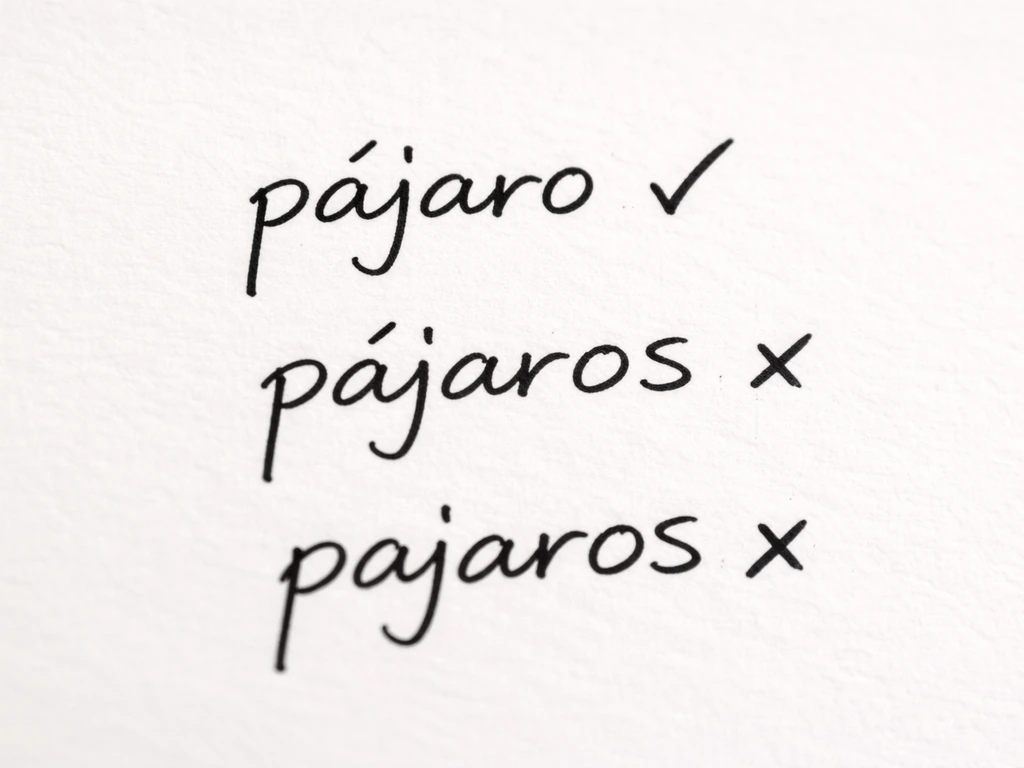
Spanish pájaro requires the accent on the first 'a.' Without it, the word is technically misspelled according to RAE (the Real Academia Española, the official authority on Spanish spelling). The accent mark is not optional: it marks the stressed syllable and distinguishes the word in formal writing. The same applies to Portuguese pássaro, where both the accent and the double 's' are necessary. Dropping the accent or the double consonant are the two most common errors when typing these words on a non-Spanish or non-Portuguese keyboard.
German Vogel must be capitalized in standard written German because all German nouns are capitalized. Writing 'vogel' in lowercase is incorrect in any standard German sentence. The plural, Vögel, requires an umlaut over the 'o.' On a keyboard without German characters, you might see it written as Voegel (substituting 'oe' for ö), which is a recognized workaround in informal digital contexts but not correct in formal writing.
For non-Latin scripts, accuracy matters enormously for meaning. Russian птица uses Cyrillic script and should not be transliterated as 'ptitsa' or 'ptitza' and treated as interchangeable: the Cyrillic form is the correct written form in Russian, and transliterations vary by system. Arabic طائر uses right-to-left script, and the presence or absence of diacritical vowel marks (short vowels) affects pronunciation guides but not standard written Arabic, where short vowels are typically omitted. Japanese 鳥 (tori) can also be written in hiragana as とり, which is more commonly used in children's materials or when the kanji might not be recognized.
| Language | Singular | Plural | Notes on writing |
|---|---|---|---|
| Spanish | pájaro | pájaros | Accent on first 'a' is required |
| French | oiseau | oiseaux | Plural adds 'x'; sounds identical to singular |
| German | Vogel | Vögel | Always capitalize; umlaut required in plural |
| Italian | uccello | uccelli | Double 'c' and double 'l' in singular |
| Portuguese | pássaro | pássaros | Accent and double 's' both required |
| Russian | птица | птицы | Cyrillic script; transliteration varies |
| Japanese | 鳥 / とり | 鳥たち / 鳥 | Plural often context-implied; -たち adds plurality |
| Mandarin | 鸟 | 鸟 (same) | No grammatical plural form; context implies number |
| Turkish | kuş | kuşlar | '-lar' suffix for plural; cedilla under 's' is required |
Where these words actually come from
The English word 'bird' has a genuinely odd history. It comes from Middle English 'brid' or 'bird,' which itself traces back to Old English 'bridd,' meaning a chick or fledgling, not a bird in the general sense. Wiktionary also lists the English pronunciation for bird as /ˈbɜːd/ and notes an etymology from Middle English brid/bird and Old English bridd, with the ultimate origin described as uncertain. The broader Old English word for what we now call a bird was 'fugol' (from which German Vogel and Dutch vogel both descend). At some point in the Middle English period, 'brid' broadened in meaning and eventually displaced 'fowl' as the everyday generic term, though 'fowl' survived in contexts like 'waterfowl.' The exact origin of Old English 'bridd' is uncertain, which is unusual for such a basic vocabulary word.
German Vogel and Dutch vogel both come from that same Old English root 'fugol,' which itself connects to a Proto-Germanic form meaning something like 'flyer' (related to the verb to fly). This root also appears in Swedish fågel, Danish fugl, and Norwegian fugl. So the Germanic languages are all using a word that essentially means 'the flying thing,' which makes intuitive sense.
The Romance language words take a different route. French oiseau and Spanish pájaro both ultimately descend from Latin. Oiseau comes from Late Latin 'aucellus,' a diminutive of Latin 'avis' (bird), which is also the source of English words like 'avian,' 'aviary,' and 'aviation.' Spanish pájaro comes from Latin 'passer,' meaning sparrow, which is the same word that gives us the scientific genus name Passer (as in Passer domesticus, the house sparrow). This means the everyday Spanish word for 'bird' literally started out meaning 'sparrow,' which is a nice parallel to the Arabic situation mentioned earlier.
Russian птица (ptitsa) comes from a Proto-Slavic root meaning bird, which connects to Old Church Slavonic forms and ultimately to a root related to 'flying' or 'feathered.' The consonant cluster at the start (pt-) that English speakers find so difficult is actually a very old feature preserved in Slavic languages that most Western European languages simplified away over time.
How to use these translations confidently in practice

If you are birdwatching in another country, knowing the generic word for 'bird' is useful for basic conversations, but you will get much further by learning the local names for the species you are likely to encounter. Most serious birdwatchers carry a bilingual field guide or use apps like eBird and Merlin, which provide species names in multiple languages and are far more reliable than a simple translation.
For pet naming, the generic 'bird' words in the table make excellent, simple names precisely because they are unexpected. Calling a cockatiel Tori (Japanese) or Vogel (German) is distinctive and has an accessible pronunciation for English speakers. If you want something more character-specific, look into translations of qualities: 'small,' 'bright,' 'loud,' 'blue,' or 'swift' in your chosen language will often produce more personalized options than the generic category word.
For word puzzles, the key is knowing how many letters the answer requires. Oiseau (6 letters) and pájaro (6 letters, or 7 if you count the accent-marked 'á' as a separate character in the puzzle's notation) are common answers in multilingual crosswords and trivia. Polish ptak (4 letters) is a favorite in puzzles precisely because it is short and unusual. If you are writing or playing word games that span multiple languages, building a personal quick-reference list from the table above is worth doing.
If you want to go deeper on any single language, the individual deep-dives are worth exploring. The Russian word птица, for example, has its own pronunciation challenges and grammar rules worth understanding on their own. If you specifically need how to say bird in Russian for speaking, focus on the word птица and practice the common pronunciation tips. And if you are focused on the English side of things, including how 'bird' is pronounced across different English accents, that is its own useful topic to explore separately. You might also recognize the English line "Oh say can you say" from the famous nursery-rhyme style song that uses "bird" as a playful sound challenge.
FAQ
How do I know when I should use the generic word for “bird” versus a specific bird species name?
Use the generic word for “bird” when the meaning is broad (for example, “I saw a bird”). Use a species name (native common name or Latin binomial) when you need identification. If your context mentions color, location, behavior, or size, that’s a strong sign you should switch from the category word to a species-specific term.
What if a dictionary translation for “bird” feels too narrow, like it only means a small bird?
In most languages, the generic translation can be misread as “sparrow” or “small bird” when the dialect narrows the meaning. A safe approach is to match the wording to your sentence (size terms like “small bird” often change the choice), and if possible, confirm with an audio example from the region you are dealing with.
What are the most common spelling mistakes people make when writing “bird” in other languages?
Check spelling rules that affect pronunciation and meaning: accents in Spanish pájaro and Portuguese pássaro, umlauts in German Vögel, and correct script for Russian and Arabic. If you are typing on an English keyboard, consider input methods (IME) rather than “fixing” letters by guesswork, since common substitutions can change the word or make it look incorrect.
Can I just memorize the translation, or do I need grammar too to use “bird” correctly in a sentence?
For short phrases and pet names, you can use the generic word. For conversations and descriptive sentences, you often need the correct grammar package: articles, gender, and sometimes plural forms. If your sentence includes adjectives like “red” or “wild,” look up how that language marks agreement with the noun.
Why do some languages seem to have multiple translations for “bird” (everyday, formal, scientific)?
Yes, because some languages use different words depending on register (formal versus everyday) or meaning class (wild, scientific grouping). If you are translating an animal category for a classroom or report, look for the formal or scientific collective term rather than the casual word used in speech.
How should I practice pronunciation so I don’t accidentally use a wrong meaning in tonal or tricky languages?
Don’t assume the letter-by-letter pronunciation will work. Some words change sounds in ways that affect fluency (for example, French has silent letters, and Mandarin tone choice can completely alter meaning). If you have to choose, prioritize tone and stress, then check audio recordings rather than relying only on text approximations.
Are there special issues with spelling, accents, or plurals when using these “bird” words in crosswords or word games?
If you’re using the word in a crossword or word puzzle, letter count and exact spelling matter. Treat accented letters (like á) as separate characters if the puzzle counts them that way, and remember plurals may have different spellings even if singular and plural sound the same in some languages.
When translating bird species, is it safe to translate the English species name word-for-word?
Generally, avoid translating an English species name word-for-word. Species names often map differently across countries, and the “same” English name can refer to different birds. Use the local common name for that bird where you are, or the Latin binomial if you need a universal identifier.
How do I handle regional differences when I learned the “bird” word from a general translation list?
It depends on what you mean by “bird” and where you learned the word. For example, some dialects use a word that means sparrow but functions like “small bird” generically. If your conversation partner is from a specific country or region, ask or listen for local phrasing, then stick to that variety consistently.
What’s the best way to confirm pronunciation beyond an IPA chart or an English approximation?
If you can, choose a pronunciation resource that has native-speaker audio for your target variety (country or dialect). Text-to-speech can get stress and tone wrong, especially for Mandarin or words with sounds not found in English. Then practice with short repetition focused on the hardest part (like initial clusters or tone).
Next Article
Oh Say Can You Say Bird Meaning and Bird Naming Guide
Find the meaning of oh say can you say bird, plus pronunciation and English bird naming and language guidance.