
If you searched 'sore like a bird,' you are most likely thinking of a line from the King James Bible: 'Mine enemies chased me sore, like a bird, without cause' (Lamentations 3:52). In that phrase, 'sore' is spelled S-O-R-E, and it means 'grievously' or 'severely,' not the flying verb 'soar.' So the spelling is correct as written, but the meaning of 'sore' here surprises most people because it does not mean painful, it means intensely or fiercely, an older English usage. If you were thinking of a bird flying high, the word you want is 'soar,' spelled S-O-A-R.
How Do You Spell Sore Like a Bird: Correct Phrase Check

James Ridgley
27 Apr 2026

The phrase 'sore like a bird' and what it actually says
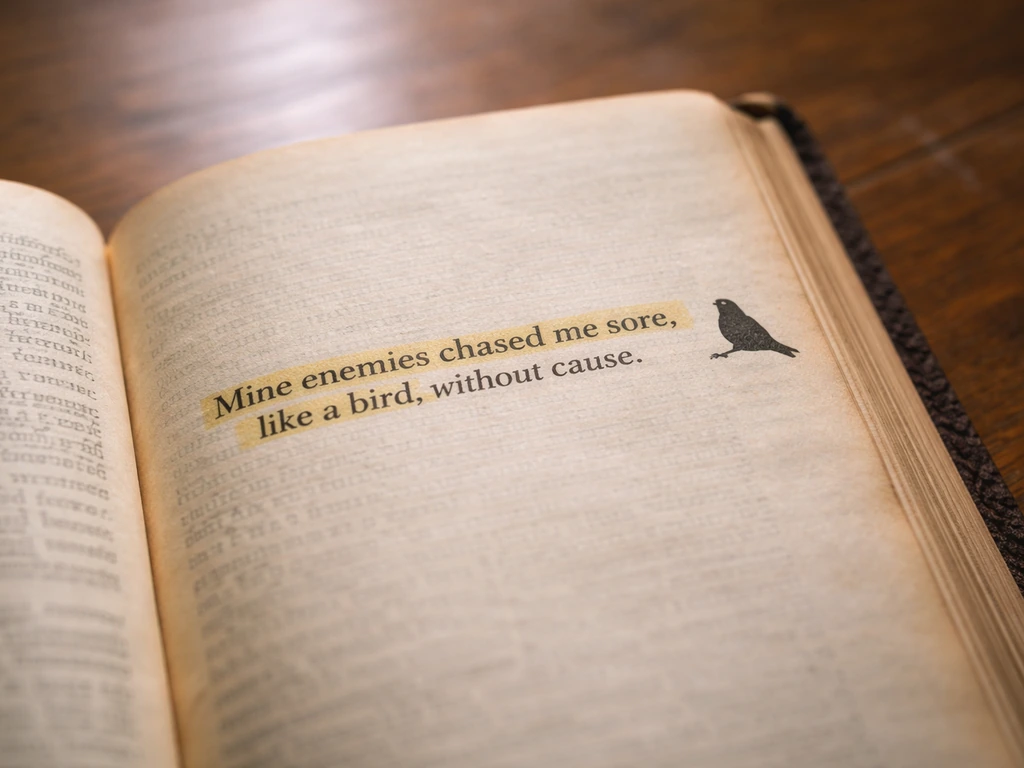
The phrase comes straight from the King James Version of the Bible, Lamentations 3:52. The full wording is: 'Mine enemies chased me sore, like a bird, without cause.' Multiple Bible databases, including BibleHub's interlinear, KingJamesBibleOnline, and BibleHub's parallel translations, all reproduce that exact spelling. Young's Literal Translation gives a slightly different word order, rendered as 'Hunted me sore as a bird,' but still spells the word S-O-R-E. So if this is the phrase you were trying to write or look up, 'sore' is the correct and verified spelling for this specific line.
The simile 'like a bird' in that verse is a vulnerability image: the speaker is being hunted the way a bird is hunted by a predator, trapped and chased without reason. It is a poetic, archaic construction, not a modern idiom, which is part of why the wording catches people off guard. Other modern Bible translations drop 'sore' entirely (for example, the ESV reads 'hunted like a bird'), so if you see different wording depending on which translation you check, that is why.
Confirming whether you mean 'sore,' 'soar,' or something else
The word 'sore' sounds identical to 'soar,' and that is the root of almost every confusion around this phrase. They are homophones: same sound, completely different spellings and meanings. Here is a quick breakdown of the three words people most commonly mix up when writing something bird-related:
| Word | Spelling | Meaning | Bird connection? |
|---|---|---|---|
| Sore | S-O-R-E | Painful (adj.) or severely/grievously (archaic adv.) | Only in the KJV Bible phrase above |
| Soar | S-O-A-R | To fly or rise high in the air (verb) | Yes — what birds do when they glide upward |
| Shore | S-H-O-R-E | The land at the edge of water | Shorebirds live here, but the word itself doesn't describe flight |
The test is simple: ask yourself what you are trying to say. If you mean a bird flying high or rising effortlessly, the word is 'soar' (S-O-A-R). If you are quoting or referencing Lamentations 3:52 from the King James Bible, the word in that verse is 'sore' (S-O-R-E), used in its archaic adverbial sense meaning 'severely.' The two words sound the same out loud, but on the page they carry completely different ideas.
How to spell 'sore' correctly and dodge the usual typos

The word 'sore' is spelled S-O-R-E. Its roots go back to Middle English 'sor' and Old English 'sār,' meaning pain or grief. As a modern adjective, Merriam-Webster defines it as 'painful' or 'causing discomfort.' As an archaic adverb (the usage you find in the KJV), it means 'greatly' or 'severely.' The word is short and relatively simple, but these are the typos that trip people up most often:
- Writing 'soar' when you mean 'sore' — the most common swap, since the words are homophones
- Writing 'shore' — looks visually similar and also rhymes loosely with 'sore' depending on accent
- Writing 'sour' — a vowel-swap typo that changes both spelling and pronunciation
- Dropping the final E and writing 'sor' — an understandable mistake given the Old English root, but not standard modern spelling
The fastest way to catch yourself: if spell-check does not flag it, the word is technically a real English word, so the auto-correct will not save you. You have to check meaning, not just spelling. Ask: am I describing pain or severity ('sore'), or am I describing flight ('soar')?
Sore vs. soar vs. shore: the full confusion map
Washington State University's Paul Brians and the APSU Writing Center both flag 'sore' and 'soar' as one of the most commonly confused homophone pairs in English. Homophone.com confirms they produce the same sound in both American and British English. Because both words are spelled correctly, no spell-checker will catch the error when you use the wrong one, which is exactly why the confusion persists.
The word 'shore' adds another layer because it looks like 'sore' with an extra letter dropped in. Pronunciation practice materials from the New Hampshire Department of Education actually group 'sore,' 'shore,' and 'chore' together specifically to teach learners that words with similar spellings can have distinct sounds. In most American accents, 'sore' and 'shore' sound quite close, but they are not homophones the way 'sore' and 'soar' are. The mnemonic that helps most people: 'soar has an A because you rise like a bird and spread your wings', picture the A as two outstretched wings. 'Sore' without an A stays grounded, literally referring to pain or heaviness.
Where the phrase actually shows up: quotes, rhymes, and how to verify

Outside of the KJV Bible verse, you might also encounter 'soar like a bird' (with the flying verb) in poetry, motivational quotes, and song lyrics, where the meaning is about freedom or rising above difficulty. That version is written with 'soar,' not 'sore.' The KJV phrase with 'sore' is specifically biblical and archaic. If you are trying to quote a poem, a song, or a general expression about birds flying freely, you almost certainly want 'soar like a bird,' spelled S-O-A-R.
To confirm the exact wording of whatever source you have in mind, here is the fastest approach: search the phrase in quotation marks ('sore like a bird' or 'soar like a bird') and look at where the results come from. If the results pull up Lamentations 3:52 in Bible databases, you are looking at the KJV verse with 'sore.' If results pull up poetry, song lyrics, or motivational writing, those almost always use 'soar.' The context of the source tells you which spelling is correct for your purpose.
If you are solving a word puzzle or crossword and the clue involves a bird flying, the answer is almost certainly 'soar.' Crossword constructors almost never draw on archaic biblical adverbs when a clean four-letter bird-flight verb exists. Similarly, if you are writing a caption about watching an eagle or hawk glide overhead, 'soar' is the word. Save 'sore' for when you are quoting Scripture or describing physical pain.
How to pronounce these words once you have the spelling right
Once you have decided on the correct spelling, pronunciation is the same for both 'sore' and 'soar' in everyday speech. Both are one syllable and rhyme with 'more,' 'core,' and 'floor. ' The IPA for 'sore' is /sɔːr/ in British English and /sɔr/ in American English, [per Cambridge Dictionary](https://dictionary. cambridge.
org/us/dictionary/english/soar). 'Soar' follows the same IPA pattern: /sɔːr/ (UK) and /sɔːr/ (US). In plain phonetic terms, say the S sound, then the 'aw' vowel as in 'law,' then a soft R. That is it.
For the oriole itself, the name is pronounced with a clear starting O sound and a short vowel afterward how to pronounce oriole bird. For the oriole itself, the name is pronounced with a clear starting O sound and a short vowel afterward does the oriole bird have a name? (oriole bird name). If you are wondering about the oriole bird mascot name, it depends on which school or team you mean oriole itself.
The word 'shore' is pronounced slightly differently in careful speech: /ʃɔːr/, starting with the 'sh' sound instead of 's.' In casual fast speech, 'sore' and 'shore' can sound nearly identical depending on accent, which is one reason people mix up the spellings. But on paper, the distinction is clear: shore starts with SH, sore starts with just S.
What to do if you still can't confirm the exact phrase
If you heard the phrase spoken aloud and you are trying to track down the original wording, run through these steps in order. First, check whether the context was religious or literary, if someone quoted it from the Bible, look up Lamentations 3:52 in the KJV and you will find 'chased me sore, like a bird.' Second, if the context was poetic, motivational, or about wildlife, search 'soar like a bird' with the A spelling and look at poetry anthologies or song lyrics. Third, if you are not sure of the source at all, search both spellings in quotation marks and compare what comes up.
The broader spelling questions around bird names and bird-related words come up more often than you might expect. Getting the right spelling of a word like 'oriole,' knowing how to pronounce a bird's name correctly, or understanding why two words that sound the same mean completely different things are all part of using bird language precisely. If you meant the bird name oriole, you can also double-check its spelling before writing your sentence.
Once you lock in whether your phrase needs 'sore' or 'soar,' you will have the confidence to write it correctly every time. If you meant a specific bird name that starts with X, you can look for the answer by searching that phrase directly X bird names. If you are specifically looking for what bird starts with N, you can find the right answer by searching that phrase directly bird name that starts with X.
If you want to find the bird name you are looking for, searching a phrase like this can quickly narrow down the options bird name that starts with X.
FAQ
Which spelling should I use if I’m writing a caption but I’m not sure if it’s a Bible quote?
If you are quoting the King James Bible, use “Mine enemies chased me sore, like a bird, without cause.” If you are paraphrasing or making a modern caption, “soar like a bird” (with A) is the safer default unless you intentionally mean the archaic KJV adverb meaning “severely.”
Is “sore like a bird” correct English if I’m not referencing the Bible?
No. “Sore like a bird” is not an established modern idiom for bird flight. In everyday writing, “soar like a bird” expresses rising or freedom, while “sore” usually signals pain or intensity, which changes the tone.
How can I tell whether “sore” or “soar” is right from the rest of the sentence?
Use “soar” if the sentence includes ideas like flying high, rising, climbing, or escaping difficulty. Use “sore” if the surrounding words suggest intensity or severity, such as chased “sore” (meaning severely) or anything that sounds like a quotation from Lamentations 3:52.
Why doesn’t spell-check catch it when I type the wrong word?
Spell-checkers often won’t flag “sore” versus “soar” because both are valid words. A reliable fix is to do a quick meaning check, replace the word with a synonym in your head (painful or severely for “sore,” rise/fly for “soar”), and see which one fits.
What should I do if I’m comparing different Bible translations and the phrase looks different?
If the source is KJV, the wording is “sore.” If the source is a modern translation, it may omit “sore” and say “hunted like a bird” or similar phrasing. So you should match the wording of the translation you are quoting.
Which word is more likely for a crossword clue: “sore” or “soar”?
For a crossword or word puzzle, check the clue type. If the clue mentions bird flight, you almost certainly need “soar.” If it mentions Scripture, archaic wording, or the exact KJV verse, “sore” becomes much more likely.
I only heard the phrase out loud, how do I confirm the correct spelling?
If you only heard it spoken, decide based on context: religious or literary discussions point to the KJV “sore,” while anything about flying or rising points to “soar.” When uncertain, search both phrases in quotation marks and compare the sources that show up.
What if I accidentally wrote “shore like a bird”?
“Sore,” “soar,” and “shore” are close visually. If you typed “shore like a bird,” it will not match the intended meaning in either modern bird-flight writing or the KJV verse. The correct pairs are “sore like a bird” (KJV meaning) or “soar like a bird” (bird flight).
Next Article
Which Bird Name Starts With O: Easy List and Tips
Curated list of bird names starting with O, with pronunciation, meanings, and tips to confirm the right species.