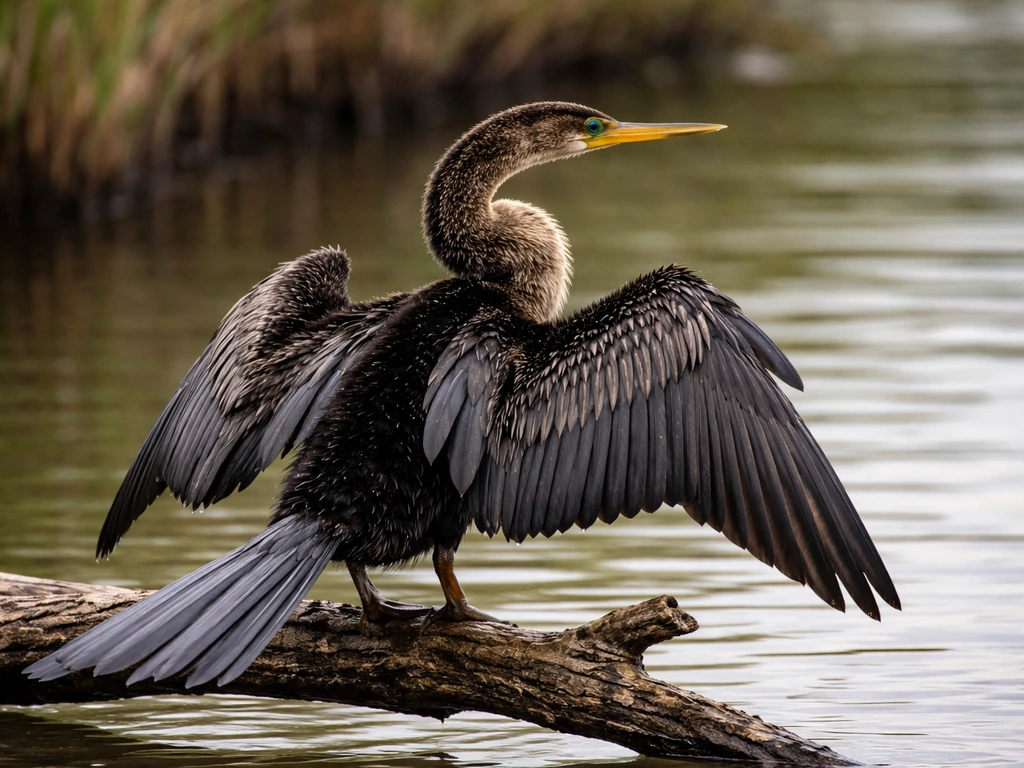
Anhinga is pronounced an-HING-guh, with the stress landing firmly on the middle syllable. In IPA it looks like /ænˈhɪŋgə/. Three syllables, second one stressed: an-HING-guh. That's the correct American English pronunciation according to Merriam-Webster, Dictionary.com, and Wiktionary, and it's what you'll hear from experienced birders in the field.
How to Pronounce Anhinga Bird: American and British

James Ridgley
30 Apr 2026
The correct pronunciation, spelled out clearly
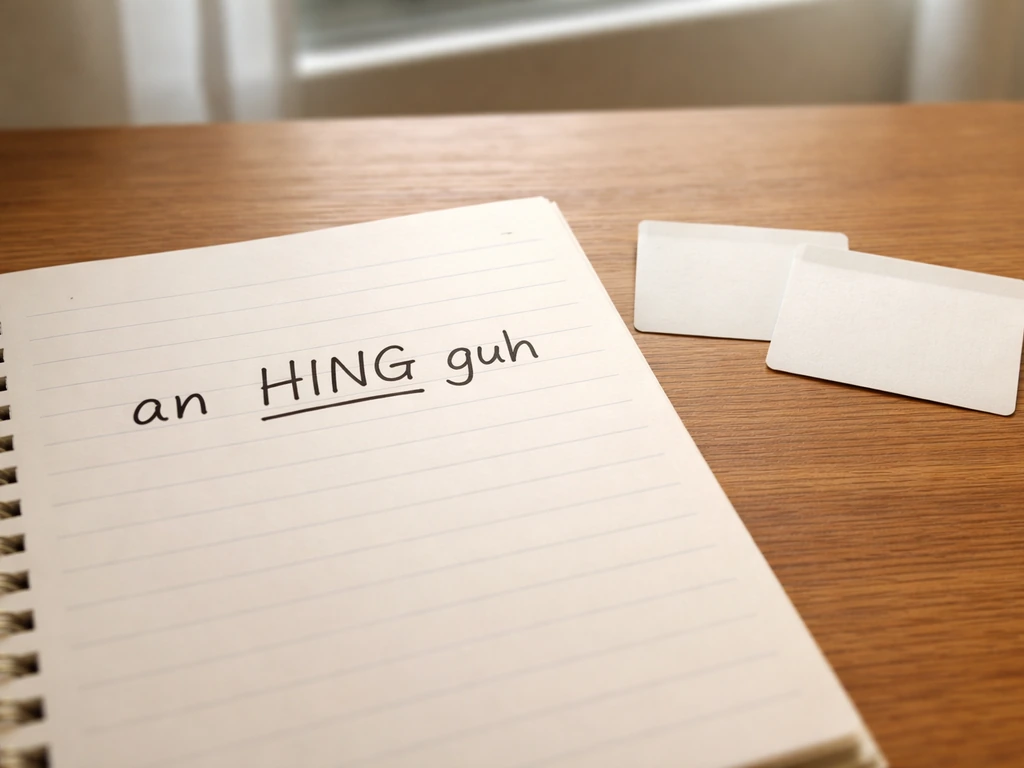
Let's make it as concrete as possible. The word has three syllables: "an" + "hing" + "guh." The middle syllable carries the primary stress, so you say it like: an-HING-guh. The final syllable is a soft, unstressed schwa sound, like the "a" at the end of "sofa" or "panda."
| Version | Phonetic Spelling | IPA |
|---|---|---|
| American English (General) | an-HING-guh | /ænˈhɪŋgə/ |
| British English | an-HING-guh | /ænˈhɪŋgə/ |
| Tupi/Portuguese origin (approximate) | ah-NYEEN-gah | /aˈɲĩŋɡɐ/ |
American and British English are very close for this word. Unlike many bird names where British and American pronunciations diverge noticeably, "anhinga" lands in essentially the same place in both dialects: stress on the second syllable, short "i" in the middle, and a soft unstressed ending. The Tupi-origin pronunciation listed above is included for context, but it's not what you need for everyday English birding conversation.
Syllable-by-syllable breakdown
Here's what your mouth should do for each syllable, step by step.
- "an" — Short, relaxed "a" sound, like the word "and" without the "d." Your jaw drops slightly, tongue stays low and flat. Unstressed, so say it quickly.
- "HING" — This is where the stress goes. Say it like the word "ring" but with an "h" in front: h-RING, h-ING. The vowel is a short "ih" sound (as in "hit" or "bing"). Feel your throat close slightly at the end as you make the "ng" sound. This syllable should be noticeably louder and longer than the others.
- "guh" — A short, quiet schwa. Like the "a" in "sofa." Your tongue briefly touches the back of the roof of your mouth for the "g," then releases into that soft "uh." Don't over-pronounce it.
Put it together slowly: an... HING... guh. Then speed it up: an-HING-guh. The rhythm should feel similar to other three-syllable words stressed in the middle, like "un-LIKE-ly" or "ba-NA-na."
Common mispronunciations and how to fix them

This word trips people up in a few specific ways. Birdwatching communities and online forums show that newcomers regularly mispronounce it, especially when reading it cold off a field guide label. Here are the most common mistakes and the quick fix for each.
| Mistake | What it sounds like | The fix |
|---|---|---|
| Stressing the first syllable | AN-hing-guh | Move the stress to the middle: an-HING-guh. The first syllable is quiet and quick. |
| Pronouncing it like 'anhinga' rhymes with 'manga' | an-HING-ah | The final syllable is 'guh,' not 'ah.' Let it trail off softly like 'sofa.' |
| Confusing it with 'anhanga' | an-HANG-guh | The vowel in the middle syllable is a short 'ih,' not 'ah.' Think 'HING' not 'HANG.' |
| Adding a fourth syllable | an-hin-EE-guh | It's only three syllables. Don't stretch the 'i' into an 'ee' sound. |
| Silent 'h' | an-ING-guh | The 'h' in 'hing' is pronounced. Say it like 'hinge' without the final 'e': h-ING. |
The "anhanga" confusion is worth a special mention. The Tupi word "anhanga" (meaning demon or evil spirit) looks and sounds similar, and since anhinga's etymology is closely tied to Tupi, some people blur the two words together. If you catch yourself saying "an-HANG-guh," just pull the vowel sound forward from "ah" to "ih" and you're back on track.
How to say it in context and in fast speech
Saying a word in isolation is different from saying it in a real sentence. Here are a few natural phrases and how they flow in normal conversational speed.
- "There's an anhinga drying its wings on that log." (Fast: "There's an-HING-guh dry-ing its wings on that log." The word slots in naturally; the stress on HING doesn't feel forced.)
- "Is that an anhinga or a cormorant?" (Fast: "Is that an an-HING-guh or a COR-mor-ant?" Two bird names in one sentence: both get their stress, and neither swallows the other.)
- "We spotted three anhingas at the nature preserve." (Plural: an-HING-guz. The final schwa just picks up an "z" sound. Easy.)
- "The Anhinga Trail is famous for close-up bird encounters." (When used as a proper name, like in Everglades National Park, it's still an-HING-guh. Same pronunciation, just capitalized in writing.)
In fast natural speech, the first syllable "an" can blur slightly into whatever word precedes it, especially if that word ends in a vowel. But the stressed "HING" syllable stays clear no matter how fast you're talking. That stress is the anchor of the word, so if you nail that syllable, listeners will understand you even if the surrounding syllables get a little relaxed.
Where the name 'anhinga' comes from
The word anhinga comes from the Tupi language, spoken by Indigenous peoples of Brazil. The Tupi form is recorded as "a'ñinga" (sometimes transcribed as "áyinga" or "ayingá" depending on the source), and it translates roughly to "devil bird" or "evil spirit of the woods." The U.S. Fish and Wildlife Service confirms this etymology, noting that the name was given by a Brazilian Indian tribe and carries the meaning of devil bird or evil spirit. It's a vivid name for a bird that lurks in swampy water with its body submerged and its long neck snaking above the surface.
The name passed from Tupi into Portuguese during Brazil's colonial period, and from there into scientific Latin via naturalists who documented the species. The bird's scientific name is Anhinga anhinga, a tautonym where the genus and species names are identical. Britannica identifies the American anhinga as the species Anhinga anhinga within the genus Anhinga, which also includes related darter species in Africa, Asia, and Australia. When you see a scientific name like Anhinga anhinga in a field guide or species list, each part is pronounced the same way: an-HING-guh an-HING-guh.
The spelling logic is actually pretty faithful to the pronunciation once you know the word. The "nh" combination in Portuguese signals a palatal nasal sound (similar to the "ny" in "canyon"), but in the English adaptation that nuance was dropped and the "nh" is just read as a regular "h." So the spelling "anh" at the start really does just say "an-h," and the rest follows naturally. Knowing that background helps explain why the word looks a little unusual on the page but sounds straightforward when spoken.
Anhinga as a name in birding and beyond
You'll hear "anhinga" used as both a common name and a proper name in different contexts. As a common name, it refers to the species in general: "I saw an anhinga. " As a proper name, it shows up in place names like the Anhinga Trail in Everglades National Park, which is famous for letting visitors walk within a few feet of these birds.
The National Park Service treats "Anhinga" as a standard common name in species and nature program materials. In Big Cypress National Preserve materials, the National Park Service uses “anhinga” as the standard common name for the bird and explains natural-history details such as how it dries its wings and swims and dives [Anhinga as a standard common name](https://www. nps. gov/bicy/learn/nature/anhinga.
htm). The bird is also widely known by the nickname "snakebird" because of the way its long neck extends above the waterline when it swims, which can help beginners connect the unusual word to the animal itself.
How to practice and confirm you've got it right
Reading about pronunciation only takes you so far. Here's a practical sequence to go from uncertain to confident.
- Say it slowly three times out loud: an... HING... guh. Pause between syllables. Exaggerate the stress on HING. This builds the muscle memory before you speed up.
- Say it at normal speed five times in a row: an-HING-guh, an-HING-guh, an-HING-guh... Keep the stress consistent each time.
- Drop it into a sentence: "I saw an anhinga at the pond this morning." Say the sentence naturally, without overthinking the word.
- Check it against an audio source. Go to Merriam-Webster (merriam-webster.com) or Dictionary.com and search "anhinga." Both sites have a speaker icon you can click to hear the word pronounced by a native speaker. Listen once, then say it yourself, then listen again and compare.
- For additional real-speech examples, Forvo has a dedicated pronunciation page for "anhinga" with recordings from actual speakers. This is especially useful for hearing how the word sounds in connected speech rather than a crisp dictionary recording.
- If you want to go deeper on the IPA symbols, Dictionary.com has a full IPA key that explains the stress marks: the /ˈ/ symbol before "hɪŋ" in /ænˈhɪŋgə/ means primary stress on that syllable. Once you can read that notation, you can confirm any dictionary pronunciation independently.
One small tip: if you're coming to this word from a crossword puzzle or a word game, you might be pattern-matching the spelling to something more familiar. "Anhinga" doesn't rhyme with "ninja" (though it's tempting to think so) or "manga." The closest rhyme in everyday English would be something like "syringa" (a type of shrub), which follows the same stress pattern: sy-RING-guh. If that anchor helps, use it.
Other bird names with similar pronunciation challenges include the junco and the towhee, both of which look more complicated on paper than they actually are to say. If you want another example of a bird name where the spelling can mislead you, see how to pronounce kakapo bird as well. If you are asking about towa bird pronouns, the best next step is to look for how the specific bird community defines pronoun usage for that context towhee.
If you are also learning how to pronounce towhee, treat it as a separate word with its own stress pattern and vowel sounds. If you're also wondering about the junco bird, you can use the same stress-check approach to say its name clearly. Anhinga falls into the same category: once you know it, it's not hard, but the spelling alone doesn't give obvious clues to a first-time reader. A few minutes with an audio dictionary will settle any remaining doubt.
FAQ
How do I pronounce anhinga if I only see it written, like on a checklist or trail sign?
Say it as three parts, an-HING-guh, and make sure the middle syllable is the loudest. If you get stuck, focus on matching the stress pattern to “un-LIKE-ly,” because even if the first syllable blurs, the clear HING syllable will usually make you understandable.
What vowel sound should I use in the stressed middle syllable, “HING”?
Use the short “i” sound like in “sit,” so HING rhymes more with “bin” than with “hang.” A common slip is saying it with a wider “a” sound, which pushes the word toward the “an-HANG-guh” mistake.
Is “anhinga” ever pronounced with a hard stop at the end, like “guhk” or “gung” ?
No, the ending is typically a soft unstressed schwa, not a hard consonant cluster. Keep the last syllable light, like “guh” as in the second part of “panda” style endings, and avoid adding an extra syllable.
How do I pronounce it in a sentence with another word right before it, for example “saw an anhinga”?
In fast speech, the “an” in “an anhinga” can blend together, but the second syllable still needs to stay clear. A good target cadence is SAW an-HING-guh, with the stress on HING acting as the anchor for recognition.
Should I pronounce it differently when referring to the Anhinga Trail versus the bird in general?
The name “Anhinga” used for the trail is still spoken the same way in English, an-HING-guh. The main difference is pragmatic, you may add a slight pause before or after it as a proper noun, but the pronunciation stays consistent.
What should I do if I accidentally say “an-HANG-guh”?
Quick correction trick: pull the vowel forward toward the short “i.” Change the first part of the stressed syllable from “ah” to “ih,” then immediately follow with “-ng-guh” so the word snaps back to an-HING-guh.
Does it ever get pronounced as two syllables by mistake, and if so how can I avoid it?
Yes, some people compress it to an-HING or anhing because the unstressed end feels optional. Avoid that by explicitly finishing the last light “guh” sound, an-HING-guh, especially when you are speaking slowly to someone who is unfamiliar with the term.
Is there a common misread based on the spelling “nh,” and what is the right approach in English?
Many readers overthink “nh” and try to recreate a “ny” or “ng” sound. In everyday English birding speech, the “nh” at the start behaves like a simple “h,” so you just commit to an- at the beginning and let the stress on HING carry the word.
What’s the best way to practice pronunciation quickly without an audio dictionary?
Do a stress drill: whisper “an… hing… guh” with exaggerated spacing, then say it once at normal speed. If you can keep HING clearly louder than the surrounding syllables, you are already producing the key pattern listeners expect.
Does knowing that it is called “snakebird” change how I should pronounce anhinga?
No, “snakebird” is just a nickname for meaning and memory. Your pronunciation of anhinga should remain an-HING-guh regardless of whether you are thinking of the nickname, the nickname is there to help comprehension, not to alter the sound.
Next Article
How to Pronounce Kakapo Bird Kākāpō: IPA and Stress Guide
Learn how to pronounce kākāpō, with IPA, syllable breaks, stress, and fixes for common mispronunciations.