The everyday Spanish word for "bird" is <strong>pájaro</strong> (masculine). That is the word you want if you are pointing at a bird on a fence, talking about your pet parakeet, or trying to fill in a crossword clue. La entrada de colibrí en el Diccionario del estudiante de la RAE describe explícitamente “Pájaro americano de tamaño muy pequeño”, usando “pájaro” como categoría de animal. There is a second important word, <strong>ave</strong> (feminine), that also means "bird" but leans toward scientific or classification contexts. Knowing when to use each one will save you a lot of confusion, so let's break both down properly.
How to Say Bird in Spanish: Bird, the Bird, Slang

James Ridgley
9 Apr 2026
The Spanish word(s) for "bird" and what they actually mean
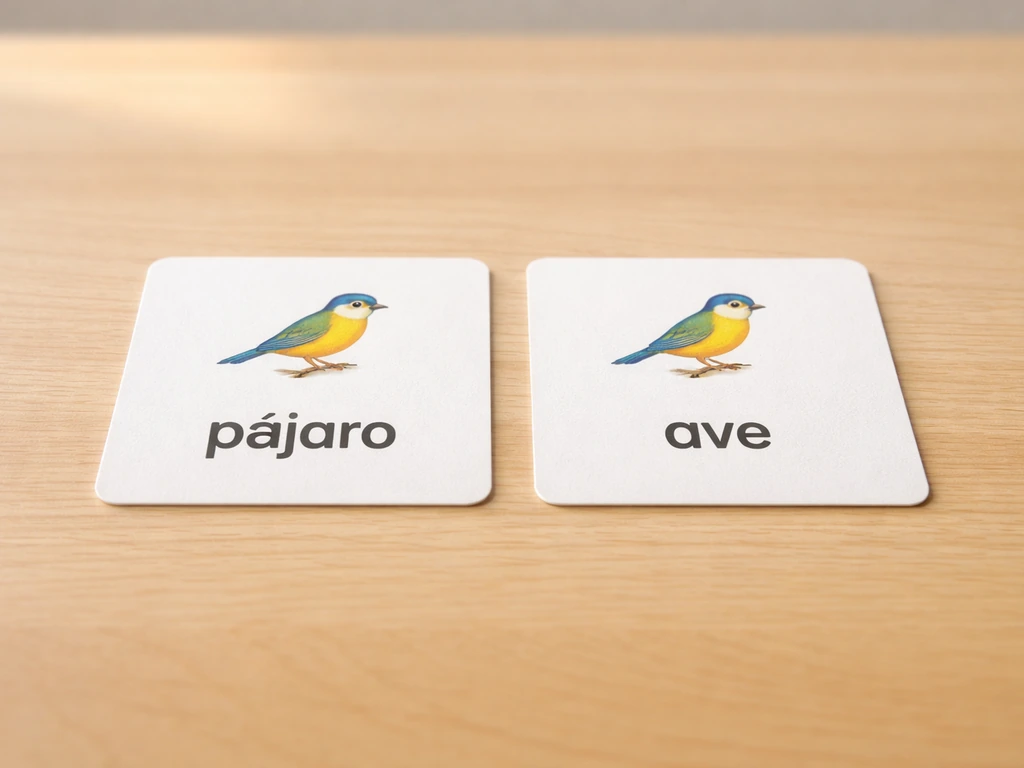
Spanish splits the English word "bird" between two terms, and they are not interchangeable in the same way that, say, "sofa" and "couch" are in English. The Real Academia Española (RAE) defines <strong>pájaro</strong> as the standard word for the bird animal, and that is what you will hear in everyday conversation across Spain and Latin America. If someone sees a robin hopping on the grass and says anything, they will almost certainly say "pájaro."
<strong>Ave</strong>, on the other hand, is what the RAE uses when defining a bird as "animal vertebrado, ovíparo" with wings (alas) and a body covered in feathers (plumas). El Wikcionario recoge el sentido zoológico de “ave” como “animal vertebrado, ovíparo… con plumas y alas aptas por lo común para el vuelo”, en línea con el uso técnico.
It is the umbrella, technical term. You will see it in field guides, scientific writing, and classification contexts. The phrase <strong>ave de paso</strong> (literally "passing bird") means a migratory bird, and that is a good illustration of how "ave" works: it fits neatly into formal or typological language. In casual speech, most Spanish speakers use "pájaro" even when referring to birds that are technically "aves" in a zoological sense.
A practical way to remember the split: use <strong>pájaro</strong> when you would just say "bird" in everyday English. Use <strong>ave</strong> when you are talking about a class or category of animal, the way a biologist might say "avian" in English.
How to spell "bird" in Spanish
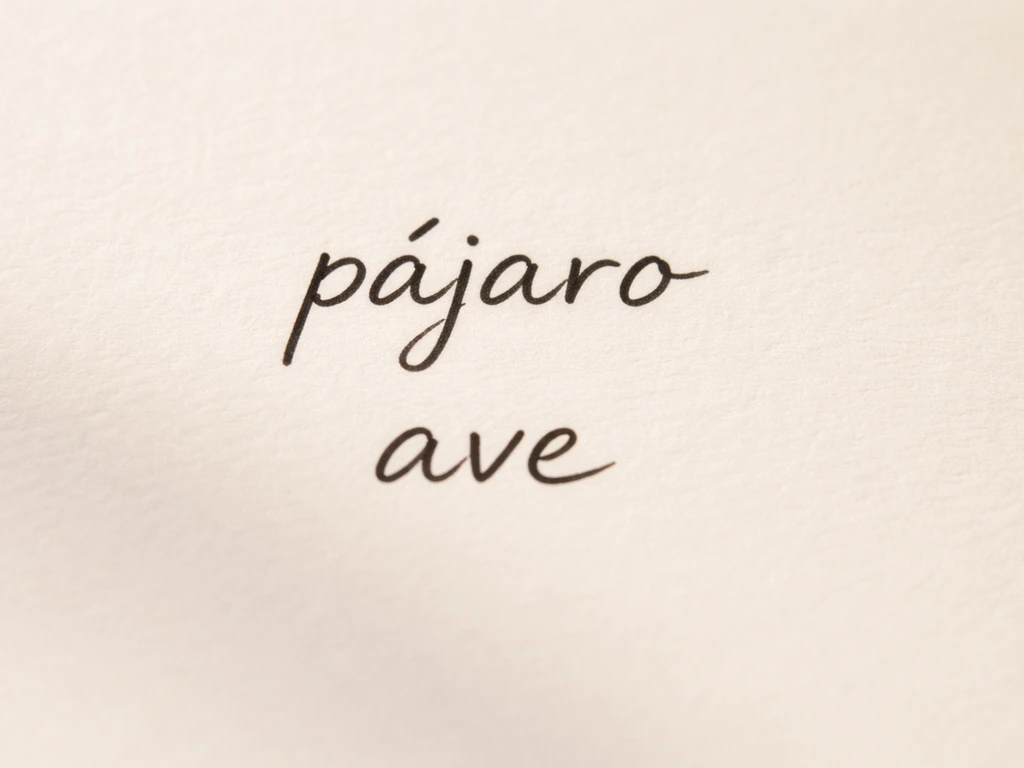
The correct spelling is <strong>p-á-j-a-r-o</strong>. The accent mark (tilde) over the "a" is not optional. In Spanish, words that are stressed on the third-to-last syllable (called <em>esdrújulas</em>) always require a written accent mark. "Pájaro" is exactly that kind of word: the stress falls on the first syllable, "pá," making it esdrújula, and so the accent is mandatory. Leaving it out is a spelling error, not a casual shorthand. You will sometimes see it written without the tilde in informal texting, but in any written context that matters, including school work, journalism, and signage, the accent must be there.
"Ave" is simpler to spell: <strong>a-v-e</strong>, no accent marks, no special characters. It follows standard Spanish vowel sounds with no surprises.
How to pronounce pájaro (and ave)
Pronouncing "pájaro" correctly is mostly about getting the stress in the right place. The accent mark tells you exactly where: the first syllable. Here is a simple breakdown:
- Syllables: PÁ - ja - ro
- Stress: heavy on the first syllable, "PÁ," like saying "PA" loudly, then letting the rest trail off softly
- The "j" in Spanish sounds like the English "h" in "hot," not like the English "j" in "jump"
- The "r" in the middle is a soft flap, similar to the quick "d" sound in the American English word "butter"
- Phonetic guide: PAH-hah-roh
- IPA: /ˈpa.xa.ɾo/
The most common mistake English speakers make is stressing the middle syllable ("pa-HAH-ro") or pronouncing the "j" like an English "j." Both will make you understood, but neither is correct. Focus on that first-syllable stress and the soft "h" sound for the "j" and you will sound natural.
For <strong>ave</strong>, pronunciation is straightforward: AH-veh. Two syllables, stress on the first, the "v" is soft (in many Spanish accents it sounds almost like a "b"), and the final "e" is a clean, short vowel sound, not silent the way it often is in English.
How to say "the bird," "a bird," and other useful phrase forms
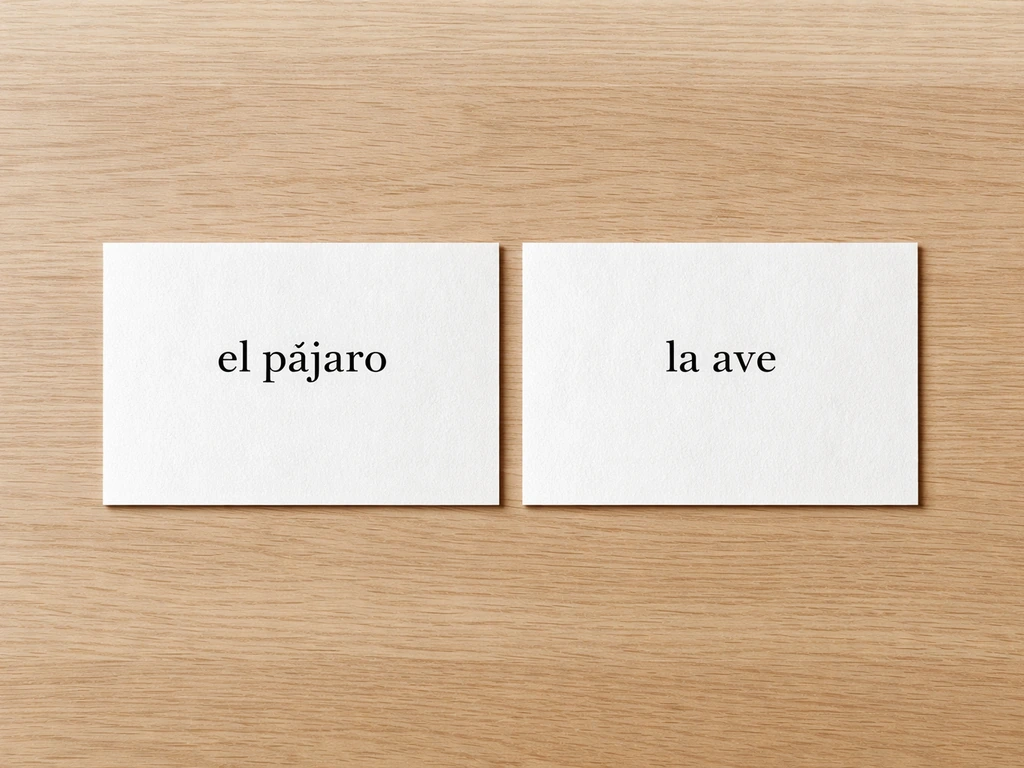
Grammatical gender matters here because the two words belong to different genders. "Pájaro" is masculine and "ave" is feminine. That changes which article you use in front of them.
| Phrase in English | Using pájaro (masc.) | Using ave (fem.) |
|---|---|---|
| a bird | un pájaro | una ave |
| the bird | el pájaro | el ave* |
| the birds | los pájaros | las aves |
| some birds | unos pájaros | unas aves |
| a little bird | un pajarito | una avecita |
One small quirk worth knowing: although "ave" is feminine, you say <strong>el ave</strong> (not "la ave") in the singular because Spanish uses the masculine article before feminine nouns that start with a stressed "a" sound. The plural goes back to normal: <strong>las aves</strong>. This same rule applies to other words like "el agua" (the water).
Here are a few practical sentence examples to show these in action. "Vi un pájaro en el jardín" means "I saw a bird in the garden." "El pájaro azul cantó toda la mañana" means "The blue bird sang all morning." For a more formal register: "Las aves migratorias llegan en primavera" means "Migratory birds arrive in spring." That last sentence is a natural home for "ave" rather than "pájaro" because it is talking about a category of bird.
If you are interested in how to say "little bird" in Spanish, the diminutive form <strong>pajarito</strong> is the go-to choice and is widely understood across all Spanish-speaking regions.
Slang and colloquial ways to say "bird" in Spanish
The main colloquial alternative is <strong>pajarito</strong>, the diminutive of pájaro. It literally means "little bird" and is widely used as a term of endearment, the kind of word you call a small pet bird or use affectionately with a child. It is warm, informal, and entirely safe in most everyday contexts.
That said, there is a register caveat you should know about. In several Latin American countries, including the Dominican Republic and Cuba, <strong>pájaro</strong> itself can carry a vulgar or sexual meaning depending on context and tone. It is similar to how some perfectly ordinary English words can double as slang in certain settings. In neutral, everyday contexts (talking about wildlife, describing your pet bird, etc.) the word is completely fine everywhere. Just be aware that in some regional varieties of spoken Spanish, the word can be loaded, especially if you say it with a particular emphasis or in an ambiguous context.
Similarly, <strong>pajarito</strong> is sometimes used as a mild, even child-friendly slang term for male genitalia in certain regions. It is considered one of the less offensive examples of that kind of slang, but it is worth knowing so you are not caught off guard if you hear it used that way. In the vast majority of contexts, though, pajarito just means a small bird and is a perfectly natural word to use.
There is no widespread, neutral slang equivalent of "bird" in Spanish the way English has "birdie" or the British "bird" (for a person). The standard pájaro is already casual enough for everyday speech. If you want a softer, more affectionate sound, pajarito is the natural upgrade.
Pájaro vs. ave: which one should you use?
Here is a quick side-by-side so you can decide at a glance:
| Feature | pájaro | ave |
|---|---|---|
| Gender | Masculine (un/el) | Feminine (una/el in singular, las in plural) |
| Register | Everyday, casual, conversational | Formal, scientific, classificatory |
| Typical use | Talking about a specific bird you can see | Referring to birds as a class or species type |
| Example context | "There's a bird on the roof" | "Migratory birds arrive in spring" |
| Pronunciation | PAH-hah-roh | AH-veh |
| Accent mark? | Yes (pájaro) | No (ave) |
My recommendation: default to <strong>pájaro</strong> in nearly every situation. It is the word Spanish speakers use when they are not thinking about it, which is the best sign that it is the right choice for everyday communication. Reach for <strong>ave</strong> when you are in a more formal or scientific setting, or when you need to talk about birds as a category rather than a specific creature you are observing.
"Bird" in other languages worth knowing
If you are building vocabulary across languages, it is useful to compare how different languages handle the word "bird." Spanish <em>pájaro</em> comes from the Latin <em>passer</em> (sparrow), which gives you a sense of how the word narrowed from a specific bird species to a general term over time. If you want to see how that compares with other Romance and European languages, how to say bird in Italian is a natural next stop, since Italian <em>uccello</em> took a very different etymological path from the same Latin root family.
For French, the word is <em>oiseau</em>, which has its own fascinating spelling-to-sound gap. You can explore that in detail in this guide on how to say bird in French. If German is on your radar, how to say bird in German covers <em>Vogel</em> and its pronunciation. For something more distant from Spanish, how to say bird in Chinese walks through the Mandarin term <em>niǎo</em> and its tonal pronunciation.
It is also worth knowing that the Latin ancestor of all these bird words is <em>avis</em>, and you can see that root clearly in the Spanish word <em>ave</em>. If you want to go back to the source, how to say bird in Latin explains <em>avis</em> and the other Latin terms in more depth.
And if you are curious about non-spoken communication, how to say bird in sign language covers the ASL sign, which involves a distinctive hand shape near the mouth mimicking a bird's beak. Finally, for a quick look at a closely related phrase in another language, how to say little bird in French is worth bookmarking if you are also working on French vocabulary alongside Spanish.
The short version if you need it fast
- Everyday Spanish word for "bird": pájaro (masculine)
- Scientific/formal word for "bird": ave (feminine)
- Correct spelling: p-á-j-a-r-o (accent mark required)
- Pronunciation: PAH-hah-roh (stress on first syllable, "j" sounds like English "h")
- "A bird": un pájaro / una ave
- "The bird": el pájaro / el ave (singular); los pájaros / las aves (plural)
- Common affectionate/colloquial term: pajarito (little bird)
- Slang note: pájaro and pajarito can carry regional slang meanings in some Latin American countries, but are neutral in most standard contexts
FAQ
Which article should I use with pájaro and ave (el/la, los/las)?
If you are talking about a single bird, use the singular articles: “el pájaro” (masculine) and “el ave” (singular uses el due to the stressed a sound). For multiple birds, switch to “los pájaros” and “las aves.”
When should I choose pájaro vs. ave in the same sentence?
“Pájaro” is the go-to for everyday “a bird” and for describing one visible bird. Use “ave” when the sentence is about the group/category of birds, such as taxonomy or biology descriptions (for example, “Las aves tienen plumas”).
Is the accent in pájaro optional in texting or informal Spanish?
In writing, “pájaro” always needs the tilde on the first a. If you omit it, people may still understand you, but it becomes a spelling error that can look careless on schoolwork, forms, captions, or signage.
How is the j pronounced in pájaro, and what’s the most common pronunciation mistake?
The letter j in “pájaro” is pronounced like a soft “h” sound in most Spanish accents. A common mistake for English speakers is saying a hard English “j” sound, which can sound noticeably off even if the stress is correct.
Can I say “two birds” or “a red bird” using the same words, and does it change with numbers?
You can use “pájaro” with numbers and descriptors normally, for example “un pájaro rojo,” “dos pájaros cantando.” Avoid using “ave” as the default for ordinary sightings, because it sounds more formal and categorizing.
What should I watch out for if pájaro has slang meanings in some places?
If you hear “pájaro” used as slang in certain countries, the meaning depends heavily on tone, emphasis, and context. When in doubt, stick to neutral wildlife context (“un pájaro en el jardín”) and avoid joking intonations.
Is pajarito always safe to use, or can it mean something else?
“Pajarito” usually means “little bird,” commonly as a term of endearment. If you hear it used with a sexual sense in a specific context, that interpretation is regional and context-driven, so it is safer to use it for cute, child-friendly situations.
What’s a natural way to build sentences, like “blue bird sang,” using pájaro or ave?
A common pattern is: “pájaro” + descriptive adjective for the specific bird (for example, “pájaro azul”), and “ave” in plural for general statements about the class (for example, “las aves migratorias”).
What’s the quickest rule of thumb to avoid common gender/article errors?
When you are unsure about gendered articles, default to “el pájaro” and “el ave” in the singular, and then switch to “los pájaros” and “las aves” for plural. This avoids the most frequent beginner error, using la with “ave.”
Next Article
How Do You Say Bird in Sign Language ASL and Tips
Learn the ASL sign for bird with step-by-step cues, plus how to choose correct signs for species and common mix-ups.