The everyday Italian word for bird is uccello (plural: uccelli). Spanish uses pájaro or ave depending on context. That is the word you will see in dictionaries, hear in conversation, and find in everything from Italian field guides to classic proverbs. If you only take one thing from this article, that is it. But if you want to actually use it, pronounce it correctly, and sound natural doing so, keep reading.
How to Say Bird in Italian: Pronunciation and Usage

James Ridgley
23 Mar 2026
The direct Italian translation for bird
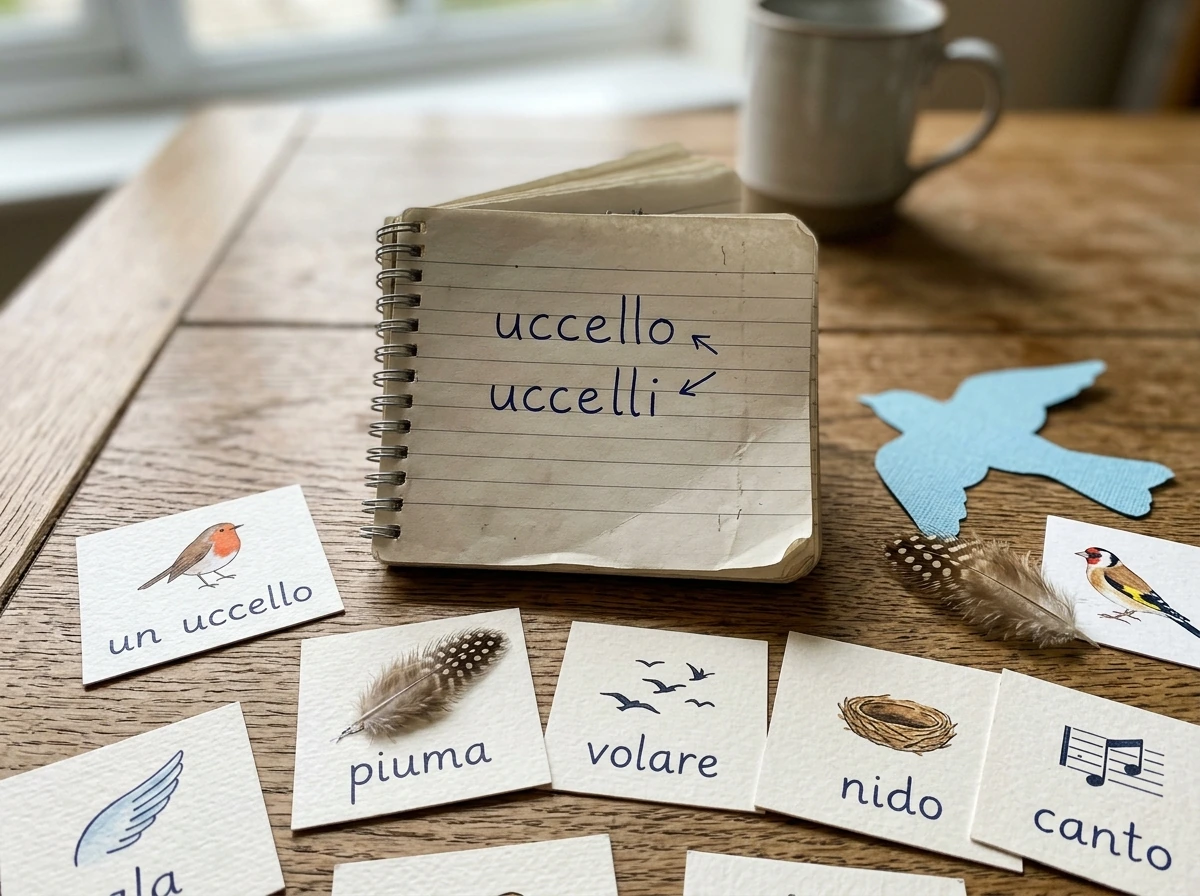
Uccello is the standard, everyday Italian noun for bird. Cambridge Dictionary’s Italian-English entry for uccello provides learning-focused grammatical information and a pronunciation guide uccello is the standard, everyday Italian noun for bird.
It is masculine, and it follows regular Italian noun patterns. The blank" rel="noopener noreferrer">Treccani dictionary (Italy's most authoritative linguistic reference, equivalent to what Merriam-Webster is in the US) lists uccello as the primary entry, with everyday usage examples that include phrases like uccelli allo spiedo (birds on a spit) showing it in real, non-fancy contexts.
The Accademia della Crusca, Italy's oldest language authority, also uses uccello as the natural default in explanatory writing, for example in the phrase il cuculo non è un uccello (the cuckoo is not a bird), demonstrating that this is the word educated Italians reach for first.
| Form | Italian | Meaning |
|---|---|---|
| Singular | uccello | bird (one) |
| Plural | uccelli | birds (more than one) |
| Diminutive singular | uccellino | little bird |
| Diminutive plural | uccellini | little birds |
How to actually pronounce uccello
This is where a lot of English speakers stumble, because the spelling looks intimidating. Break it down syllable by syllable and it is much simpler than it looks. The word has three syllables: oo-CHEL-lo. The stress falls on the middle syllable. Here is what each part sounds like for an English speaker:
- oo: like the 'oo' in 'food', not a short 'u' sound
- CHEL: like the name 'Kel' but with a 'ch' sound in front, similar to 'shell' but shorter
- lo: like 'lo' in 'low', with a clean Italian 'o' (not the diphthong English speakers tend to add)
The IPA transcription is /utˈtʃɛllo/. The double 'l' at the end is a genuine Italian geminate consonant, meaning you hold the 'l' just a beat longer than you would in English. It is a subtle difference, but native speakers will notice. For the plural uccelli, swap the final 'o' for a clean 'ee' sound: oo-CHEL-lee. One important point: Italian vowels are consistent. The 'e' in chel always sounds like the 'e' in 'bed', never like the 'ay' in 'say'. Sites like Forvo have native-speaker audio recordings of both uccello and uccelli if you want to train your ear directly.
Pronouncing the diminutive: uccellino
The diminutive uccellino (little bird) follows the same logic: oo-chel-LEE-no. The stress shifts to the third syllable when you add the -ino suffix. Plural is uccellini: oo-chel-LEE-nee. Once you have uccello nailed, the diminutive forms come naturally.
Not all 'bird' words are equal: context matters
In practice, Italians use two main words depending on the register of what they are saying. Uccello is the default for almost every situation. But there is a second option worth knowing: volatile (plural: volatili). Treccani defines volatile as a generic designation for birds, with example phrases like il colombo è un volatile (the dove is a bird/fowl) and volatili di razza esotica (exotic birds/fowl). This word sounds noticeably more formal or technical. You would encounter it in veterinary contexts, regulatory language, or older literary writing, not in everyday conversation.
| Word | Register | When to use it | Example |
|---|---|---|---|
| uccello / uccelli | Everyday, neutral | Conversation, writing, birdwatching, pet talk | Ho visto un uccello nel giardino (I saw a bird in the garden) |
| uccellino / uccellini | Affectionate, informal | Small birds, children's contexts, pet birds | Che uccellino carino! (What a cute little bird!) |
| volatile / volatili | Formal, technical | Official, veterinary, or literary contexts | Volatili di razza esotica (exotic birds/fowl) |
A quick note on uccellino: Treccani specifically flags it as carrying an affectionate value beyond just indicating small size. It is not simply 'small bird' in a clinical sense; it has a warm, endearing tone. Think of the difference between calling a child's pet 'the bird' versus 'the little birdie'. In Spanish, you would typically say "pajarito" for "little bird". If you are talking about your pet parakeet or describing a tiny songbird in the garden, uccellino feels natural. If you are at a birding club meeting, stick with uccello.
Moving from 'bird' to specific bird species in Italian
Once you move past the generic word for bird, Italian handles species names the same way English does: each species has its own common noun. These behave like any regular Italian noun, taking articles and forming plurals normally. A few examples to show the pattern:
| Bird (English) | Italian common name | Plural | With definite article (singular) |
|---|---|---|---|
| Dove / Pigeon | colombo | colombi | il colombo |
| Sparrow | passero | passeri | il passero |
| Swallow | rondine | rondini | la rondine |
| Eagle | aquila | aquile | l'aquila |
| Owl | gufo | gufi | il gufo |
| Cuckoo | cuculo | cuculi | il cuculo |
Notice that each species name is simply a standalone noun, and the gender (masculine or feminine) is built into the word itself, not borrowed from uccello. So rondine (swallow) is feminine, giving you la rondine and le rondini, while colombo is masculine, giving you il colombo and i colombi. If you are into birdwatching in Italy, the activity is called l'osservazione degli uccelli or, in more specialist circles, l'osservazione ornitologica. The umbrella term uccelli is doing the heavy lifting in both phrases. Italian bird conservation groups like LIPU also use the English loanword birdwatching alongside the Italian equivalent, so you will see both.
For anyone going deeper into how Italian species names work etymologically, that territory overlaps with Latin roots since scientific ornithology names are Latin-derived. If that angle interests you, our article on how to say bird in Latin explores the foundation that Italian bird nomenclature builds on, and if you’re also wondering how to say bird in French, we cover that too.
Articles, plurals, and everyday phrasing
Italian requires an article (the equivalent of 'a' or 'the') in most situations where English would also use one. Uccello is a masculine noun starting with a vowel, so the articles work like this:
| Use | Italian | English equivalent |
|---|---|---|
| Definite singular (the bird) | l'uccello | the bird |
| Definite plural (the birds) | gli uccelli | the birds |
| Indefinite singular (a bird) | un uccello | a bird |
| Indefinite plural (some birds) | degli uccelli | some birds |
The apostrophe in l'uccello happens because Italian drops the final vowel of 'lo' before a word starting with a vowel, giving you l' instead of lo. And gli uccelli uses gli (pronounced 'lyee') rather than i because uccelli starts with a vowel. These are standard Italian rules, not exceptions for birds specifically, but they trip up beginners who have only memorized 'il' and 'i'.
For the diminutive forms, the articles shift accordingly: l'uccellino (the little bird), gli uccellini (the little birds), un uccellino (a little bird). Because both uccello and uccellino start with a vowel, the same apostrophe rule applies.
Example sentences you can use right now
Here are ready-to-use sentences covering the most common things you might actually want to say. These are built around natural Italian phrasing patterns, not word-for-word translations.
- Ho visto un uccello nel giardino. (I saw a bird in the garden.)
- Che tipo di uccello è? (What kind of bird is it?)
- Gli uccelli cantano la mattina. (The birds sing in the morning.)
- Ho un uccellino come animale domestico. (I have a little bird as a pet.)
- Quanti uccelli hai visto oggi? (How many birds did you see today?)
- L'uccello è in gabbia. (The bird is in the cage.)
- Mi piace osservare gli uccelli. (I enjoy watching birds / birdwatching.)
- Quel piccolo uccellino è caduto dal nido. (That little bird fell from the nest.)
If you are learning Italian for travel, birdwatching, or simply satisfying curiosity, those eight sentences cover the most practical territory: identifying a bird, asking about it, talking about your pet, and describing birdwatching as a hobby. Once you are comfortable with uccello and uccelli, expanding your vocabulary to specific species names is straightforward since they all follow the same noun and article patterns shown above. If you are also trying to figure out how to say bird in Chinese, use the same beginner strategy of starting with the single most common everyday word before you move to species or more specialized terms Once you are comfortable with uccello and uccelli.
If you are exploring how other Romance languages handle this same word, the patterns are interestingly different. If you are wondering how to say bird in French, the standard word you are looking for is oiseau. If you also want the German equivalent for everyday use, look for the word Vogel. If you are exploring how other Romance languages handle this same word, the patterns are interestingly different.
If you are exploring how other Romance languages handle this same word, the patterns are interestingly different. French uses oiseau, Spanish uses pájaro or ave depending on context. Those comparisons are worth a look if you are building vocabulary across multiple languages at once. If you are also wondering about non-spoken ways to say “bird,” learn how the word is signed in sign language too how do you say bird in sign language. If you are also wondering about non-spoken ways to say “bird,” learn how the word is signed in sign language too how do you say bird in sign language.
how to say bird in chinese. how do you say little bird in spanish. how do you say little bird in french In French, a common way to say little bird is "petit oiseau".
FAQ
How do I say “a bird” or “the bird” in Italian, given uccello is masculine?
Use articles that match both gender and the next sound: “un uccello” (a bird), “l’uccello” (the bird), and for plural “un uccello” has no plural form, while “gli uccelli” means “the birds”.
Is “uccello” the same word Italians use for “bird” in a restaurant or when talking about meat?
Not always. Italians often use more specific terms for dishes, but the generic plural “uccelli” can appear in contexts like “uccelli allo spiedo.” If you are ordering food, stick to the exact dish name or ask, “Che tipo di carne è?” to avoid sounding odd.
What should I say if I mean “bird species” or “birds” as a category, not individual birds?
You can use “uccelli” as a general category, but for a more technical or official tone use “volatili” (for example in regulatory or veterinary contexts). In casual conversation, “uccelli” is the safer choice.
Can I use uccello as a verb or is it only a noun?
“Uccello” is a noun, not a verb. To express action you need a different verb, for example “volare” (to fly). If you want “a bird is flying,” say “Un uccello sta volando.”
How do I pronounce the plural uccelli so it sounds natural to Italians?
Keep the stress on the middle syllable and pronounce the ending as a clear “-ee” sound: oo-CHEL-lee. The final double consonant issue is mainly in the singular, where the “-ello” includes the geminate “l” held slightly longer.
When should I choose uccellino versus uccello?
Use “uccellino” when you want an affectionate, endearing tone, often for pets or something you find cute. If you are in a birding club or giving an informational description, “uccello” sounds more neutral and appropriate.
How do I say “little bird” if I want to be affectionate, but not necessarily about size?
In Italian, “uccellino” carries more than literal smallness, so it works for affection even when the bird is not tiny. If you want to emphasize smallness only, you can add a descriptive word like “piccolo,” but “uccellino” is usually the natural option.
What common beginner mistake happens with the articles for uccello and uccelli?
Swapping in English-like “il” and “i” without checking the next sound. Because uccello starts with a vowel sound, you typically say “l’uccello” and “gli uccelli,” not “il uccello” or “i uccelli.”
How do I refer to “birdwatching” naturally in Italian?
The standard phrase is “l’osservazione degli uccelli.” In more specialist or informal contexts, you may also hear “osservazione ornitologica.” If you need a shorter everyday line, mention “gli uccelli” and “osservare” in a full sentence rather than translating word-by-word.
If I want to say “bird” in a proverb or quote, should I always use uccello?
Often yes, because it is the default generic noun. However, proverbs and literary quotes sometimes prefer older or more formal wording, and “volatili” may appear for a more elevated or technical register.
Next Article
How to Say Bird in German: Vogel, Eule, Pronunciation
Learn how to say bird in German, including Vogel, Eule, spelling, pronunciation, and easy example sentences.