The German word for bird is der Vogel. That's your direct answer. If you're buying a pet bird, flipping through a German field guide, or just trying to nail a crossword clue, Vogel is the word you need. Everything else in this article builds on that: how to say it correctly, how to spell the plural, when to use it versus a specific bird name, and the small mistakes that trip up almost every learner.
How to Say Bird in German: Vogel, Eule, Pronunciation

James Ridgley
23 Mar 2026
The direct translation: 'bird' in German
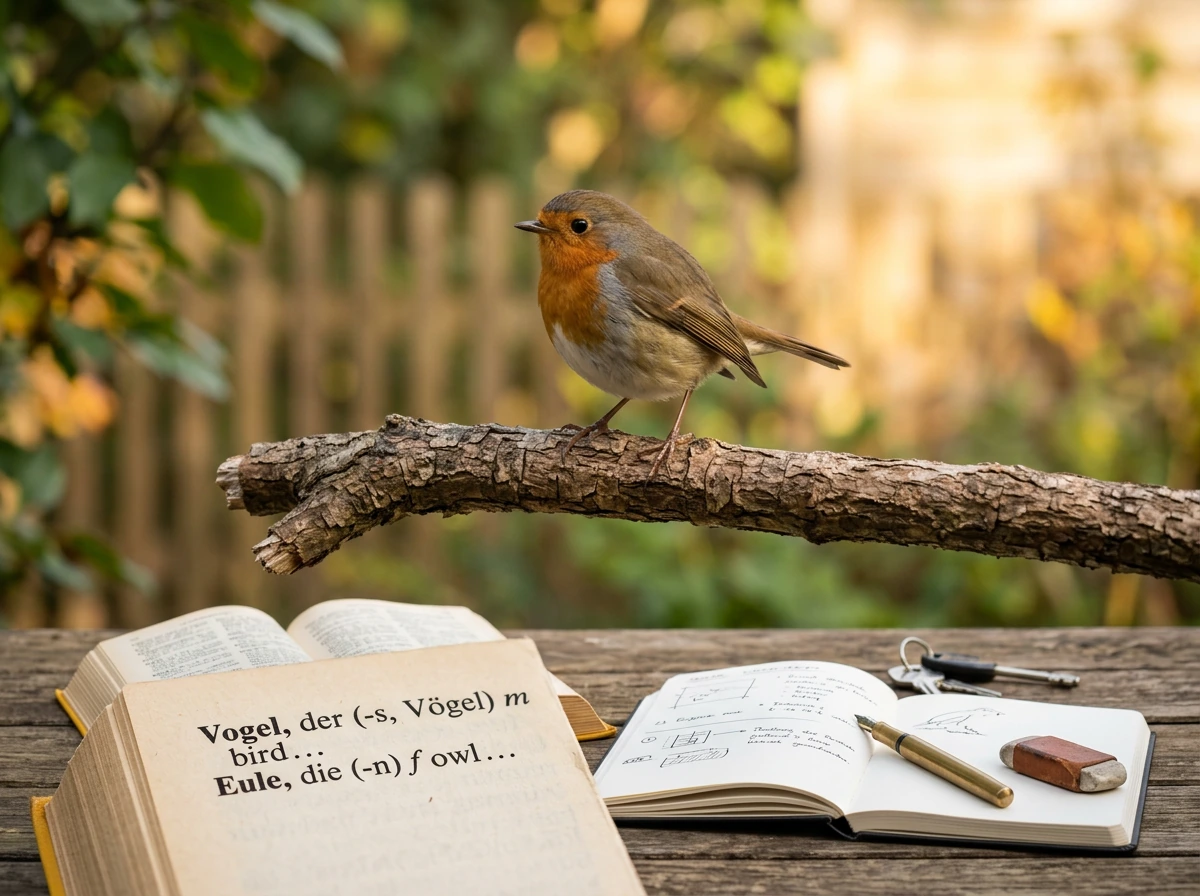
German nouns come with a grammatical gender, and Vogel is masculine. Duden lists Vogel as a masculine noun: der Vogel, with Genitiv des Vogels and Plural die Vögel Vogel is masculine. That gives you der Vogel in its basic (nominative singular) form. The plural is die Vögel, where the umlaut over the 'o' is a core part of the word, not optional decoration. Here are the forms you'll actually run into most often:
| Form | German | English meaning |
|---|---|---|
| Singular (subject) | der Vogel | the bird |
| Singular (direct object) | den Vogel | the bird (as object) |
| Singular (possessive) | des Vogels | of the bird |
| Plural (subject/object) | die Vögel | the birds |
| Plural (indirect object) | den Vögeln | to/for the birds |
| Indefinite singular | ein Vogel | a bird |
German also has two diminutive forms for a small or cute bird: das Vögelchen and das Vöglein. Langenscheidt’s dictionary provides an entry for Vöglein, which can be useful for learners looking up this diminutive form blank" rel="noopener noreferrer">das Vöglein. Vöglein is identified by Wiktionary as blank" rel="noopener noreferrer">a diminutive related to Vogel, described as “Diminutiv von Vogel”. Both are neuter (das), which is standard for German diminutives regardless of the base noun's gender. You'll see Vöglein especially in poetry, folk songs, and children's books. One word to avoid confusing with Vogel is Geflügel, which means poultry, as in domesticated birds raised for food. It's a related concept but a completely different word.
Spelling and pronunciation you can trust
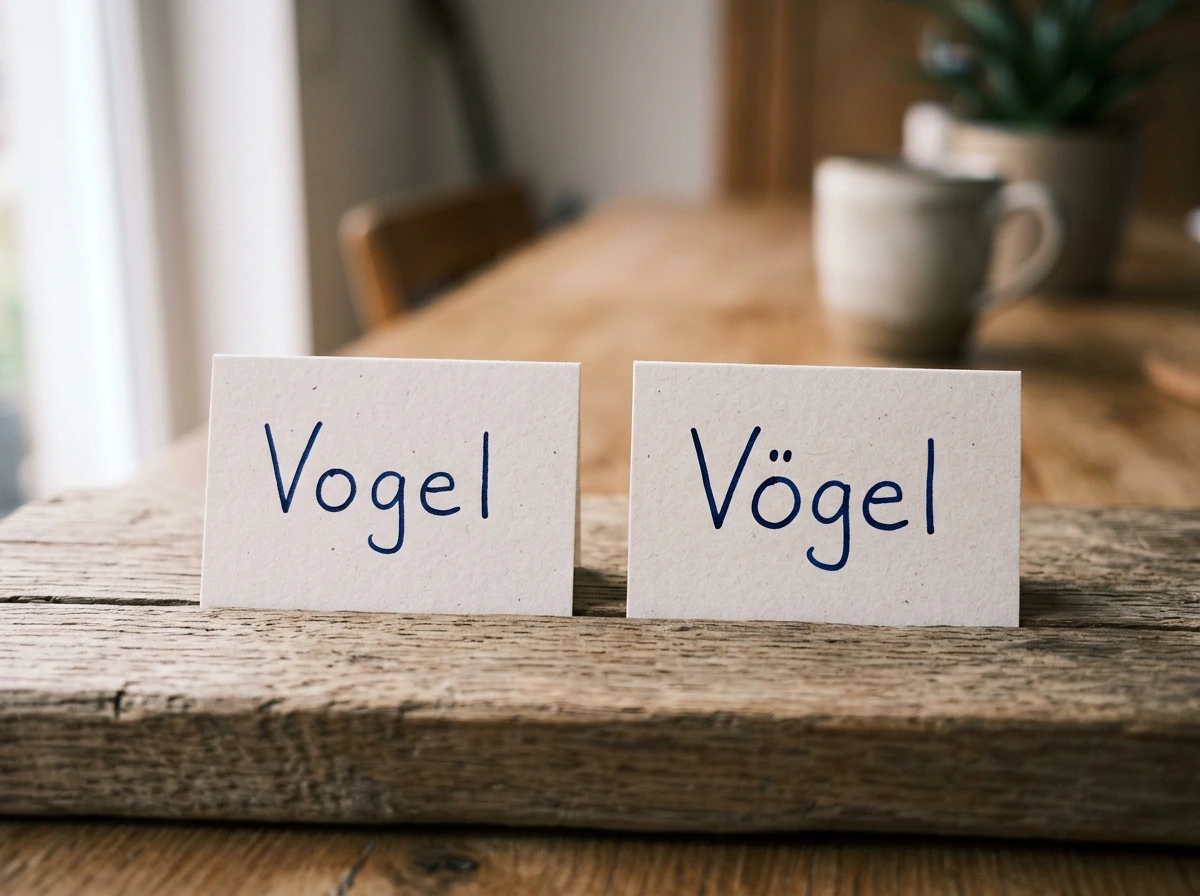
Spelling first: Vogel with a capital V (all German nouns are capitalized), and the plural Vögel with the umlaut. That two-dot mark over the 'ö' is not a typo. Dropping it gives you a different (incorrect) word form. If you're typing on a non-German keyboard, the umlaut ö can be written as 'oe' in informal contexts, so Vögel becomes Voegel, but use the actual umlaut whenever you can.
For pronunciation, the IPA for Vogel is /ˈfoːɡəl/. If IPA isn't your thing, here's a practical breakdown: the 'V' in German sounds like an English 'F', the 'o' is long (like 'oh'), the 'g' is a hard 'g', and the final '-el' sounds like the '-ul' in 'pull'. Put it together and you get something close to FOH-gul. For the plural Vögel, the ö sounds like the 'u' in the English word 'burn', making it roughly FUHG-ul (with that slightly rounded German ö). Listening to a native speaker on an audio pronunciation site will sharpen this quickly.
Generic 'bird' vs specific bird names: how to choose
Vogel works exactly the way 'bird' works in English: it's the general, catch-all term. Use it when you're talking about birds as a category, when you don't know what species something is, or when the species doesn't matter. The moment you want to name a specific type, German switches to its own noun for that species, just as English does.
A good example is the owl. In German, owl is die Eule (feminine), and its plural is die Eulen. You wouldn't call an owl ein Vogel unless you were making a general statement like 'an owl is a bird' (Eine Eule ist ein Vogel). In conversation and writing, Germans use the specific noun. The same logic applies to every other species: each has its own German noun with its own gender and plural. Some common ones:
| English | German | Gender | Plural |
|---|---|---|---|
| bird (generic) | Vogel | der (masc.) | die Vögel |
| owl | Eule | die (fem.) | die Eulen |
| eagle | Adler | der (masc.) | die Adler |
| sparrow | Spatz | der (masc.) | die Spatzen |
| parrot | Papagei | der (masc.) | die Papageien |
| robin | Rotkehlchen | das (neut.) | die Rotkehlchen |
The practical takeaway: use Vogel when speaking generally, and learn the individual noun when you care about the specific species. If you're a birdwatcher keeping notes in German, or a pet owner talking to a German-speaking vet, knowing the species name will serve you much better than defaulting to Vogel every time.
Quick example sentences for real conversation
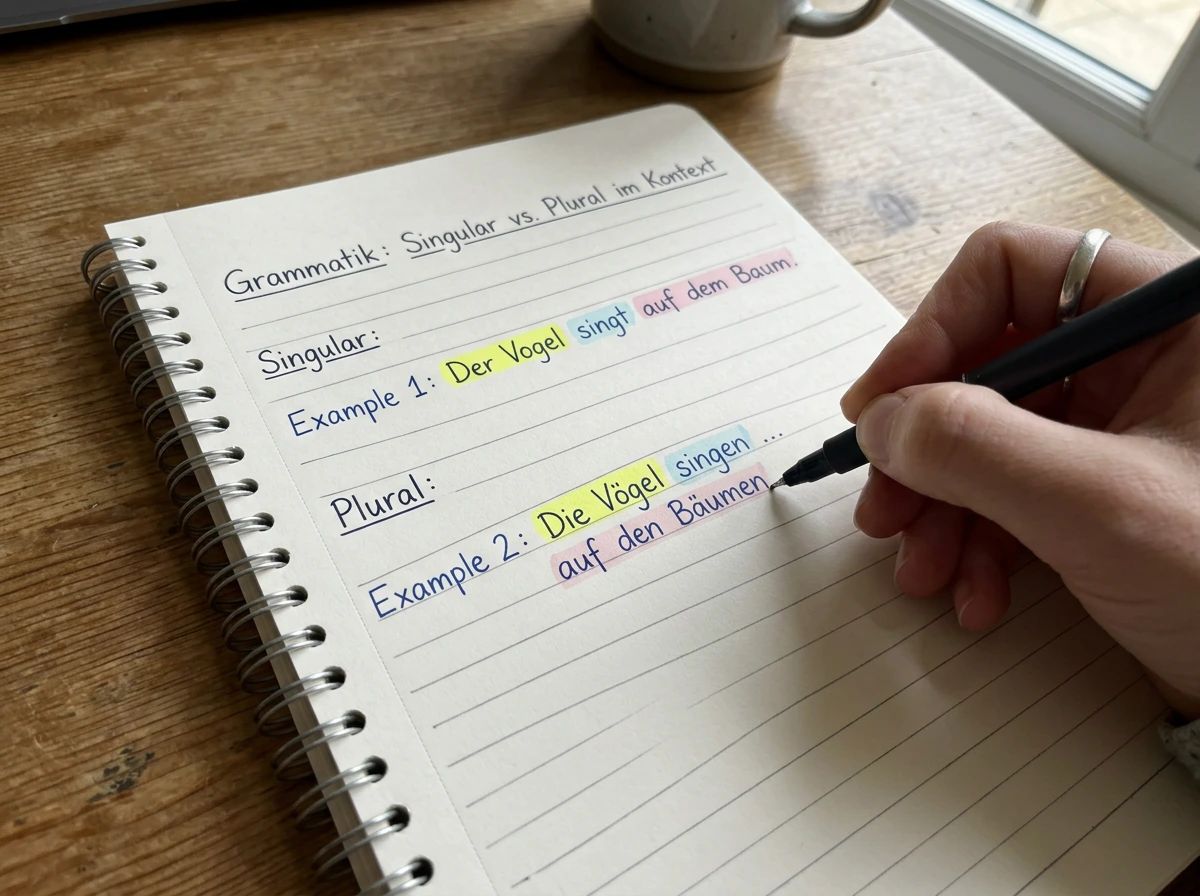
The best way to lock in a new word is to see it in action. Here are a handful of simple, realistic sentences using Vogel and its forms, the kind you'd actually encounter in everyday German. If you're also working on Spanish, you'll want to learn the Spanish word for bird next how to say bird in spanish. Now you can say “little bird” in Spanish too by using the word for “little” with “pájaro” (or “ave”) Spanish word for bird.
- Der Vogel singt auf dem Baum. (The bird is singing in the tree.) — Basic singular, great for beginners.
- Der Vogel fliegt über den See. (The bird is flying over the lake.) — Shows 'der' as the subject article.
- Ich sehe einen Vogel. (I see a bird.) — Uses the indefinite article ein in accusative: einen.
- Die Vögel fliegen nach Süden. (The birds are flying south.) — Plural in action.
- Das ist ein schöner Vogel! (That is a beautiful bird!) — Useful for complimenting someone's pet.
- Welcher Vogel ist das? (Which bird is that?) — Perfect for birding situations when you're trying to identify a species.
Common mistakes and close alternatives
The single most common mistake is dropping the umlaut in the plural. Writing 'Vogel' when you mean 'Vögel' is an easy error on a foreign keyboard, but it marks you as someone who hasn't quite absorbed the word yet. Always double-check that the ö has its two dots in the plural.
The second mistake is getting the article wrong. Vogel is der (masculine) in the singular, but the plural uses die Vögel, and the dative plural becomes den Vögeln. Learners often freeze at 'den Vögeln' because it looks very different from where they started. It's correct German, it's just case declension doing its job. If you're not sure which form to use, sticking to der Vogel (singular) and die Vögel (plural) will cover the vast majority of everyday situations.
A third point of confusion comes from Geflügel, which technically refers to birds but specifically means poultry. If you walk into a German supermarket and see 'Geflügel' on a sign, it means chicken, turkey, or duck in a culinary context, not wild birds. Don't use Geflügel when you mean birds in nature or pet birds.
Finally, a cultural note: in colloquial German, 'einen Vogel haben' (literally 'to have a bird') is an idiom meaning to be crazy or to have a screw loose. It's used playfully, but it's worth knowing so you aren't caught off guard when a native speaker taps their temple and says 'Du hast wohl einen Vogel!' It has nothing to do with actual birds. If you’re exploring how other languages handle the word for bird, the patterns in Spanish, French, and Italian follow a similar logic of a general term plus specific species nouns, which makes the comparison across languages a genuinely useful exercise for language learners. In Italian, the common word for bird is uccello bird in italian. how to say bird in french. how do you say bird in sign language how to say bird in chinese. If you want the sign language word for bird, look up how to say bird in sign language and practice it with a native signer if possible. If you’re also wondering how do you say bird in latin, the Latin term is ave. how to say bird in french. how do you say bird in sign language how to say bird in chinese. If you’re also wondering how do you say bird in latin, the Latin term is ave.
FAQ
How do I say “a bird” in German, and what article do I use?
Use “ein Vogel.” Vogel is masculine in singular, so it takes “der” in the basic form, but for “a/an” you use “ein” (ein Vogel). For plural “some birds,” you typically say “Vögel” or use “einige Vögel,” depending on the context.
What’s the dative plural of Vogel, and when should I use it?
The dative plural is “den Vögeln.” You use it when something is being given to, helped, or spoken to (for example, “Ich gebe den Vögeln Futter,” meaning I give food to the birds). If you can identify the verb’s role (to/for whom), you can choose the correct case.
Can “Vogel” be used for poultry in everyday German?
Yes, but only in a generic sense. If you mean domesticated birds raised for food, “Geflügel” is the standard word (as on grocery labels). In casual conversation, “Vogel” could still appear in statements like “poultry birds” in English meaning, but Germans more naturally switch to Geflügel for the culinary category.
How do Germans pluralize bird when they are writing it as plain ASCII (no umlauts)?
If you cannot type umlauts, “Vogel” plural is often written as “Voegel” (ae-style spelling for ö as oe). In formal writing, learner notes, or anything you want to look correct, prefer “Vögel” with the actual umlaut character, because German spelling conventions expect it.
What changes when I use Vogel as part of a compound word?
German compounds keep the spelling of “Vogel” as the base word, so you’ll see it inside larger terms (for example, “Vogelkäfig” for bird cage). The article and gender can change for the whole compound noun, so check the gender of the compound as a whole rather than assuming it matches Vogel.
How do I distinguish “bird” from “owl” in a sentence?
Owl is “die Eule,” so you should not use Vogel when naming the species. For example, “Eine Eule ist ein Vogel” is correct as a general statement (an owl is a bird), but if you ask about a specific owl, you should say “die Eule” (and its plural “die Eulen”).
Is “einen Vogel haben” always offensive?
No, it is usually playful and colloquial, meaning “to be a bit crazy” (literally, “to have a bird”). However, the tone matters, and it can sound rude if said sharply or to someone you do not know well, so treat it like an informal insult rather than a neutral phrase.
Next Article
How to Say Bird in Chinese and Write 鸟 Correctly
Say bird in Chinese is 鸟 (niao) and write it correctly in simplified and traditional with pinyin and stroke tips.