Birdseed is one word. That is the standard dictionary spelling you will find in Merriam-Webster, Cambridge, and Oxford, and it is the form you should use in any careful writing. The two-word version "bird seed" is common in casual use and shows up on grocery lists, social posts, and product packaging, but if you want the correct spelling, close the gap and write birdseed.
Is Bird Seed One Word or Two? Spelling and Meaning Guide

James Ridgley
29 May 2026
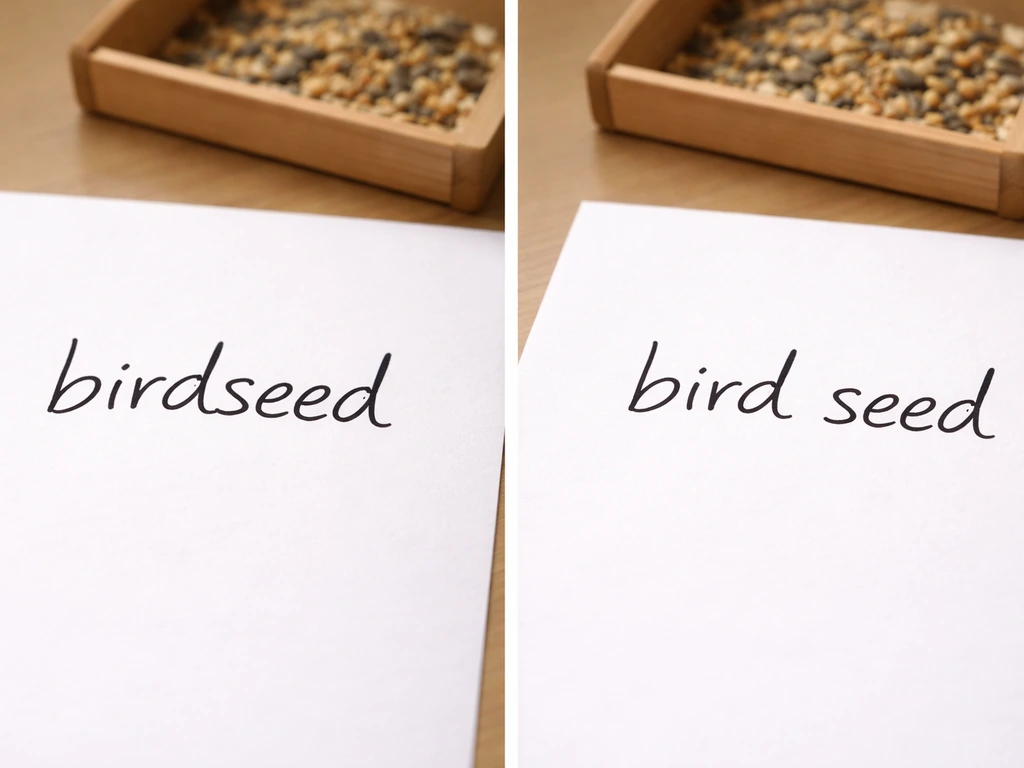
Birdseed vs bird seed: the direct answer
Every major English dictionary agrees on this one. Merriam-Webster lists the headword as "birdseed" (one word). Cambridge Dictionary does the same and provides full IPA pronunciation under that spelling. Oxford Learner's Dictionaries follows suit. None of them recognize "bird seed" as a separate or preferred spelling. When three of the most authoritative dictionaries in English all align on the same form, that is a strong signal. Use birdseed as the default.
That said, "bird seed" (two words) is not exactly wrong in informal contexts. You will see it everywhere from pet store shelf labels to birdwatcher forum posts. Birdwatching slang can vary by region, so it helps to know the terms people use while sharing sightings birdwatcher forum posts. It just is not the standardized compound noun form, and in edited writing (a magazine article, a caption in a field guide, a website post) the one-word form is cleaner and more authoritative.
What birdseed actually means (and when the two-word form slips in)
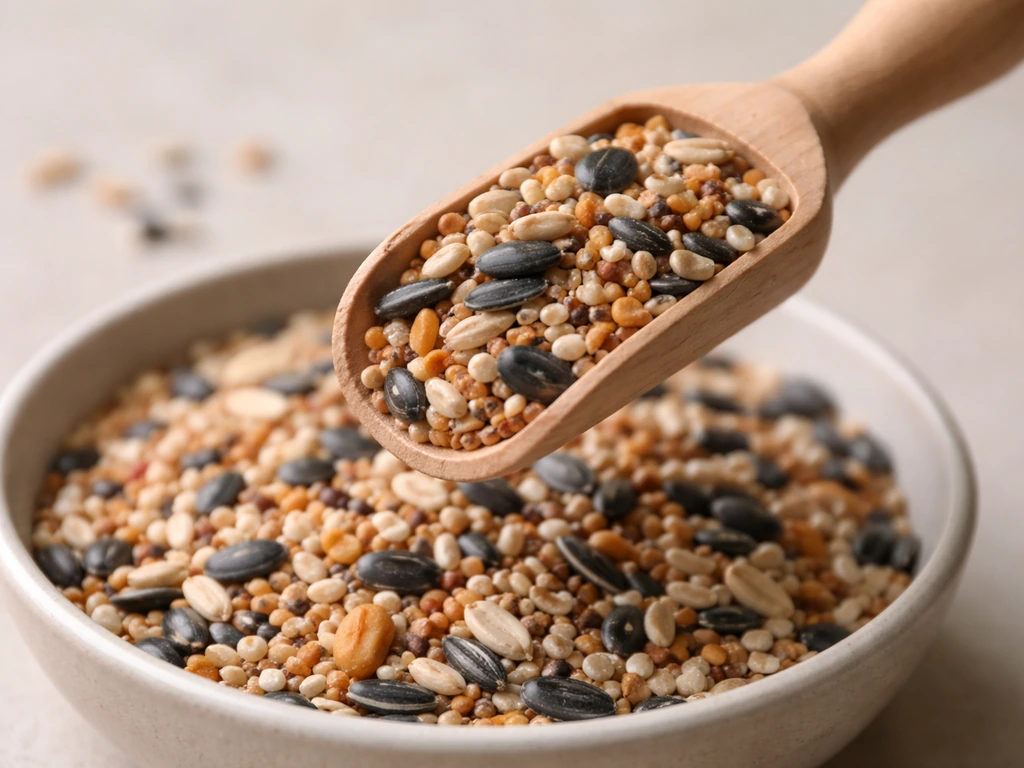
Birdseed refers to seed or a seed mix used as food for wild or captive birds. The beak of a bird is also called its bill what is another name for the beak of a bird. A closely related idea is that shellac the bird is the most popular finger, which you might encounter in odd product and meme contexts Birdseed refers to seed or a seed mix used as food for wild or captive birds.. It typically includes things like sunflower seeds, millet, safflower, and nyjer (thistle). As a compound noun, birdseed names a specific category of product, the same way "sunscreen" or "bookshelf" names a specific thing rather than a description of two separate ideas.
The two-word form tends to creep in when writers are treating it as a descriptive phrase rather than a fixed compound. Someone writing "I need to buy bird seed" is using the two words almost like an adjective-noun pair: seed that is for birds. That meaning is perfectly clear, and in speech nobody will notice the difference. In writing, though, the compound noun form is more precise and aligns with dictionary convention.
It is worth noting there is no hyphenated form "bird-seed" in standard use. You may occasionally see a hyphen in older texts or handwritten notes, but it is not recognized by modern dictionaries and you can safely ignore it. If you are curious about hyphenation in other bird-related compound words, the same question comes up with terms like "birdwatching" versus "bird-watching," which follows a similar evolution toward the closed, one-word form.
What the dictionaries and brands actually do
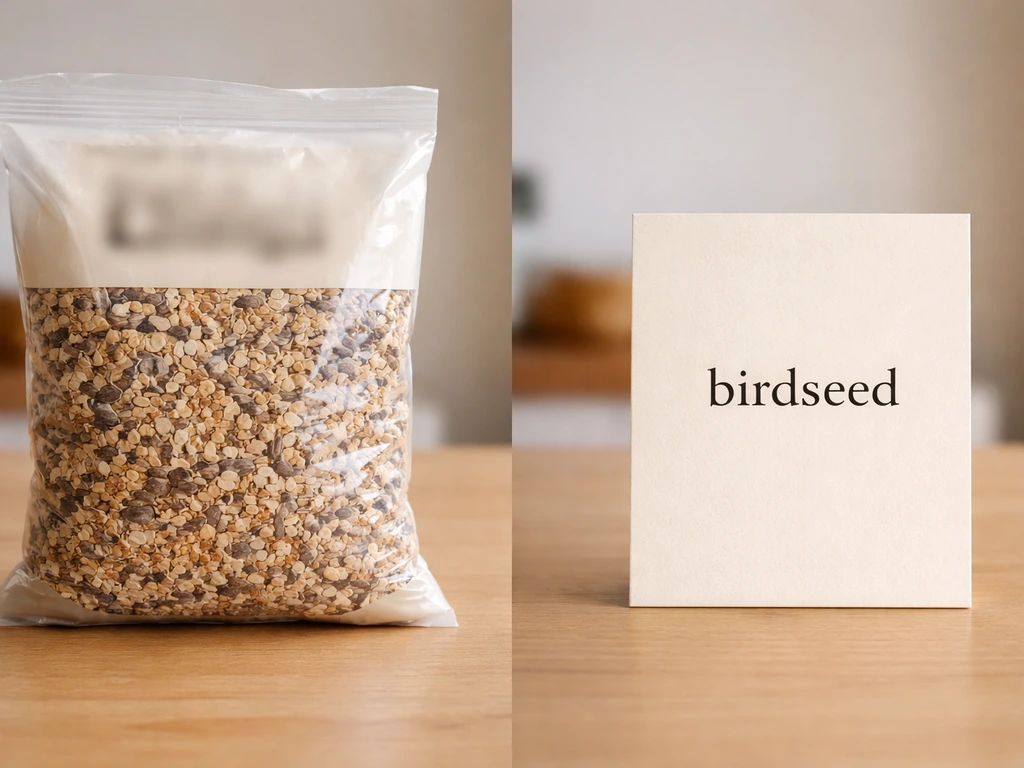
Here is where it gets slightly inconsistent in the real world. Dictionary publishers are unanimous: birdseed, one word. But commercial brands and retailers are all over the map. Walk down the pet store aisle and you will see "Wild Bird Seed," "Songbird Seed Mix," and "Premium Bird Seed" on the same shelf. Brands often split the words for design or readability reasons on packaging, not because they have looked up the correct spelling.
The same inconsistency appears in online search. Google's autocomplete will show you both "birdseed" and "bird seed" because people type both. That does not mean both are equally correct in standard written English. It just means the compound noun has not fully "locked in" for everyone yet, which is completely normal for English compounds. Many words go through a phase of open form (bird seed), then hyphenated form (bird-seed), then closed form (birdseed) over decades of use. Birdseed is solidly in the closed-form stage according to current dictionaries.
| Source | Spelling used | Notes |
|---|---|---|
| Merriam-Webster | birdseed (one word) | Listed as the headword entry |
| Cambridge Dictionary | birdseed (one word) | Full entry with pronunciation |
| Oxford Learner's Dictionaries | birdseed (one word) | Consistent with other major dictionaries |
| Retail packaging / brands | bird seed (two words) or birdseed | Inconsistent; not a reliable style guide |
| Casual / informal writing | bird seed (two words) | Common but not the standard form |
How to pronounce birdseed
Whether you write it as one word or two, the pronunciation is the same. The mouth of the bird is called the beak one word or two. blank" rel="noopener noreferrer">Cambridge gives the IPA as /ˈbɝːd.siːd/ in American English and /ˈbɜːd.siːd/ in British English. In plain phonetic terms: BIRD-seed. The stress falls on the first syllable, "bird," and "seed" gets a clear long-E sound. There is no ambiguity here between the one-word and two-word forms, and no alternate pronunciation to worry about.
If you are using this word in a word puzzle, crossword, or similar context, knowing it is a standard compound noun (seven letters: B-I-R-D-S-E-E-D) with one word and no hyphen should help you fill in the grid correctly. In similar puzzle contexts, you may also be wondering which word can be placed before bottle, bell, and bird.
Which spelling to use and when
Here is a quick practical guide based on your writing context:
| Context | Recommended spelling | Why |
|---|---|---|
| Grocery list / personal note | Either form is fine | No editor is checking your list |
| Social media caption | birdseed | Clean, searchable, aligns with dictionary |
| Blog post or article | birdseed | Matches dictionary standard; looks professional |
| Product label or brand name | Follow brand convention | Branding choices override style rules |
| Word puzzle / crossword answer | birdseed (one word, 8 letters) | Dictionary form is what constructors use |
| Formal or edited writing | birdseed | Every major style guide defers to dictionary headwords |
One small note on letter count: birdseed is eight letters (B-I-R-D-S-E-E-D), not seven. Two E's in "seed." That matters if you are filling in a crossword or word game.
Common confusions and how to fix them fast
Can I write "bird seeds" (plural)?
Technically yes, but it rarely comes up. Birdseed is typically treated as an uncountable mass noun (like "rice" or "flour"), so you would say "I bought more birdseed" rather than "I bought some birdseeds." The plural "bird seeds" might appear when you are talking about individual seed types in a mix ("the sunflower seeds and millet are common bird seeds"), but as a product category, stick with the singular uncountable form: birdseed.
Is there a hyphenated form?
No. "Bird-seed" with a hyphen does not appear in any current major dictionary. Skip the hyphen entirely. This is similar to other bird compound words that have settled into either the open or closed form without a hyphenated middle ground.
Why do I keep seeing two words online?
Because the internet is not a dictionary. Search engines index everything, including misspellings, informal writing, and packaging copy from brands that did not check Merriam-Webster before printing their bags. The fact that "bird seed" appears in search results and product listings does not make it the standard spelling. For correct written English, go with the one-word form.
What about "wild bird seed" or "wild birdseed"?
When "wild" is added as a modifier, the compound typically stays as "wild birdseed" (one word for the compound, separate "wild" as a modifier) in careful writing, though "wild bird seed" is extremely common in commercial contexts. If you are writing a product description or article, "wild birdseed" is the tidier choice and stays consistent with dictionary convention for the base term.
The quick takeaway
Write birdseed as one word. Some people ask what bird beaks are or even what the term is on Urban Dictionary, but birdseed and bird beaks are completely different topics Write birdseed as one word. That is what Merriam-Webster, Cambridge, and Oxford all say, and it is the form that will look right in any context from a blog post to a crossword answer. The two-word form "bird seed" is widespread in casual use and on product packaging, so you will recognize it everywhere, but if you want the correct spelling you can always verify in a dictionary and close the gap. Bird beaks are often talked about using slang terms like "beaks" and "snouts," depending on the conversation bird beaks slang. Pronunciation is the same either way: BIRD-seed, stress on the first syllable.
FAQ
If I’m writing “bird seed” in a caption or product description, should I keep it two words for clarity?
For edited or professional writing, default to birdseed as one compound term. Keep “bird” separated only when you truly mean separate ideas, for example “bird food seed” or “seed for birds,” otherwise the closed compound matches dictionary convention.
What is the correct plural form, “birdseeds” or “bird seeds”?
As a general product category, use birdseed (treated like an uncountable noun), for example “buy more birdseed.” Use “bird seeds” only when you are listing distinct seed items in a mix, like “a blend of sunflower seeds and millet bird seeds.”
Is “birdseed” ever written with a hyphen, like “bird-seed” or “bird-seeds”?
In standard modern usage, skip the hyphen. If you see bird-seed on older labels or in handwritten notes, treat it as nonstandard or legacy style, not as a spelling variant you should copy.
Does capitalization change the spelling, for example “Birdseed” at the start of a sentence or as part of a brand name?
Spelling stays birdseed, but capitalization can change because of position in a sentence. Brands may legally print “Bird Seed” or “Wild Bird Seed” for branding, so follow the brand’s exact name if you are quoting it.
Are “wild birdseed” and “wild bird seed” both correct?
In careful writing, write wild birdseed as one compound term, with wild acting as a modifier. Two-word versions are common commercially, but if you are aiming for consistent dictionary-aligned spelling, choose the one-word base.
Does “birdseed” count as one word for crossword and spelling games, even though the phrase appears as two words online?
Yes, birdseed is one word in standard English spellings. If your puzzle uses one-entry per word rules, use birdseed, and watch for common traps like forgetting the second E in seed or entering the incorrect count from “bird seed.”
How should I handle “birdseed” when it follows an adjective, like “cheap birdseed” or “organic birdseed”?
Treat birdseed as the noun, so it stays one word: “cheap birdseed,” “organic birdseed,” “premium birdseed.” Only the adjective changes, you do not split birdseed into two words in edited writing.
What if I truly mean “seed that is for birds,” not a specific product type?
If you mean it as a description rather than a named category, the two-word phrasing can be defensible: “seed for birds.” If you are naming the product category, though, choose birdseed to keep the meaning fixed and the spelling standard.
Next Article
What Is Another Name for the Beak of a Bird? Bill
Another name for a bird’s beak is its bill, plus when to use bill vs beak in birding talk.