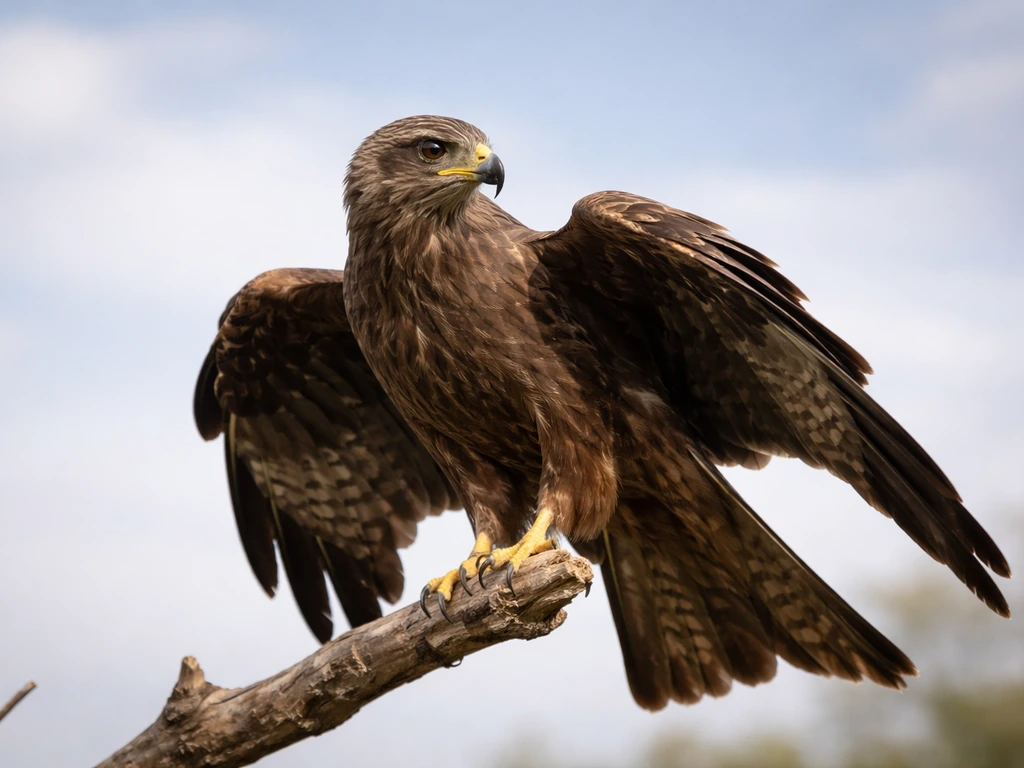
In everyday English, bird feet are simply called "feet" (singular: "foot"). If you mean a specific bird, you would name that bird in English and then use the right word for its foot, like “talons” for raptors feet. That's the standard, universally correct term. But depending on the part of the foot you're describing, the type of bird you're looking at, or the context (anatomy, behavior, field identification), you'll also hear toes, claws, talons, and tarsi. Each of those words has a specific job, and knowing which one to reach for will make you sound like you actually know your birds.
What Are Bird Feet Called in English? Terms Explained

James Ridgley
30 May 2026
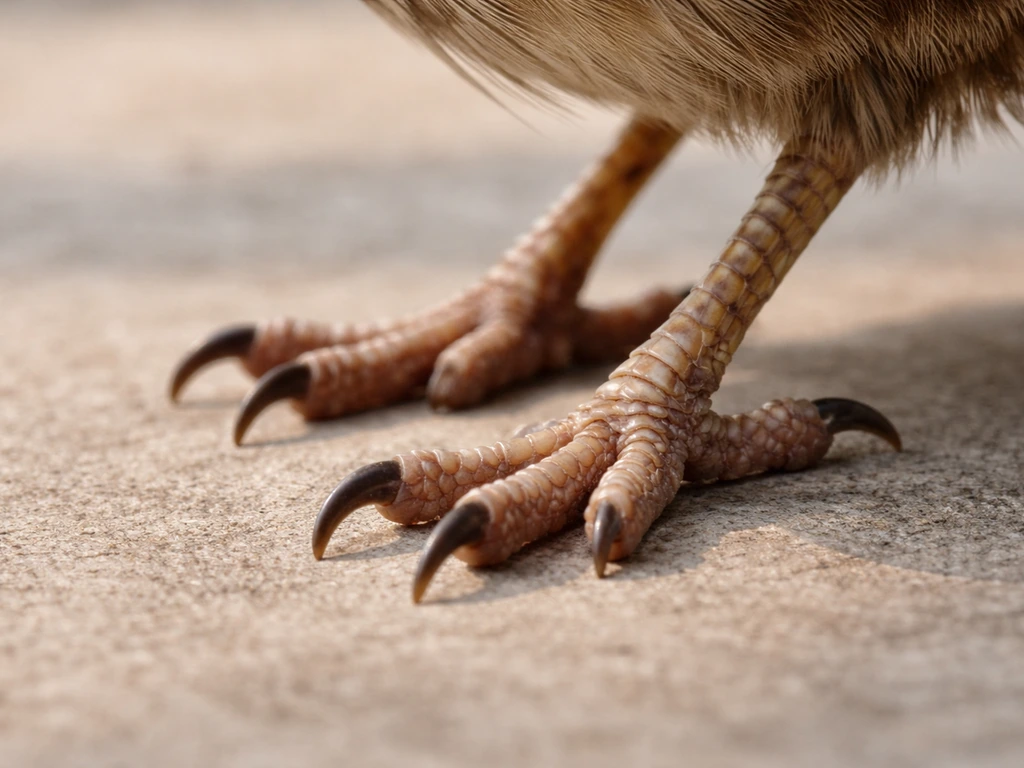
The everyday term: "feet" and when it covers everything you need
"Feet" is the go-to word for bird feet in English, and it works in almost any situation. Merriam-Webster defines "foot" as "the terminal part of the vertebrate leg upon which an individual stands," and Cambridge simply calls it "the part of the body at the bottom of the leg on which a person or animal stands." Both definitions apply cleanly to birds. You can say a sparrow has tiny feet, a heron has long feet, or a duck has webbed feet, and everyone will understand you perfectly. There's no reason to reach for a fancier word if "feet" does the job.
Where things get more interesting is when you need to be precise. A raptor's feet aren't just feet in the way a chicken's are. A shorebird's lower leg isn't quite the same as a parrot's. That's where the vocabulary below becomes genuinely useful rather than just pedantic.
Toes, claws, talons, and legs: what each word actually covers
Toes (digits)
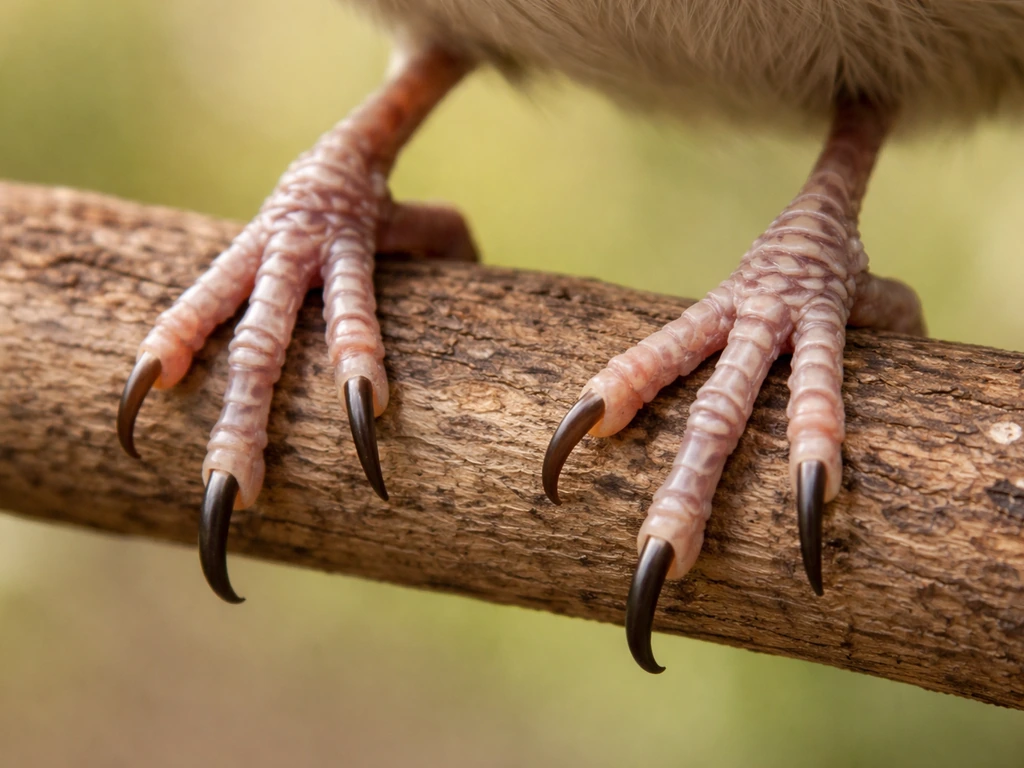
The individual projections at the end of a bird's foot are called toes, or in more technical writing, digits. Most perching birds (passerines like robins, sparrows, and finches) have four toes. Birds walk digitigrade, meaning they walk on their toes rather than the full flat of the foot, which is why the "foot" you see in a small songbird is mostly toes. When you say "that bird has three forward-facing toes and one backward-facing toe," you're being anatomically precise without needing specialist language.
Claws
At the tip of each toe sits a claw: a curved, pointed, keratinous structure. "Claw" is the general catch-all term that applies to virtually any bird. Ground birds use their claws to scratch and dig for roots and insects. Songbirds grip branches with their claws. It's a broad word, which is exactly what makes it useful when you're not talking about raptors specifically.
Talons
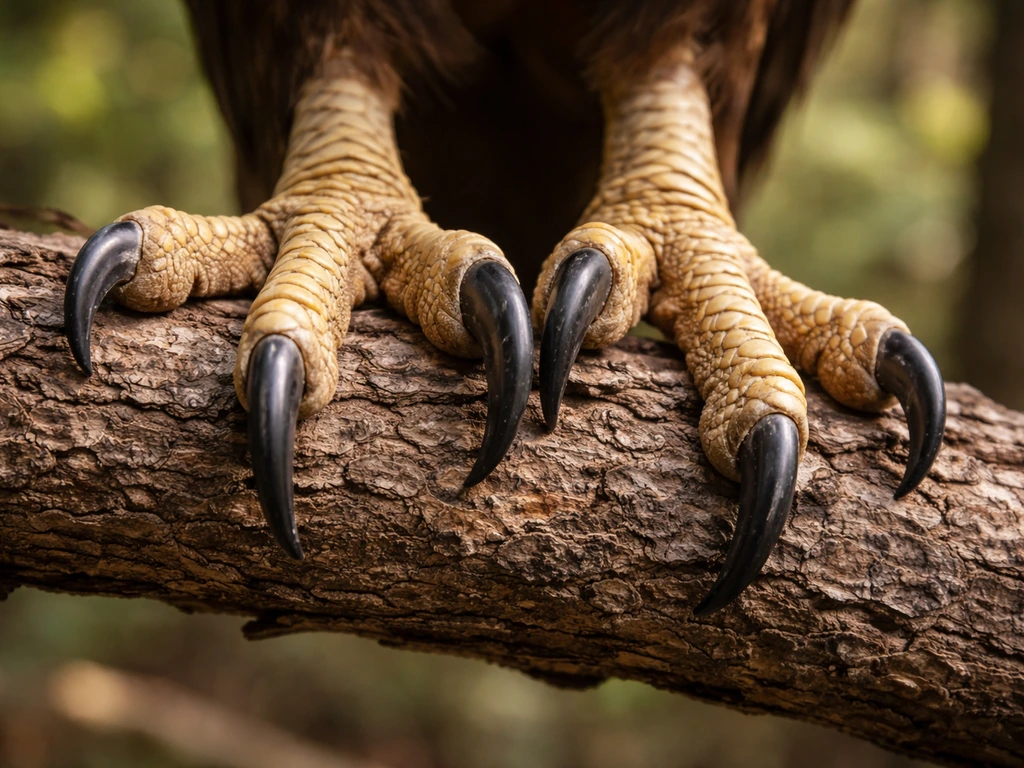
Talons are claws too, but the word is reserved, by convention, for birds of prey. Merriam-Webster defines "talon" as "the claw of an animal and especially of a bird of prey." Oxford Learner's Dictionaries is even more specific: "a long, sharp, curved nail on the feet of some birds, especially birds of prey." The University of Minnesota Raptor Center explains that talons are a keratin covering protecting the bone underneath, and the MBZ Raptor Conservation Fund puts it simply: raptors have "claws on their feet also known as talons." So biologically, talons are claws. The difference is context and convention: you say "talons" for hawks, eagles, owls, and falcons; you say "claws" for everything else.
Legs
"Legs" refers to the limb above the foot. In everyday bird talk, the visible "stilt" portion on a heron or flamingo is usually called the leg, even though some of what you're seeing is actually the foot region (more on that in the tarsi section below). For general conversation, "legs" is perfectly fine and widely understood.
When to say "talons" vs "claws" vs "feet"
The confusion between these three words is one of the most common slip-ups in bird writing and conversation. Here's a simple way to think about it: the entire structure at the bottom of the leg is the foot; the individual projections are toes; the hooked tips are claws; and when those claws belong to a raptor, we call them talons. So a red-tailed hawk grabs prey "with its talons" (not its claws, not its feet, though both are technically defensible).
Cambridge English Dictionary defines “talon” as “a sharp nail on the foot of a bird that it uses when hunting animals. ” with its talons.
A chicken scratches the ground "with its claws" (not talons). A parrot "perches on its feet" (and grips with its claws).
blank" rel="noopener noreferrer">National Geographic uses "talons" consistently for raptors, describing hawks grabbing prey "with their talons." Discover Wildlife puts it plainly: English writers tend to reserve "talons" for predatory birds, and whether calling a curved claw a talon versus a claw is technically a biological distinction or just convention, the convention is now firm enough to be treated as a rule in practice. What is a common name for bird feet in English is simply “feet,” with more specific terms like toes, claws, and talons depending on the situation.
| Term | What it refers to | Best used for |
|---|---|---|
| Feet | The whole terminal structure at the base of the leg | Any bird, any context |
| Toes / digits | The individual projections on the foot | Any bird, anatomical detail |
| Claws | The curved, pointed tips at the end of toes | Non-raptor birds, general use |
| Talons | The large, sharp, hooked claws of birds of prey | Raptors only (hawks, eagles, owls, falcons) |
| Legs | The limb above the foot | Any bird, especially long-legged waders |
Technical anatomy terms birders use: tarsi and the tarsometatarsus
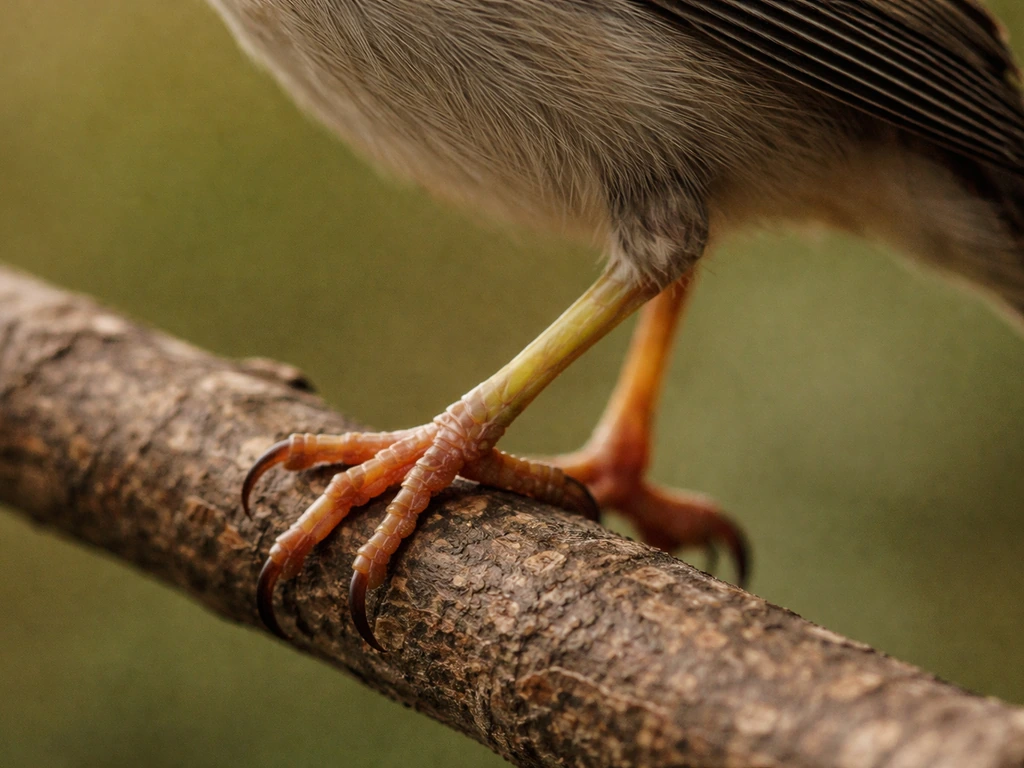
If you've spent any time reading field guides or ornithology references, you've probably run into the word "tarsus" (plural: "tarsi"). This is the technical term for the visible lower leg region on a bird, and it matters more than you might think. In mammals, the tarsus is a set of ankle bones. In birds, evolution has fused the metatarsal bones with the lower tarsal bones to create a single compound bone called the tarsometatarsus. Britannica has a dedicated entry for it, and Wikipedia places it as "the upper part of the foot" in birds, with the digits making up the toes below it.
Merriam-Webster defines "tarsus" in the bird sense as "the large compound bone of the lower leg of a bird that is formed by fusion of the metatarsals with the distal end of the tarsus," and even gives a practical example: measuring a bird band placement "above the tarsus." In the field, birders use tarsus length as a key measurement for species identification and for fitting leg bands. When someone says a shorebird has long tarsi, they mean that elongated visible lower leg region, not just the ankle.
You'll also occasionally hear "scales" mentioned in this context. The tarsus region (and often the toes) is covered in small horny scales, and their arrangement and color can actually help identify species. For most everyday birdwatching conversations, "tarsus" is enough; you don't need to go deeper than that unless you're doing scientific work or banding.
Spelling, pronunciation, and quick example sentences
Most of these words are straightforward to spell, but a few trip people up. "Talons" is the most commonly misspelled: people sometimes write "tallons" (double-L) or "taleons." The correct spelling is T-A-L-O-N-S. The singular is "talon," pronounced TAY-lon (IPA: /ˈteɪ.lən/), with the stress on the first syllable. Both Cambridge and Oxford Learner's Dictionaries include pronunciation guides for it. "Tarsus" is T-A-R-S-U-S, pronounced TAR-sus (IPA: /ˈtɑː.səs/), plural "tarsi" (TAR-sye, /ˈtɑː.saɪ/).
- "The eagle seized the fish with its talons." (talons = raptor claws, correct context)
- "Ground-feeding birds use their claws to scratch through leaf litter." (claws = non-raptor, general use)
- "The robin perched on the fence, balancing on its tiny feet." (feet = whole-foot reference, any bird)
- "Ornithologists measure tarsus length to compare species." (tarsus = technical lower leg bone)
- "The heron's long toes spread its weight across the mudflat." (toes = individual digits)
How to pick the right term for the bird you're looking at
The quickest way to land on the right word is to think about the bird type first, then the body part. If you're describing a hawk, falcon, owl, or eagle doing something predatory, use "talons." If you're describing any bird's foot in a general anatomical sense, "feet" is always safe. If you're getting specific about individual digits, say "toes." If you're describing non-raptor claws (a rooster, a parrot, a woodpecker), use "claws." And if you're reading a field guide or scientific paper and see "tarsus," know it refers to that visible lower leg segment, not the whole foot.
Context also shapes word choice beyond anatomy. In behavioral descriptions, you might say a kingfisher "dives and snatches fish with its feet" rather than its claws, because the behavior emphasizes the foot as a grasping unit. In imagery or poetry, "talons" often gets extended beyond raptors for dramatic effect, which is a legitimate idiomatic use even if it's not strictly accurate. And in crossword clues or word puzzles, "talon" is a classic four-letter answer for "raptor's weapon" that's worth keeping in your back pocket.
One thing worth noting: the conventions described here are specifically for English. If you're looking up what a bird or bird part is called in another language or in a regional dialect, the terminology can shift significantly. One thing worth noting: if you are also looking up a species name like what is cheel bird called in english, you can keep using the same English bird-terminology approach for related parts (feet, claws, and talons) once you know the bird.
If you need this in another language, you can also look up what a bird is called in Afrikaans. Just as other articles on this site explore what specific birds are called in English from other-language names (like "vak," "bagla," or "cheel"), bird body part terminology also varies across languages and cultures, so it's worth verifying against the specific language or reference you're working with.
You may also see the name spelled differently when people look up what is akala bird in English, so it helps to check the exact bird name you mean. If you mean the word "vak" as a bird name, it is called something different in English, so it helps to check an English bird-name reference.
For most practical purposes, whether you're writing a field journal, describing a photo, caring for a pet bird, or just satisfying curiosity: "feet" gets you there in everyday conversation, "talons" handles your raptors, "claws" covers everyone else's tips, "toes" drills into the digits, and "tarsi" is what you need when a field guide asks you to measure something. That's the full vocabulary toolkit for bird feet in English.
FAQ
Should I call any hooked bird claw a talon, or only raptors?
Use “talons” only when you are specifically talking about a bird of prey, not the claws of other birds. For example, a hawk grabbing prey uses talons, but a chicken or parrot typically uses claws.
When describing a bird in a photo, is it better to say feet, toes, or claws?
It depends on the level of detail. In casual speech, “feet” is fine for the whole bottom part. If you are describing grasping points on a perching bird, “claws” is usually clearer than “feet,” and “toes” is best when counting digits.
In bird-band or field-guide contexts, what do I call the part above the toes?
For raptors, say “talons” for the claw tips. If you need the anatomical lower leg region, use “tarsus” (or “tarsi” in plural) instead of calling everything “feet,” since banding and field measurements often refer to the tarsus length.
How do I choose the right word when I mean a bird’s walking versus grasping?
If the word is about walking, use “toes” when you are counting or describing the digit arrangement, and “feet” when you are describing size, shape, or whether they are webbed. “Claws” is best for grip or scratching behavior, and “talons” is raptor-specific.
Is “tarsus” the same thing as an ankle?
“Tarsus” refers to the visible lower leg segment, which is not the same as the foot. For most field descriptions, avoid saying “ankle” for birds unless a guide explicitly uses it, because bird anatomy is discussed in terms of tarsus and tarsometatarsus.
Are “claw” and “talon” biologically different, or just different words?
Yes, but with the usual convention. “Claw” and “talon” both describe the horny tip, and “talon” is mainly the raptor term used in English. If you are writing scientifically or for a general audience, pick one convention and stick to it.
What is the plural form, foot or feet, when talking about birds?
“Feet” is countable, but “foot” is singular. Plural “feet” is standard for everyday descriptions (for example, “tiny feet”). Avoid “foots” in standard English.
Common spelling mistakes to watch for with talons and tarsus?
Pay attention to spelling and stress. “talons” has a single “l” in “talon” then “-ons,” not “tallons” or “taleons.” “tarsus” is “TAR-sus,” and “tarsi” is “TAR-sye,” in common English pronunciation.
What should I say if I do not know whether the bird is a raptor yet?
If you cannot identify whether the bird is a raptor, “claws” or “feet” is the safest choice. Once you confirm raptor identity, switching to “talons” matches the common English convention and sounds more natural.
Do birds with webbed feet change the terminology I should use?
Yes, and it helps to be explicit when needed. For example, you can say “webbed feet” for ducks, and still use “toes” if you are talking about the individual digits, since webbing is between or at the toe structure.
Next Article
What Is Cheel Bird Called in English? Names and ID
Learn the English bird name for cheel, species options, pronunciation, scientific names, and how to verify your exact ra