The most natural Spanish translation of 'little bird' is pajarito. That's the word you want in almost every situation, whether you're pointing out a small bird at the feeder, naming a pet, or dropping the phrase into a crossword answer. It comes directly from pájaro (bird) with the diminutive suffix -ito tacked on, and the RAE (Real Academia Española) confirms it in exactly those terms. If you only take one thing from this article, take pajarito.
How Do You Say Little Bird in Spanish? Translations

James Ridgley
19 Apr 2026
The best default translations for 'little bird'
Pajarito is your go-to. It is masculine (el pajarito, un pajarito), and native Spanish speakers use it casually every day. It covers both the literal meaning (a small bird) and an affectionate tone, so it works whether you're watching wildlife or cooing over a budgie. Beyond pajarito, a more literal but less common construction is pájaro pequeño (small bird), where pequeño just means small. That phrase is grammatically correct but sounds descriptive rather than warm. If you want poetic or very affectionate register, some speakers also say pajarillo or pajarín depending on their region, but those are regional variants, not the standard choice.
| Phrase | Literal meaning | Tone / register | Best use |
|---|---|---|---|
| pajarito | little bird (diminutive) | Warm, affectionate, everyday | Default choice for almost any context |
| pájaro pequeño | small bird | Neutral, descriptive | Scientific or purely descriptive writing |
| pajarillo | little bird (regional dim.) | Slightly literary or rural | Some regions of Spain, poetry |
| pajarín | little bird (regional dim.) | Informal, regional | Northern Spain dialects |
Pájaro vs. ave vs. diminutives: which word root do you need?
Spanish has two main words for bird: pájaro and ave. If you are specifically looking for the German translation of “bird,” the word you want is Vogel. If you’re specifically wondering how to say “bird” in Spanish (not “little bird”), the basic word is pájaro. If you are looking for the Latin word for bird, you can look it up in Latin dictionaries as avis bird in Spanish. If you want to translate bird into Chinese, the next step is learning the correct Chinese characters and pronunciation bird in Spanish. They are not interchangeable in everyday speech even though dictionaries sometimes treat them as synonyms. Pájaro is the common, conversational word, the one a child learns first and a birdwatcher uses in the field. Ave is more formal and is the word you'll see in taxonomy, legal texts, and scientific contexts. You can think of ave a bit like the word 'avian' in English: technically correct, but nobody says it over coffee.
Because pajarito comes from pájaro and not ave, it carries all of pájaro's casual, everyday warmth. If you tried to build a diminutive from ave, you'd get avecita or avecilla, and while those words exist and appear in literature, they sound noticeably old-fashioned or literary in modern speech. Stick with pajarito unless you have a specific stylistic reason to use the ave root.
The suffix -ito is the most common diminutive in standard Spanish, recognized and listed by the RAE as the primary diminutive form. It does not just mean 'small.' The RAE's grammar explicitly notes that -ito and its variants express nuances beyond size, blank" rel="noopener noreferrer">including affection, familiarity, and even emotional intensity. ThoughtCo explains that diminutives like -ito/-ita often signal affect or softness, not just physical smallness blank" rel="noopener noreferrer">affection or softness. So pajarito can mean a physically tiny bird, a baby bird, or simply a bird you feel fondly toward. Context decides which meaning is active.
Natural and idiomatic options, and how tone changes meaning
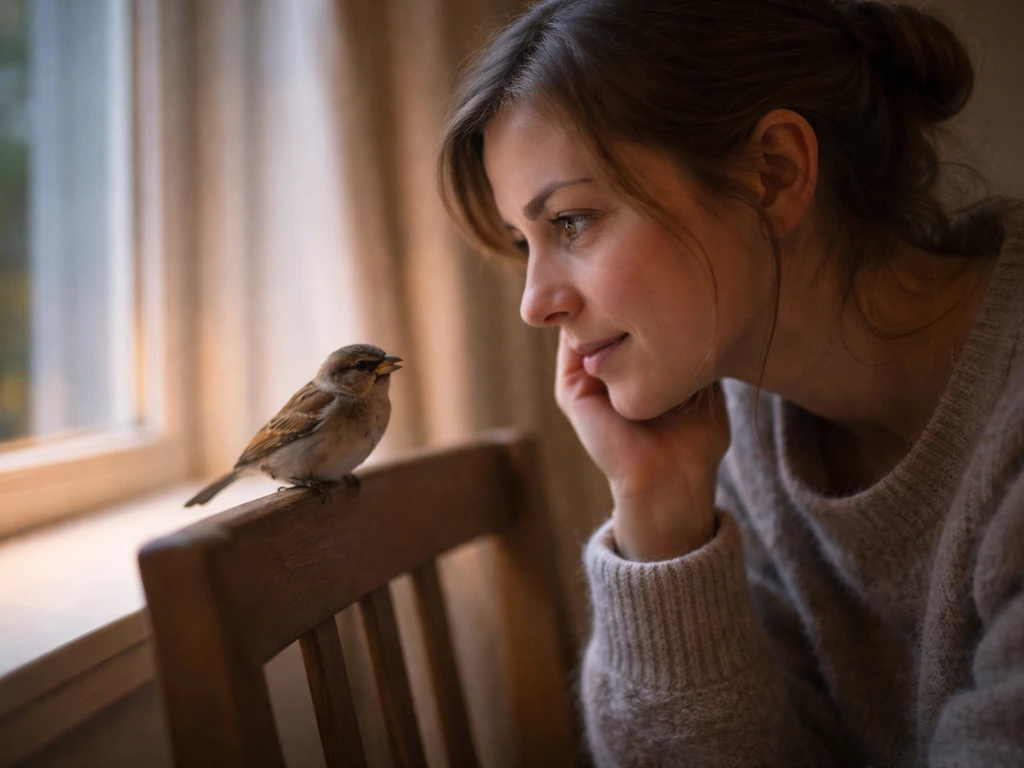
The most famous idiomatic use of pajarito in Spanish is the phrase me lo dijo un pajarito, which translates directly to 'a little bird told me.' That expression works exactly the same way the English idiom does: you use it when you know something but don't want to reveal your source. It's light, playful, and universally understood across Spanish-speaking countries. The masculine article un confirms the word's gender in natural use.
Another everyday phrase is ¡Mira el pajarito! which means 'Look at the little bird!' Spanish-speaking parents and photographers use this to get children to look at the camera (the same way English speakers might say 'watch the birdie!'). Both examples show that pajarito sits comfortably in spoken, informal Spanish with no awkwardness.
Collins's Spanish-English dictionary also lists pajarito in an ornithological sense as 'baby bird' or 'fledgling.' So the word neatly covers three overlapping meanings: a small bird by size, an affectionate term for any bird, and specifically a young or baby bird. If you need to make the 'baby bird' meaning unmistakably clear, you can say cría de pájaro (bird chick/young bird), but pajarito alone usually does the job in conversation.
Spelling and pronunciation guide
Pajarito is spelled exactly as it sounds in Spanish, which is one of the language's great advantages. Here is a practical breakdown:
| Word | Spelling | IPA | Practical phonetic guide | Stress |
|---|---|---|---|---|
| pajarito | p-a-j-a-r-i-t-o | /pa.xa.'ri.to/ | pah-hah-REE-toh | Third syllable: REE |
| pájaro | p-á-j-a-r-o | /'pa.xa.ro/ | PAH-hah-roh | First syllable: PAH |
| pájaro pequeño | pájaro + pequeño | /ˈpa.xa.ro pe.'ke.ɲo/ | PAH-hah-roh peh-KEH-nyoh | Each word stressed on its own syllable |
The letter j in Spanish is pronounced like a strong English 'h,' similar to the 'ch' in the Scottish word 'loch.' So the 'ja' in pajarito sounds like 'hah,' not like the English 'ja.' The stress lands on the third syllable: pa-ja-RI-to. Run through it a few times out loud: pah-hah-REE-toh. Once you have the j sound down, the rest of the word follows naturally.
Example sentences in real Spanish
Seeing the word in context is the fastest way to lock it in. Here are several sentences that cover different situations:
- ¡Mira el pajarito en el jardín! — Look at the little bird in the garden!
- Me lo dijo un pajarito. — A little bird told me.
- El pajarito cayó del nido. — The little bird fell from the nest. (baby bird / fledgling sense)
- Mi hija le puso de nombre Pajarito a su periquito. — My daughter named her parakeet Pajarito.
- Hay un pajarito azul en esa rama. — There is a little blue bird on that branch.
- ¿Ves ese pajarito? Creo que es un jilguero. — Do you see that little bird? I think it's a goldfinch.
Common mistakes and how to choose the right phrasing
The most common mistake is trying to say 'little bird' by translating it word for word as pequeño pájaro. While this is not wrong in a strict grammatical sense, it sounds unnatural and overly literal to native speakers. Adjectives in Spanish typically follow the noun (pájaro pequeño), and even that version sounds stiff compared to pajarito. Native speakers almost never describe a small bird that way in conversation.
A second mistake is using ave when you mean a friendly, casual little bird. If you say avecita, you will be understood, but you'll sound like you're quoting a 19th-century poem. Save ave and its derivatives for formal or scientific contexts.
Gender agreement is worth a quick note too. Pajarito is masculine, so the article and any accompanying adjectives must match: el pajarito (not la pajarito), un pajarito bonito (not una pajarito bonita). If you're referring to a bird you know to be female, Spanish speakers typically still use el pajarito by default because the grammatical gender of the word is masculine regardless of the bird's sex.
Finally, do not confuse the -ito diminutive with a separate word. Pajarito is not a different species or a separate entry with a completely distinct meaning. It is pájaro plus an expressive suffix, the same way 'duckling' is related to 'duck' in English but with a Spanish flavour of warmth built in.
Matching the phrase to a specific bird or context
If you are looking for a general-purpose phrase for conversation, pet naming, or a crossword answer, pajarito is all you need. In French, you can look for “petit oiseau” as a common way to say “little bird. If you are also wondering how to say “bird” in French, this guide on how to say bird in french can help you pick the right everyday word fast. ”. But if your goal is more specific, here are quick next steps depending on your situation: If you want the Italian equivalent, the next step is to learn the natural way to say “little bird” and “bird” in Italian But if your goal is more specific, here are quick next steps depending on your situation:.
- Naming a pet bird: Pajarito works as both a descriptive term and a nickname. Many Spanish-speaking pet owners do literally call their bird Pajarito the way English speakers might call theirs Birdie. It reads as affectionate rather than unimaginative.
- Referring to a baby or fledgling bird: Pajarito covers this naturally in speech, but if you need precision, you can say polluelo (chick) or cría for a very young nestling.
- Talking about a specific small species: Combine pajarito with the species name or a color descriptor: pajarito azul (little blue bird), pajarito cantor (little singing bird). For actual Spanish species names, look up the common Spanish name for that species directly, since ornithological names vary by country.
- Using it in writing or poetry: If you want a slightly more elevated register, pajarillo gives you that without sounding jarring. Pajarillo appears in classic Spanish literature and feels warmer than the purely descriptive pájaro pequeño.
- Learning how Spanish compares to other languages: The logic here (a diminutive suffix making a common noun affectionate) shows up in other Romance languages too. French handles 'little bird' differently, with its own diminutive conventions, and the same is true in Italian. If you are building a broader cross-language bird vocabulary, comparing how each language forms diminutives can be genuinely useful.
The bottom line: say pajarito. It is correct, natural, warm, and instantly recognizable to any Spanish speaker from Madrid to Mexico City to Buenos Aires. Pronounce it pah-hah-REE-toh, remember it's masculine, and you're set for practically any context where you need 'little bird' in Spanish.
FAQ
If the bird is clearly a female, should I say “la pajarita” instead of “el pajarito”?
Use la forma masculina, el pajarito. Even if the bird is female, Spanish keeps the grammatical gender, so you would say “un pajarito bonito,” not “una pajarito.” If you really need to mark sex, you can add it as information, for example “el pajarito hembra,” but that sounds more technical than everyday.
How do you make “little bird” mean “baby bird” without it sounding ambiguous?
For most everyday situations, pajarito already sounds affectionate and friendly. If you want to specify “baby bird” more clearly, use “cría de pájaro” (or “polluelo de pájaro” in some contexts). “Pajarito” can mean baby bird, but the added phrase removes ambiguity if the setting is formal or educational.
Can I use “pajarillo” or “pajarín” anywhere, or are they only in certain countries?
“Pajarillo” and “pajarín” are understandable and can be affectionate, but they are regionally flavored. If you want the safest choice across all Spanish-speaking countries, stick with pajarito, especially for conversation with strangers or for writing.
What word should I use if I mean “bird” in general, not a small or affectionate “little bird”?
If you mean a bird as a general category, use “pájaro” or “ave.” “Pajarito” implies smallness or a warm, diminutive vibe. So “pajarito” is usually not ideal when you are trying to mean “any bird” in a neutral, general way.
Is “pájaro pequeño” ever natural, or is it always too stiff?
Avoid “pájaro pequeño” in casual speech unless you want a descriptive, slightly stiff tone. If you write it for an assignment, it can be grammatically fine, but for natural everyday Spanish, pajarito is the default.
Does “pajarito” always mean physically small, or can it change tone depending on context?
The “-ito” diminutive often adds affection or familiarity, not just size. If you say pajarito to someone, it typically lands as warm and playful. To avoid sounding overly intimate or childish, choose a neutral term like “pájaro” or “ave,” depending on the context.
How do I use “pajarito” in a full sentence, and does it behave like a normal noun?
In most standard situations, you can use it with articles and verbs like a normal noun: “Mira el pajarito,” “Escuché un pajarito,” “Tengo un pajarito.” The key rule is agreement with gender, and you keep the meaning of diminutive built into the word.
What are the most common pronunciation mistakes with “pajarito,” and how can I avoid them?
Pronounce the j as a strong “h” sound, so “pa-ja-RI-to” with the stress on “RI.” If you misplace the stress (for example, “PA-ja-ri-TO”), people may still understand you but it will sound noticeably off. A quick practice tip is to repeat it with the rhythm “pah-hah-REE-toh.”
Next Article
How Do You Say Bird in Latin Plus Plural Forms
Learn how to say bird in Latin, with correct singular and plural, meanings, pronunciation, and naming examples.